
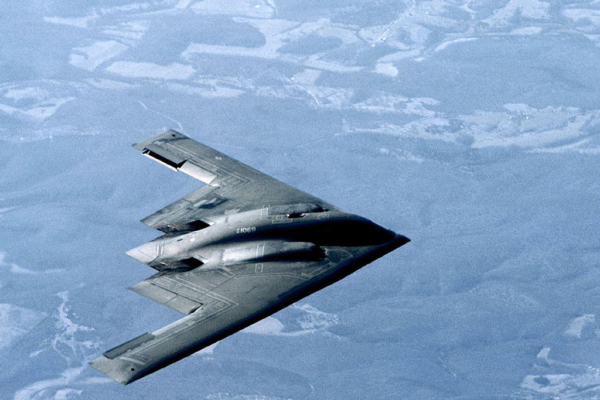
The US military’s B-2 Spirit bomber, which has been in service since 1997, has subverted traditional aviation thinking with its stealthy flying wing design. It is considered one of the most successful designs in the US military post-World War II era, as its design and concept have truly stood the test of time. The way it executes missions completely aligns with the original strategic bomber warfare concept. The most striking feature of this aircraft is its unique shape with the absence of a tail fin.
Why did the B-2 Spirit bomber choose to abandon the tail fin, and what is the underlying reason? Not only will the upcoming B-21 Raider bomber adopt this design, but various countries are also gradually emulating it: similar designs have appeared in China’s new fighter jets and drones.
The B-2 Spirit is the world’s first flying-wing strategic bomber, designed with stealth in mind. The main idea behind its design is invisibility, with a focus on minimizing the radar cross-section (RCS) of the bomber to breakthrough enemy air defense systems during missions.
Vertical tail fins generate strong radar reflections at multiple angles, forming corner reflectors in the aircraft structure, which intensify radar waves that reflect back. By eliminating the tail fin, experts have designed the aircraft with smooth aerodynamic surfaces to effectively scatter or eliminate radar reflections, enhancing its stealth capability and simplifying the overall exterior design.
Another advantage of this aircraft is reduced air resistance, allowing for longer flight distances. This design has been adopted by subsequent large stealth reconnaissance drones such as the RQ-170 and rumored RQ-180.
Additionally, this bomber can stay airborne for extended periods at subsonic cruise speeds, flying at high altitudes.
The tail fin is a critical structure that helps airplanes maintain balance and stable flight. By removing the tail fin, the theoretical flight stability of the B-2 Spirit is compromised.
To compensate for this deficiency, the B-2 Spirit relies on advanced fly-by-wire control systems, allowing the computer to constantly fine-tune and stabilize the flight in real-time.
Furthermore, eliminating the tail fin may sacrifice some maneuverability of the aircraft. However, experts believe that this has limited impact on the primary missions of the B-2 Spirit. The large-sized B-2 Spirit primarily relies on its stealth capabilities, self-defense systems, and escort fighters to carry out missions. Its design focuses on long and stable flights rather than engaging in highly mobile combat, unlike fighter jets that emphasize dogfighting and evasion tactics.
The B-21 Raider has also abandoned the tail fin design and is expected to become the backbone of the US military’s long-range bombing missions.
As technology advances and the demand for stealth capabilities increases, the next generation of US fighter jets will gradually eliminate tail fin designs.
The forthcoming sixth-generation stealth fighter, the F-47, currently only has a conceptual rendering from the US Air Force showing it potentially as a tailless fighter. Renderings released by Boeing and Pratt & Whitney also depict a tailless design concept.
However, the US Air Force has hinted that the rendering may deliberately hide or mislead certain design details.
It is widely believed that the “all-round stealth capability” is likely the design goal of the F-47. It is speculated that the F-47 may be larger than conventional fighter jets and serve as a command center to lead unmanned drone operations, launching long-distance attacks while maintaining a concealed status.
Senior aviation and defense journalist Aaron Spray stated that the F-47 may adopt a design concept similar to the B-2 and B-21. He pointed out that the rendering suggests the F-47 may utilize forward canards, thrust vectoring nozzles, and high-precision computer control to replace the functions of the tail fin.
This design concept was tested many years ago by Boeing on the X-36 tailless fighter aircraft. Lower air resistance also helps to increase the aircraft’s range.
This article is based on the report from the aviation news website “Simple Flying.”