
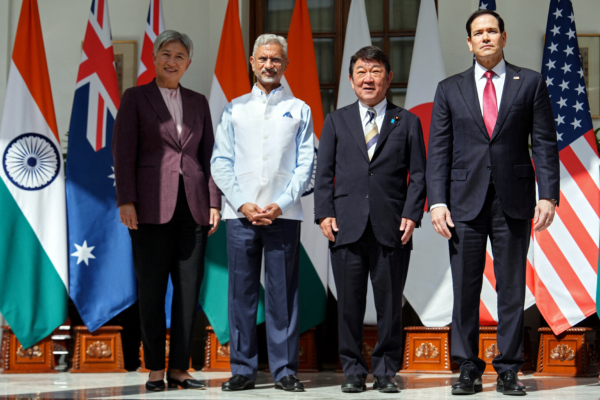
On Tuesday, May 26th, the foreign ministers of the Quad (Quadrilateral Security Dialogue) met in New Delhi to announce cooperation in at least four major areas, including maritime security, port infrastructure, energy, and critical mineral security initiatives. As China continues to expand its economic and military influence in the Indo-Pacific region, this move aims to deepen cooperation among the United States, Japan, India, and Australia in the region.
The meeting was chaired by Indian Foreign Minister S. Jaishankar, and attended by Australian Foreign Minister Penny Wong, Japanese Foreign Minister Toshimitsu Motegi, and US Secretary of State Marco Rubio.
Regarding the first joint infrastructure project, the Quad nations stated that they would collaborate with Fiji to advance port infrastructure in the country. Rubio highlighted during a press conference that this initiative aims to address the insufficient port capacity in Pacific island nations, emphasizing it as a practical demonstration of collective contribution towards resilient and high-quality infrastructure capability.
At a time when global energy security is facing challenges, the United States and Iran are engaged in negotiations to potentially end a three-month conflict and reopen the Strait of Hormuz. Wong noted that the Indo-Pacific region is under severe economic pressure and the world is becoming more unpredictable. She emphasized the consequences of Iran’s closure of the Strait of Hormuz on regional energy security, economy, and people, amidst economic fluctuations.
To address such risks, the Quad initiated the “Indo-Pacific Energy Security Initiative” and coordinated investments and economic policy tools through the “Critical Minerals Framework” to strengthen critical mineral supply chains in mining, processing, and recycling sectors.
This initiative holds particular significance for Japan. The diplomatic stalemate between Japan and China following last year’s remarks regarding “Taiwan’s situation” remains unresolved, with Beijing continuing to halt exports of minerals used in aerospace, defense, and semiconductor industries to Japan. The increasing military threats from China in the Indo-Pacific region are a common concern for the Quad nations.
Foreign Minister Motegi mentioned the “Free and Open Indo-Pacific” (FOIP) concept introduced a decade ago, noting the ongoing structural changes in the international order. He stated that Prime Minister Sanae Takichi previously mentioned the need to update FOIP, focusing on showcasing strength, resilience, and necessary capabilities for Indo-Pacific nations to determine their future, including economic security decisions.
Motegi reiterated the collective stance against any attempt to unilaterally change the status quo through the use of force, which was seen as directed towards China.
Maritime security was also a core focus of the meeting, as 60% of global maritime trade passes through the Indo-Pacific region. The Quad announced the initiation of the “Indo-Pacific Maritime Surveillance Cooperation Initiative” and expanded the “Maritime Domain Awareness Initiative” (MDA) to the Indian Ocean, enabling partner countries to access near-real-time non-classified satellite tracking data to combat illegal fishing and trafficking activities and enhance humanitarian disaster response capabilities.
Rubio emphasized that the Quad is transitioning from a platform for discussing issues to an “action forum” for addressing them, beginning to demonstrate “real outcomes and achievements.”
Jaishankar expressed before the meeting that as “maritime democracies, plural societies, and market economies,” the Quad nations share a collective responsibility for a free and open Indo-Pacific region. He highlighted the need for strategic trust-building, ensuring maritime security, promoting economic choices, fostering deeper cooperation, and advancing credible and transparent partnership relations as the best way forward.
Regarding concerns about the impact of the absence of a summit of leaders last year on the organization’s importance, the foreign ministers did not publicly comment on the possibility of a summit later this year.
However, Rubio had previously stated that diplomats would strive to advocate for a meeting later this year.
Premesha Saha, a senior policy researcher at the Asia Society Australia in Melbourne, stated, “The absence of a leaders’ summit has indeed raised some concerns, but this does not necessarily indicate diminishing importance.” She mentioned that if the Quad continues to deliver results at the ministerial and working levels, it can maintain its influence even without regular signals at the leaders’ level.
This meeting marked the third of its kind held by the Quad since September 2024, and the third summit in less than 18 months. Foreign ministers also mentioned ongoing practical cooperation in areas such as undersea cables, combating fraud centers, law enforcement capacity building, and network cooperation.