
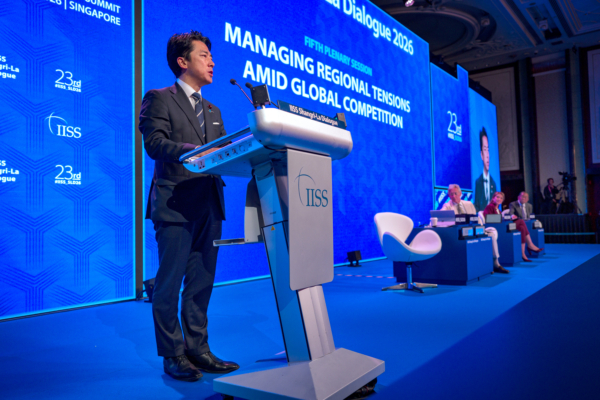
At the end of May, during the “Shangri-La Dialogue” in Singapore, Chinese representatives once again criticized Japan’s recent defense policy as “neo-militarism,” drawing international attention. Several Taiwanese defense strategic scholars pointed out that China’s accusation lacks factual basis and that Beijing’s substantial increase in military spending annually, along with its powerful offensive military capabilities and military intimidation towards Asian countries, actually reflects true “militarism” under the Chinese Communist regime.
The “Shangri-La Dialogue” of this year took place from May 29th to 31st in Singapore. On the forum held on the 30th, the head of the Chinese delegation, Major General Meng Xiangqing, criticized Japan for not having eradicated the “militaristic” residue and therefore not being qualified to discuss international defense cooperation in such a venue like the Shangri-La Dialogue.
In response, Japanese Defense Minister Taro Kono promptly refuted the accusations of “militarism,” stating that “nothing could be further from the truth.”
During his speech on the forum on the 31st, he exclaimed, “It is strange to label Japan, a country without nuclear weapons and strategic bombers, as ‘neo-militaristic’ when compared to a country possessing a large number of both.” He emphasized that Japan always abides by the United Nations Charter and international law, striving to maintain a free and open international order while making sincere efforts.
Regarding China’s continued rhetoric of “neo-militarism” towards Japan in recent years, Su Ziyun, director of the Institute of Defense Strategy and Resources, expressed to Dajiyuan that China is essentially sounding an old drum, with the objectives of expressing dissatisfaction towards Japan’s defense policy reforms under the leadership of the Shinzo Abe government, utilizing historical memories of World War II to equate Japan’s current self-defense measures with past Japanese militaristic expansion, and manipulating domestic nationalism in China.
“Because the general public may not differentiate that present-day Japan has an elected government entirely different from the military government during World War II.”
Concerning the definition of “militarism,” Professor Chen Shimin of the Department of Political Science at National Taiwan University told Dajiyuan that “militarism” includes at least three important characteristics: military dominance in political decision-making, the establishment of a powerful offensive military force for expansionist purposes, and the actual use of military force for aggression or coercion. At present, Japan does not fit these criteria.
He believes that the Japan Self-Defense Forces do not control political power, and their defense policy focuses on defense and deterrence. Therefore, labeling Japan as “neo-militaristic” lacks objective basis.
Geopolitical scholar and Vice President of Kainan University, Chen Wenjia, told Dajiyuan that “neo-militarism” has become an important political label in China’s foreign propaganda efforts. On one hand, Beijing seeks to maintain domestic political legitimacy by invoking memories of World War II, while on the other hand, it attempts to convey the impression of “Japan’s military resurgence” to Southeast Asian countries, thereby diminishing Japan’s influence in Indo-Pacific security cooperation.
Since the establishment of the second Shinzo Abe administration at the end of 2012, Japan’s defense budget has continued to rise annually, although it remains within the informal limit of “annual defense expenditure not exceeding 1% of that year’s Gross Domestic Product (GDP).”
In response to the regional security situation in recent years, Japan has increased defense spending. The defense-related budget for 2026 is approximately 10.6 trillion yen (about 454 billion yuan), accounting for about 1.9% of GDP, approaching the Japanese government’s set target of 2%.
Regarding China’s accusation of Japan as resurrecting “neo-militarism,” during the National People’s Congress in March of this year, according to the Chinese Ministry of Finance’s proposed government budget report, China’s military budget for this year is 1.909.561 billion yuan, representing a 7% increase from the previous year. Over the past three years, China’s military spending growth has been maintained at 7.2%.
From an objective perspective on military development, Chen Wenjia stated that although Japan has increased defense spending in recent years, deployed counterattack capabilities, and strengthened defense of the Southwest Islands mainly in response to China’s rapid military expansion and the escalating situations in the Taiwan Strait and East China Sea; Japan’s defense budget, while continually growing, is still far less than that of China. Its policy core remains the establishment of deterrent capabilities rather than expansionism.
Yuzu Zongji, former director of the College of Political Warfare at the National Defense University of Taiwan, who was invited to participate in this year’s “Shangri-La Dialogue,” told Dajiyuan that from his observation of the overall atmosphere at this summit, China’s accusations against Japan did not receive a response from participating countries. Instead, Japan’s role in regional security garnered support and recognition from many ASEAN countries.
He mentioned that China’s attempts to stir up conflicts between Asian countries and Japan based on historical memories of World War II have limited practical effects. Many countries are more concerned with current regional security challenges rather than repeating past political rhetoric.
Of note, on the 30th at the “Shangri-La Dialogue,” 17 countries including Singapore, Australia, New Zealand, France, Finland, and Sweden agreed to cooperate on defense strategies for key maritime infrastructure such as undersea cables. Australian Defense Minister Marles cited incidents of undersea cable damage in the Baltic Sea and Taiwan Strait in recent years, warning that the seafloor has become a “battleground.”
In response, Yuzu Zongji stated that it is evident to everyone that it is China that disrupts other countries’ undersea cables in Asia. Therefore, although it is not explicitly stated, the common target of prevention is China, which is a clear phenomenon at this year’s Shangri-La Dialogue.
However, several scholars have warned that China’s actual military expenditure far exceeds this figure, and its vast and opaque “hidden military spending” not only poses a huge threat to Taiwan but has also become the true root of the arms race in East Asia, forcing surrounding countries in the Indo-Pacific region to significantly increase defense budgets for their own protection.
Nan Tian, a researcher at the Stockholm International Peace Research Institute (SIPRI), stated, “Our estimates show that China’s total military spending is about 30%-35% higher than the official budget.”
Reviewed satellite images by Reuters show that China is constructing a massive network near the areas where its long-range missiles are stored in Xinjiang and Gansu provinces, consisting of launch pads, shelters, and communication facilities.
U.S. officials describe that China’s expansion of its nuclear weapons exceeds that of any other nuclear-armed nation.
Chen Shimin stated that it is clear that China is a regime ruled by the military, a dictatorship. Xi Jinping can exclude other factions, including the Jiang faction and the “Red Second Generation,” because he has control over the military. This enables Xi Jinping’s dictatorial regime.
“It’s clear that China is poor in terms of morality. It is developing a powerful offensive military force,” said Chen Shimin. Beijing constantly maintains an outward image of a defensive national defense policy and advocates for peace, so why develop so many offensive weapons?
Moreover, Beijing frequently uses its substantial offensive military power to conduct a form of “gray zone” military coercion towards other countries, including Taiwan, the Philippines, Japan, and Vietnam.
Chen Shimin sarcastically remarked that it is actually the Chinese Communist Party that is truly promoting “militarism.” The CCP is the regime that presents signs of “militarism” at present.