
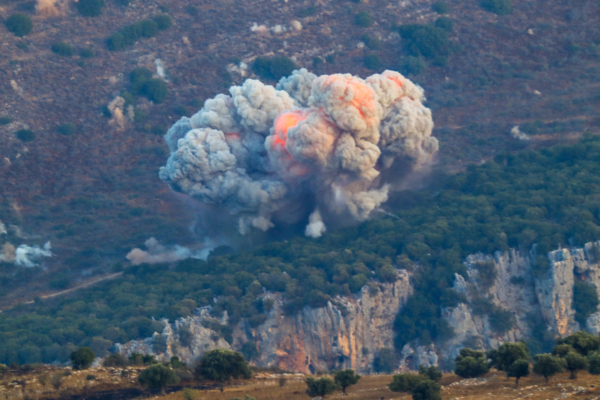
Israeli Prime Minister Benjamin Netanyahu revealed on Sunday (May 31) that he has ordered the Israeli military to further advance into Lebanon, expanding the military operations against Hezbollah.
According to Reuters, the Israeli army seized the strategically important Beaufort Castle, built during the Crusader era in southern Lebanon, marking the first time Israel has regained control of this area since withdrawing from southern Lebanon in 2000.
Beaufort Castle, located near Nabatiyeh, was taken after intense battles and airstrikes between the Israeli army and Hezbollah militants in the surrounding villages.
Netanyahu stated that the goal of the Israeli military is to “deepen and expand control over the areas formerly controlled by Hezbollah.” He emphasized that Israel will continue to target the Iran-backed Hezbollah armed forces.
Hezbollah launched rocket and drone attacks on northern Israel on Saturday (May 30), leading to school closures and local evacuations.
This latest attack is considered the most severe since the ceasefire in April along Israel’s northern border.
In response, the Israeli military initiated a new ground operation in southern Lebanon, occupying the historic Beaufort Castle and the surrounding mountainous areas.
The high ground provides strategic value as it overlooks large portions of southern Lebanon and northern Israel.
Israeli Defense Minister Israel Katz announced on Sunday that the Israeli military will continue to hold Beaufort Castle and designate the area as part of the “security zone” in southern Lebanon.
He stated, “This battle is not over, and we are determined to completely destroy Hezbollah.”
Lebanon’s official news agency reported on Sunday that at least 8 people were killed when Israel conducted overnight airstrikes in the southern village of Deir El Zahrani on Saturday. On Sunday, the Israeli military launched over 40 airstrikes in various areas of southern Lebanon.
Israel also issued evacuation warnings to residents south of the Zaharani River and conducted operations near Nabatieh to weaken Hezbollah’s military infrastructure.
During the recent military operation, an Israeli soldier was killed.
With the situation escalating, the French Foreign Ministry announced plans to convene an emergency meeting at the United Nations Security Council on Monday (June 2) to discuss the situation in Lebanon.
This conflict is one of the most severe fronts of the ongoing Iran-linked war spillover. Since Hezbollah began launching rockets at Israel on March 2, causing Israeli retaliations, over 1.2 million people in Lebanon have been displaced due to airstrikes and evacuation orders. The Lebanese government reported over 3,370 fatalities.
Meanwhile, Israel disclosed that 24 soldiers and 4 civilians have died in the conflict, with tens of thousands of residents in northern Israel forced to evacuate due to Hezbollah attacks.
The occupation marks a significant advancement for Israel in the latest round of the Israel-Lebanon War. The war erupted on March 2 when Hezbollah launched rockets at Israel, two days after the U.S. and Israel targeted its main supporter, Iran.
Following this, Israel entered Lebanese territory, seizing numerous border towns adjacent to Lebanon. Hezbollah retaliated by firing thousands of missiles and drones at Israeli soldiers stationed in southern Lebanon and northern Israel.
On May 29, the U.S. government hosted representatives from Israel and Lebanon in Washington to push for ceasefire negotiations and discuss disarming Hezbollah.
Both Israel and Lebanon have agreed to extend the previous ceasefire agreement by 45 days this month. The Israeli advancement occurred during the ceasefire agreement that nominally took effect on April 17, with only a few days left until the next round of direct negotiations between Lebanon and Israel scheduled for June 3 in Washington.
Previously, Hezbollah’s key ally and Speaker of the Lebanese Parliament, Nabih Berri, stated that he can ensure Hezbollah will “fully, thoroughly, and immediately comply with the ceasefire agreement.” As of now, Hezbollah has not issued a formal response to the latest Israeli military actions.