
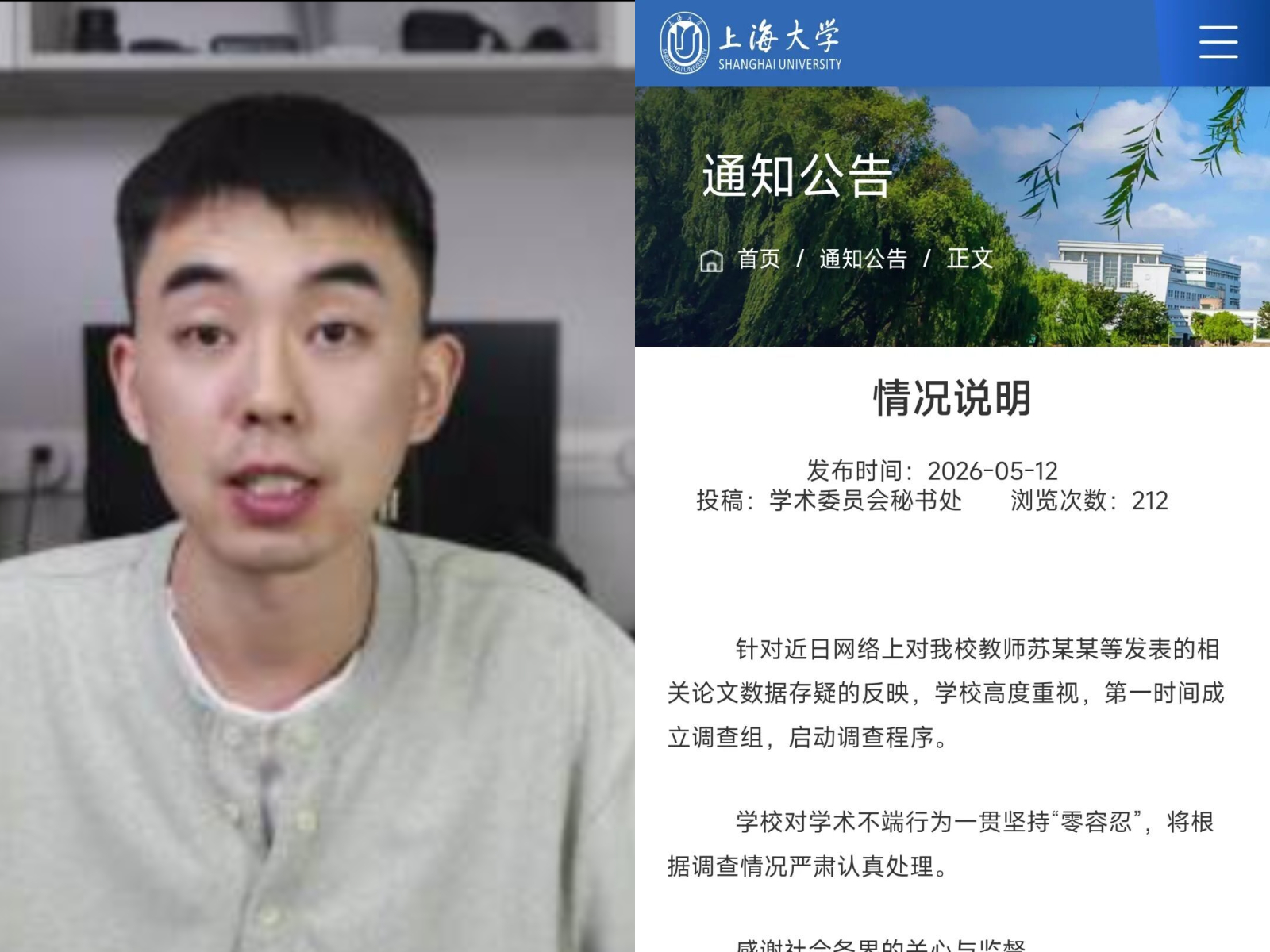
Recently, a Chinese scholar who returned from overseas, known as “Geng Tongxue,” has exposed academic fraud, leading to the downfall of one “sea turtle” scholar. What’s worth noting is that “Geng Tongxue” has received backing from official Chinese media. Analysis suggests that “Geng Tongxue’s” actions may align with the intentions of the Chinese Communist Party (CCP), enabling Xi Jinping to crack down on the academic circle, deceive grassroots people into believing the anti-corruption efforts, and also highlight the systemic issues within academia and the party’s bureaucratic system, all rooted in the CCP system.
“Geng Tongxue” began reporting academic fraud in mainland China since April, resulting in the investigation of five prominent scholars. In July, he turned his attention to “sea turtle” scholars who have returned to top-tier universities in China from American institutions.
One of his targets was Lu Xiongbin, a prestigious professor at the School of Medicine at Zhejiang University. Although “Geng Tongxue” did not explicitly name him in the video report, sources close to the university revealed that Lu Xiongbin had resigned, and his personal webpage had been closed.
It was reported that Lu Xiongbin had previously served as a distinguished professor at the Indiana University School of Medicine in the US, and he became a faculty member at Zhejiang University in May 2024. In April this year, a paper by Lu Xiongbin’s team was rejected by the journal “Science Translational Medicine” on the grounds of suspected image manipulation.
“Geng Tongxue” was originally a Ph.D. student at Beihang University’s School of Biomedical Engineering, and after leaving in 2025, he started as a science popularizer on social media before quickly transitioning into an academic fraud whistleblower. With the support of official Chinese media, his efforts have instilled fear and vigilance in the mainland academic community.
In April and May, “Geng Tongxue’s” reports led to the downfall of five high-ranking scholars at four renowned Chinese universities, causing a seismic disturbance in the country’s academic circles.
Subsequently, Chinese state media published articles for three consecutive days praising “Geng Tongxue’s” efforts in exposing academic fraud and highlighting the ineffectiveness of academic oversight.
According to Beijing-based lawyer and independent scholar Lai Jianping, the pervasive academic fraud in China in recent years has reached a state of “rampant disaster,” with the CCP seizing this opportunity to clean up the academic sphere.
In late May, Xinhua News Agency published a commentary endorsing “Geng Tongxue’s” crusade against academic fraud. Commentator Lan Shu believes that this stance reflects the CCP’s considerations after weighing the pros and cons, with Xi Jinping using the anti-corruption campaign to solidify the Party’s rule.
“Xi Jinping is using the so-called ‘self-revolution’ to negate the fundamental achievements of the CCP in marketization and reform over the past few decades, and to return to the basic ideological framework of Marxism-Leninism and Maoism,” Lan Shu said. “Xi Jinping, within the CCP system, faces significant obstacles in denouncing the reform achievements of the market economy in the past few decades. In this context, the exposure of academic fraud, especially by scholars returning from the West, plays right into Xi Jinping’s hands.”
Lan Shu emphasized that the market economy is seen as the existential enemy of communism in Xi Jinping’s eyes, and his push towards a Marxist-Leninist-Maoist direction involves presenting initiatives like ongoing anti-corruption efforts and “self-revolution.”
Regarding “Geng Tongxue’s” actions, Lan Shu pointed out that they align with what Xi Jinping aims to achieve, particularly with the exposure of scholars returning from overseas, garnering support at the grassroots level under the guise of combating corruption.
Lai Jianping highlighted how the entire academic system under the CCP, along with its bureaucratic and official-centric structure, lacks academic freedom, where researchers are bound by the Party’s administrative framework. Thus, academic fraud, official corruption, and other forms of decay stem fundamentally from the CCP’s system.
“The academic sphere cares little about genuine talent and expertise. As long as you can network and please those in power, securing projects, funding, resources, and influence is possible in that field,” criticized Lai Jianping.
“Once things spiral out of control, the CCP never reflects on its scientific research, academic, and educational systems at their core. It merely ‘detaches’ itself from surface issues, conducts a crackdown, and displays the ‘false topics’ it seeks to prove,” he added.
Lai Jianping stated that the CCP shifts responsibility onto individuals in the academic field rather than addressing systemic issues, following a typical “passing the buck” approach to project a “clean and noble” image while society pays for the decay of its institutions.
“Geng Tongxue claims that academic fraud predominantly arises from two reasons: junior researchers seeking quick promotions and senior professors compromising academic integrity for personal gain,” explained Lan Shu.
Lan Shu noted that “Geng Tongxue’s” actions fall within the acceptable boundaries set by the Chinese authorities, but official media support for him has its limitations. If the exposure and criticism extend beyond the permitted scope of the CCP system’s stability, suppression and restrictions will follow.
Lai Jianping concurred that “Geng Tongxue” is merely a tool for the CCP, serving a “temporary and expedient” purpose. The Party neither intends nor desires to address the fundamental issues at hand.
“As long as the absolute leadership of the Party is not relinquished, this phenomenon will not change. ‘Geng Tongxue’s crusade against fraud is just a passing fad; his actions will soon subside. Like many past occurrences, once the storm has passed, the status quo remains, and fraudulent practices continue without any substantial impact,” said Lai Jianping.