
Recently, the Chinese Communist Party (CCP) revised the rules for developing party members to strengthen political screening for party admission. Subsequently, the CCP’s official journal emphasized the need to prevent two extremes: hasty party admission and the so-called “closed-doorism.” Analysts believe that the CCP’s stance of “both wanting and not wanting” reveals its sense of fear. With the rise of the movement to quit the Party over the past 20 years, both Xi Jinping and the CCP fail to gain sincere support from within and outside the party, indicating that this regime could collapse at any time.
The CCP Central Office issued a revised version of the “Detailed Rules for Developing Party Members” on May 18, after a 12-year gap since the last revision. The new version requires stricter political scrutiny for party applicants, particularly emphasizing compliance with the political requirements to “uphold the core directives” and “uphold the core leader, Xi Jinping.”
Following the revision of the rules for developing party members, the CCP’s Central Party School publication, Study Times, published an article on the 29th stating that the development of party members should “prevent two incorrect tendencies,” namely, hasty development and closed-doorism. The article also mentioned that stopping hasty development does not mean halting development but rather systematically carrying out the regular development of party members while ensuring quality. It also opposes closed-doorism, which is not about lowering the standards for developing party members, and so on.
Wang Zhiyuan, the Chairperson of the Global Quit the Party Service Center, told the media that the CCP’s journal opposes closed-doorism while aiming to raise the standards for party members. This is a typical Xi Jinping-style thinking: wanting both, which reveals their sense of insecurity and fear.
Wang Zhiyuan explained that the opposition to “closed-doorism” is because the central government fears that after raising the standards, grassroots cadres may fear making mistakes. The safest approach for them is to develop fewer party members or halt recruitment altogether, which would cause problems with the organizational renewal of the CCP. However, if the standards are not strictly controlled, there is a fear that individuals who do not meet Xi Jinping’s requirements might infiltrate the party and even enter various levels of the power structure. “In fact, what Beijing fears the most now is not the loss of a few party members but losing control.”
He believes that the Study Times hastily came out to explain, possibly because this new regulation has indeed sparked much discussion and concern within the party. So, the official unified stance ultimately reflects their fear.
The party journal article claims that in some places, mechanical efforts are made to meet quotas, some recruit party members as a means of exchange for benefits under the guise of “favors for party admission,” and some violate procedural principles by bulk admissions. It also points out that some set thresholds to exclude so-called advanced individuals, while others stagnate in their work, hindering the admission of so-called “outstanding young people” into the party.
In response, a mainland Chinese lawyer, Tan Ming (pseudonym), told the media that indeed, some people within the CCP, particularly those with good relationships with the government, seek promotion through forced party admission. Some ordinary individuals join simply for the sake of gaining connections. However, in reality, many are just being used. Those who wish to profit or gain influence from the party may have a strong desire to join, but for many, party admission holds little appeal.
In the past, articles from the CCP’s disciplinary agency revealed that university student party members graduating and seeking employment felt ashamed to disclose their party member status.
Moreover, many CCP members are not actively paying party dues. The CCP’s People’s Daily once acknowledged in an article that “some party members lack awareness of paying party dues and do not actively pay unless reminded; some consider paying party dues a minor issue and forget to pay, it’s normal; some intentionally procrastinate from paying party dues due to considering them too high.” According to the CCP’s party regulations, if a party member fails to pay party dues for six consecutive months, they are considered to have voluntarily left the party. Some analysts point out that many party members intentionally neglect paying party dues for an extended period as a form of “indirectly quitting the party.”
In 2016, the CCP carried out a nationwide party fee review and repayment work, with some party members even being asked to repay party fees dating back to 2008, sparking complaints from some party members online.
Previously reported by Dajiyuan, Chinese people currently have mixed views on joining the CCP. Some join for career prospects, public exam considerations, or to climb the ranks, while others pay to join. In the military, the situation is similar. On the opposite end, many refuse to join the party, and even more gradually realize the CCP’s negative aspects after joining.
Tan Ming said that the CCP’s ideology has long been bankrupt, and most people have distanced themselves from it mentally. However, due to its control over vast material resources and various opportunities for survival and development in society, many feel compelled to remain associated. This inhumane and unnatural entity will not last long. Depending on material benefits or spiritual bondage can only be temporary.
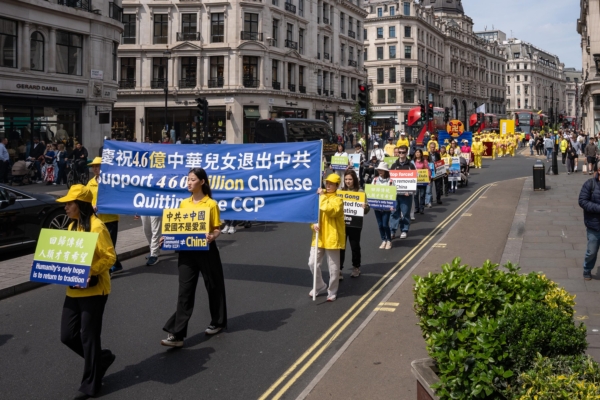
Since 2004, the movement to quit the Party (including quitting the Party, the Youth League, and the Young Pioneers) has been on the rise both domestically and abroad. Chinese individuals have been declaring their withdrawal from the CCP and its affiliated organizations anonymously or publicly through the Global Quit the Party Service Center platform, with over 440 million declarations (not including the number of party members).
A statement dated May 16th, signed by Ren Weiming, mentions, “I am a policeman from Liaoning Province. I have learned the truth and wish to take this opportunity to withdraw from the CCP and its affiliated organizations that I once joined, rendering my oath made when I joined the Party void.”
According to official CCP data, by the end of 2024, the total number of CCP members was 100.27 million, with a net increase of 1.086 million compared to the end of 2023, representing a growth of 1.1%.
Xiaolian, a volunteer who has been helping Chinese people quit the Party online for years, told reporters that many who join the CCP do so for personal gain rather than genuine belief in communism. Even if joined unknowingly, upon realizing the truth, they tend to withdraw ideologically. Although the CCP’s membership numbers reach over a hundred million, they fail to win over hearts.
Xiaolian mentioned that in her experience assisting the police in quitting the Party, many university students are willing to quit. In one case, 11 high school students from the same dormitory, with two party members and nine Youth League members, all withdrew after understanding the historical evils of the CCP.
Wang Zhiyuan pointed out the revision of the rules for developing party members has added a requirement to recognize “upholding the core directives” and “upholding the core leader, Xi Jinping.” This signifies a shift from emphasizing loyalty to the party to now emphasizing loyalty to the core leader. This is an important characteristic of the Xi Jinping era. Loyalty to the organization is transitioning to personal loyalty. Such means of binding reflect a lack of security. “If a leader has full confidence in their authority, they don’t need to repeatedly emphasize loyalty. If loyalty thresholds continue to rise, it often indicates declining internal trust.”
Chinese affairs expert Li Linyi stated that with the rise of the movement to quit the Party over the past 20 years, there have been significant changes in China’s situation and within the CCP. Currently, the CCP’s ideology has collapsed, and it cannot deceive people anymore. On the other hand, Xi Jinping’s authority is waning as both Xi and the Party fail to receive genuine support internally and externally. This regime is like a skyscraper built on sand, ready to collapse at any moment.