
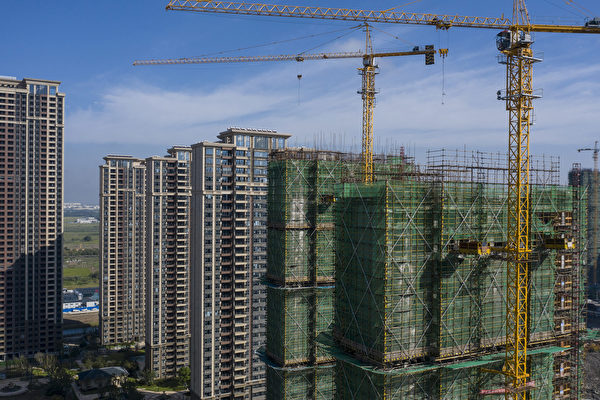
According to the first quarter fiscal revenue and expenditure data released by the finance departments in various regions of mainland China in 2026, Beijing, Shanghai, Guangdong, and 28 other provincial-level areas all had a general public budget self-sufficiency rate below 100%. The general public budget revenue in these areas did not cover the budget expenditures during the same period. The data from the Chinese Communist Party (CCP) also indicated that local-level revenues were lower than expenditures, with land sales revenue continuing to decline.
The CCP’s Ministry of Finance previously released data for the first quarter of 2026, showing that the national general public budget revenue was 6.1613 trillion yuan, an increase of 2.4% year-on-year. The national general public budget expenditure was 7.4706 trillion yuan, an increase of 2.6% year-on-year. Among them, local general public budget revenue was 3.6622 trillion yuan, while local general public budget expenditure was 6.5557 trillion yuan. Based on this calculation, local-level revenues only covered about 55.9% of local expenditures.
Data analysis showed that Zhejiang had the highest fiscal self-sufficiency rate in the first quarter at 96% among the 28 provincial-level regions. This was followed by Shanghai at 90%, Tianjin at 89%, Jiangsu at 82%, Fujian at 79%, Shandong at 74%, Guangdong at 73%, and Beijing at 66%. The fiscal self-sufficiency rates were even lower in central and western regions as well as border areas, with Gansu at 22% and Tibet at 14%. Even in economically developed eastern provinces and municipalities, general public budget revenue failed to cover expenditures during the same period.
Chinese financial scholar Wang Yin (pseudonym) told reporters that the fiscal self-sufficiency rate refers to the ability of local governments to cover their expenditures with their own revenue. The lower the fiscal self-sufficiency rate, the more reliant they are on higher-level subsidies. The fact that the fiscal self-sufficiency rates of all 28 provincial-level regions were below 100% reflects issues in the CCP’s fiscal system. Wang stated, “This reflects that local government tax and non-tax revenues, including fines and administrative charges, are no longer sufficient to cover general public expenditures. In the past, they could rely on land sales to make up for it, but now they can’t come up with something to compensate.”
Regarding Zhejiang and Shanghai ranking high in fiscal self-sufficiency rates but still failing to cover general public budget revenue with expenditures during the same period, Wang Yin explained that despite the favorable policies by the CCP towards these regions, they still cannot achieve fiscal self-sufficiency. He mentioned, “This indicates that the local revenues in these regions are no longer enough to support expenditures. Now with declining resident consumption, subsidy removal for exports, local governments inflating export figures to deceive central finance, if the fiscal self-sufficiency rates in Jiangsu, Zhejiang, and Shanghai drop below 80%, many provinces and cities will have to close down.”
CCP’s Ministry of Finance data showed that in the first quarter, government fund budget revenue was 775.1 billion yuan, a decrease of 16.2% year-on-year; local government fund budget revenue at the local level was 660.2 billion yuan, a decrease of 19.1% year-on-year. Among them, revenue from state-owned land use rights transfer was 517.6 billion yuan, a decrease of 24.4% year-on-year. From January to April, revenue from state-owned land use rights transfer was 680.1 billion yuan, a decrease of 27.2%, with the decline continuing to widen.
Professor Xu from Jiangsu University stated that for the past 20 years, the major source of revenue for local CCP finances was land income, which has now decreased. After the decline in land sales revenue, the methods previously used by local CCP authorities—including land sales, debt borrowing, and urban expansion for fiscal turnover—have reached their limits. He mentioned, “Urban expansion, building metros, blind expansion, and widespread corruption—all this money comes from land sales. Now that developers are not buying land and houses are not selling, residents are reducing consumption, the economy stalling, none of these measures can solve the tight fiscal situation.”
Xu also mentioned that after the tax-sharing system reform in 1994, the central government centralized major tax revenue sources, leaving local governments responsible for a significant amount of education, healthcare, elderly care, infrastructure, and grassroots governance expenditures.
He remarked, “Entering the 2000s, China joined the World Trade Organization with the help of the US to alleviate poverty and revitalize the economy, leading to the subsequent rapid expansion in real estate. The top leadership in Beijing thought they had the ability, but it seems they only have the ability for corruption and stability maintenance. After the burst of the real estate bubble, they are at a loss for countermeasures.”
In recent years, the CCP has maintained local fiscal operations through central transfers, special debts, refinancing bonds, and implicit debt substitution. Scholar Shen Liang said, “This will strengthen central control over local areas, as central funding and debt arrangements reduce local autonomous financial resources. Doesn’t this mean that local finances will return to the planned economy era?”
Shen Liang pointed out that before the 20th National Congress of the CCP, local authorities could rely on land sales, borrowing, and project turnovers. Now, with the decline in land revenue and increasing debt interest, the means of relying on land sales, borrowing, and project turnovers are exhausted, but it is becoming increasingly difficult to sustain. In order to maintain stability among the population, authorities are fabricating figures.
He said, “I don’t believe the official figures released are accurate; the actual situation may be worse. The high-ranking CCP officials can only turn a blind eye because their lives will not be affected. The massive capital outflow from the middle-class population indicates the problem.”