
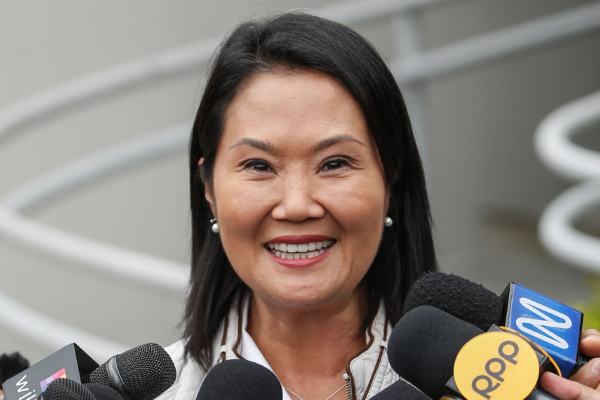
Peru’s presidential election is nearing its final stages, with the counting of votes. The latest statistical results indicate that right-wing candidate Keiko Fujimori of the “People’s Power” party has taken a leading advantage, positioning her to potentially become Peru’s first female president elected through elections.
According to reports from Reuters, the latest results released by Peru’s National Office of Electoral Processes (ONPE) on Tuesday showed that after counting over 99% of the votes, Keiko Fujimori obtained 50.11% of the votes, leading her left-wing opponent Roberto Sanchez by 43,386 votes. There are still 40,213 votes to be counted.
The election committee announced plans to release the final election results in mid-July, citing the need to review disputed votes, delays in the arrival of overseas votes, and the extremely small margin in the candidates’ vote counts.
Earlier on Tuesday, Sanchez accused without providing evidence of “electoral fraud” and stated that he would refuse to acknowledge the election results. Sanchez had called for the invalidation of thousands of overseas votes primarily supporting Fujimori, but his request was rejected by Peru’s National Electoral Jury on Tuesday evening.
Following the recent election of political outsider Abelardo De La Espriella as president of Colombia on Sunday, a potential victory for Fujimori would further deepen the rightward trend in Latin America. Voters concerned about crime issues have been turning towards tough-talking candidates.
In the past eight years, Peru has seen eight presidents, none of whom completed their full term, with three impeached, one resigning after just six days in office, and currently four former presidents are embroiled in legal troubles.
Amid this election, Peru is facing serious economic disparities between the capital and rural areas, soaring crime rates, and a deep disillusionment among the public towards political figures.
Keiko Fujimori, aged 51, is the daughter of former Peruvian President Alberto Fujimori. She has run for the presidency three times in 2011, 2016, and 2021 but faced defeat at the final stages each time.
During Alberto Fujimori’s presidency, he cracked down on the radical leftist insurgent group, the Shining Path (Communist Party of Peru), through strong measures and promoted market reforms, a stance that still resonates with some voters. However, he was later convicted on corruption and human rights abuse charges, serving a 16-year prison sentence.
While Keiko Fujimori had previously kept a distance from her father’s political legacy, in this election, she has leaned on that legacy and projected an image of a strong leader capable of maintaining order and stability, garnering broad support.