
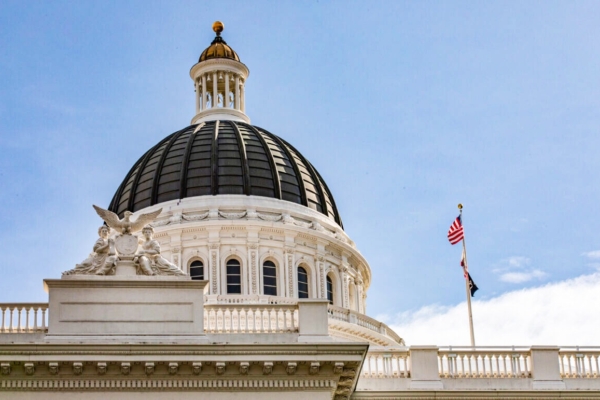
On June 15 and 16, the California Senate and Assembly passed Governor Newsom’s budget for the 2026-27 fiscal year, totaling 355.9 billion dollars, an increase of 30.9 billion compared to the 2025-26 budget. Republican lawmakers criticized the plan for not prioritizing easing the burden on residents, relying instead on billions in new taxes to maintain a balanced budget.
Since taking office in 2019, Newsom has been presenting budgets that have been increasing at a remarkable pace year after year, starting from 214.8 billion in 2019, with an eight-year increase of 141.1 billion (65.7%). Two weeks later, on July 1, the legislature is set to reach a final agreement with the governor on the new budget plan.
Compared to the governor’s May revised proposal, the latest budget plan includes the following changes:
1) Postponing cuts to California’s Medi-Cal welfare program for undocumented immigrants or refugees until July 2027;
2) Allocating a record 127.1 billion to pre-K to 12th grade schools and California community colleges, an increase of 2.7 billion from the May budget;
3) Increasing state taxes: imposing a new digital software tax on computer software; setting the cap on corporate tax credits at 5 million or 50% of total tax liability (whichever is higher); reducing tax breaks for large corporations.
According to the non-partisan Legislative Analyst’s Office (LAO), this budget assumes a 5.5 billion increase in state revenue and reduces around 2 billion from the funds originally planned to be transferred to the “Temporary Surplus Reserve Account,” resulting in approximately 8 billion in additional available funds, but “does not alter the overall budget’s final balance.” Previously, the LAO predicted a 16.9 billion deficit.
To achieve a deficit-free 2026-27 and 2027-28 fiscal year and reduce the structural deficit by half in the 2028-29 fiscal year, the budget proposal plans to cut 1.8 billion in spending from the state’s general funds; at the same time, inject 9.7 billion into the “reserve account” to strengthen reserve fund capacity; and maintain a nearly 30% increase in the comprehensive reserve fund, compared to Newsom’s tenure.
However, the LAO and the non-profit organization California Budget and Policy Center predict that in the coming years, the growing expenses of maintaining various state government programs and services will outpace revenue growth. Federal cuts to funding for California’s healthcare, food assistance, and other programs, along with geopolitical conflicts, energy price fluctuations, and potential economic downturns, could all impact California’s fiscal condition.
Most Republican lawmakers in the Senate and Assembly voted against the budget, urging further spending cuts. While the budget appears balanced for these two fiscal years, the 2028-29 fiscal year is projected to face a 10.3 billion deficit, and the 2029-30 fiscal year deficit is expected to be 9.6 billion.
John Laird, chair of the Democratic State Senate Budget Committee, stated out of the total budget of 355.9 billion, 253 billion comes from the state’s general fund, “We are facing some tough choices,” calling for balanced and targeted cuts, alongside additional 5 billion in revenue through new tax measures.
In addition to continuing to provide health insurance for undocumented immigrants, the budget also offers up to 1.9 billion in forgivable loans to struggling hospitals, an extra 2.5 billion to public hospitals; meanwhile, it allocates funding to increase 22,770 childcare slots and continues to provide housing assistance funds for the homeless.
Roger Niello, vice-chair of the Republican State Senate Budget Committee, said, “California’s budget has nearly doubled in less than a decade, and when average families struggle to afford housing, gas, groceries, and medical costs, it’s evident that California’s financial accounting system is flawed.”
Niello noted that the budget relies on new tax revenues and borrowing, requesting working-class families to pay more for underperforming government projects without addressing the increasingly serious unemployment insurance debt problem, forcing employers to bear over a 250% increase in tax burden per employee. He pointed out that California households face the highest gas prices in the nation, with California’s gasoline sales tax set to increase to 63.4 cents per gallon on July 1, up from 41.7 cents at the beginning of 2019.
Senate Minority Leader Brian W. Jones said, “The budget clearly illustrates that our once proud ‘Golden State’ has become a playground for left-wing politicians: spending 2 billion on creating a ‘green fleet’ is seen as a more reasonable use of fuel tax dollars than repairing roads. Additionally, suing the federal government is prioritized over investing in the funds needed to safeguard public safety.”
“California must stop using taxpayers’ money to fund politicians’ pet projects or engage in political retaliation, which goes against the demand that the budget prioritize the interests of the people,” said Jones.
Republican lawmakers have proposed five funding priorities, including: funding Proposition 36, which aims to crack down on repeat offenders, fentanyl drug trafficking, and advancing mandatory rehabilitation; compensating businesses for the unemployment insurance loans during the pandemic period, instead of shifting the burden to them; funding wildfire prevention projects, struggling hospitals, and implementing anti-fraud and accountability measures within state projects.