
Hello, viewers! Welcome to “Century Truth.”
On May 8, 1958, during the second meeting of the Eighth National Congress of the Communist Party of China (CPC), Chairman Mao Zedong made the following statement:
“What is Qin Shi Huang? He only buried four hundred and sixty Confucian scholars, we buried forty-six thousand Confucian scholars… I have debated with democratic individuals. If you curse us as Qin Shi Huang, it’s not correct. We surpass Qin Shi Huang one hundred times. If you curse us as Qin Shi Huang and dictators, we admit consistently, but unfortunately, you don’t say enough, often requiring us to supplement.”
After saying that, he laughed heartily.
Mao Zedong directly admitted that he was a dictator, he was cruel. However, no matter how cruel he was, in every political movement he initiated, there were people who stood up to resist.
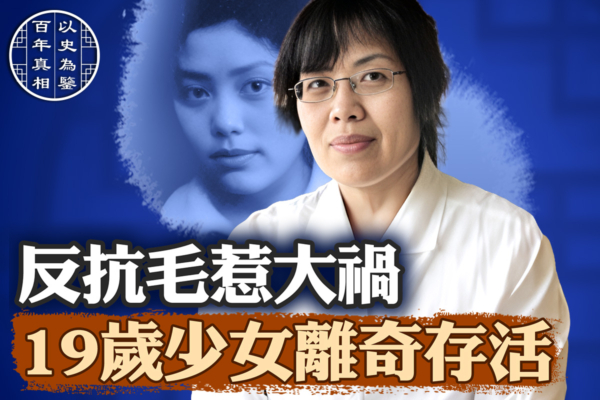
In 1966, during the Cultural Revolution, 19-year-old girl Wang Rongfen was one of the valuable resisters.
Today, based on the information in Dai Qing and Luoke’s “Female Political Prisoner Wang Rongfen” and other sources, let’s talk about her legendary life.
Born in 1947 in Haidian District, Beijing, Wang Rongfen attended elementary school at Peiyuan School. At the age of 10, she entered Beijing No. 101 Middle School with a score of 200 in both Chinese and mathematics. At 16, excelling academically, she was admitted to Beijing Foreign Studies University to study German.
In 1966, at the age of 19, she was already a senior student cadre in college. On August 18 of that year, as a student representative, she saw Mao Zedong, who was adored by countless people, at Tiananmen Square.
This was the first time Mao Zedong met the Red Guards at Tiananmen Gate Tower that year. After the meeting, the Red Guards, as if injected with chicken blood, rushed out of the campus, into the streets of Beijing, smashing, looting, and burning in the name of “Destroy the Four Olds,” creating the “Crazy August.”
According to the “Beijing Daily,” in August and September 1966, 1772 people in Beijing were killed by the Red Guards, including many teachers, principals, and civilians.
In the midst of the “Crazy August,” Wang Rongfen witnessed many horrifying events that tormented her conscience. On September 24, 1966, unable to bear it any longer, she wrote a letter to Mao Zedong.
In the letter, she wrote: “Please think as a Communist Party member: What are you doing? Please think in the party’s name: What does everything happening now mean? Please think in the name of the Chinese people: Where are you leading China? The Cultural Revolution is not a mass movement; it is one person using bayonets to control the masses. I solemnly declare: I withdraw from the Communist Youth League from today.”
After writing the letter, Wang Rongfen ran to the nearby Qipan Street Post Office near Tiananmen and sent the letter. She also sent letters with the same content to her mother, the Communist Party Central Committee, and her school as a farewell.
After sending the letters, she went to a pharmacy in Wangfujing, bought four bottles of the pesticide “DDT,” then walked towards the Soviet Embassy outside Dongzhimen.
As she neared the Soviet Embassy, she took out each bottle of “DDT” from her pocket and drank them all, then collapsed on the ground, unconscious.
At that time, Wang Rongfen’s intention was that as Sino-Soviet relations deteriorated, only the Soviet Communist Party dared to confront the Chinese Communist Party. She wanted the Soviet diplomats to be the first to discover her body, and then spread the news of her death resisting the Cultural Revolution.
Years later, when asked why she wrote to Mao, Wang Rongfen told interviewers:
“(Before August 18) the streets were already chaotic, our house was dug up three feet, saying that someone was hiding… listening to enemy broadcasts… spies, and all that. One scene I saw on the street was a big truck carrying a woman who had her head shaved, the so-called ‘Devil’s Haircut’ at the time, with one half bald and the other half long, it was terrifying. It was hanging a big thick sign, very heavy, with fine iron wire cutting into the flesh of the neck, and that person was even pregnant, I really couldn’t bear to watch.”
“There were so many inhumane acts… too many of them, our Foreign Language College was in Weigongcun. When entering the school gate, there was a public cemetery from Hunan, and the grave of the famous painter Qi Baishi was smashed. The bones were pulled to the stage in the Foreign Language College sports field, placed on a table for struggle sessions, what kind of atrocities were these! Several teachers committed suicide.”
“At our school, in the French department, a professor, because his wife was French, was forced to commit suicide by the Red Guards. In the school medical room, there was a doctor surnamed Huang, a graduate of Huangpu Military Academy, because his graduation certificate had the signature and seal of (Principal) Chiang Kai-shek, they forced him to death too.”
Studying German, Wang Rongfen had listened to Hitler’s speeches and watched documentaries about the Nazi massacre. She compared the scenes in front of her with Nazi atrocities, feeling that the reality she witnessed was more brutal, more savage, and more unimaginable. She thought, “This country is finished! This world is too dirty, I can’t live anymore!” So she decided to write to Mao Zedong and resist with her death.
A 19-year-old female college student, in the midst of national fervor, including many high-ranking officials, maintained rare sharpness and clarity with her common sense and conscience.
Some describe her actions as: “Knowing she would be destroyed, yet throwing herself vigorously into the raging fire.”
Although Wang Rongfen was determined to die, fate did not take her. When she woke up, she found herself in a public security hospital.
Recalling the moment, she said: “When I woke up, surrounded by a lot of police officers in the public security hospital. I stayed there for a day and two nights, then I was taken away and sent to the Gongdelin Prison.”
After a period of time in Gongdelin Prison, she was transferred to the “Juvenile Criminals Reeducation Facility” outside Deshengmen, where she underwent struggle sessions. Later, she was moved to the Beijing Public Security Bureau detention center near Banbuqiao. In 1969, amid rumors of imminent conflict between China and the Soviet Union, local authorities evacuated, and she was relocated to a jail in Jincheng, Jinan.
On January 8, 1976, nearly 10 years of detention later, Wang Rongfen was sentenced to life imprisonment for “current counter-revolutionary” crimes. The charge was: using the most vicious language to attack our deeply revered Chairman Mao, the reddest red sun. After the verdict, she was escorted to the women’s prison in Yuci, Shanxi, for labor reform.
The year before her sentencing was the most difficult time she endured in prison. She reminisced, “When I arrived in Shanxi, (the guardians) indeed didn’t hit me, didn’t scold me. They put on ‘small shackles,’ these iron shackles were embedded in my flesh, with a huge lock. Once those shackles were on, within three hours, it all ‘admitted defeat,’ because it was unbearable, oppressing the heart, pressing on the arteries. It blocked them completely.”
But she did not want to beg for mercy, she gritted her teeth and endured it. Later, a forensic doctor came, saw her, and told the guards, “This person is about to die.” Only then did they take off her shackles.
Recollecting, she said: “When they took them off, it was the tenth month of winter, they couldn’t take them off, the entire skin, iron, and flesh were all grown together. They forcibly tore it off.”
On October 6, 1976, less than a month after Mao Zedong’s death, Mao’s wife Jiang Qing and the “Gang of Four” were arrested, and the Cultural Revolution finally ended after a decade.
In December 1978, after the Third Plenary Session of the Eleventh Central Committee of the Communist Party of China decided to start reform and opening up, the process of rectifying wrongful convictions began.
Wang Rongfen’s mother had been tirelessly advocating for her innocence. Due to her mother’s continuous efforts, her case was included in the first batch of significant cases to be reviewed.
On March 11, 1979, after being detained for over 12 and a half years and serving a sentence of two years and two months, Wang Rongfen was declared “innocently released.”
Upon release, Wang Rongfen worked as a substitute German teacher. Later, as the Chinese Academy of Social Sciences began to rebuild sociology, she submitted a thesis, which led to her acceptance after an interview.
She initially worked in the preparatory group of the Chinese Sociological Association at the Chinese Academy of Social Sciences, later becoming an expert on the political economist and sociologist Max Weber, introducing and translating many German social science classics.
In June 1989, Wang Rongfen moved to Germany, where she continues to live and work to this day.
On April 15, 1989, former General Secretary of the CPC Central Committee Hu Yaobang, who had been forced to resign, passed away. Subsequently, protests erupted in Beijing, led by students, with various sectors of society joining in calling for “anti-corruption, democracy, and freedom.”
Wang Rongfen recalled: “At that time, I was in Beijing and went to Tiananmen Square every day. I participated in the capital’s intellectual group supporting the students. They even let us join in the hunger strike, which I also participated in. I informed my family, informed my mother-in-law, and left my child with her. My mother-in-law even gave me a thick cotton coat, saying ‘Don’t freeze at night.'”
On June 4, 1989, Deng Xiaoping sent 200,000 troops to Beijing, leading to the Tiananmen Square massacre. The U.S. government, through contacts within Chinese security forces, learned of an internal document in Zhongnanhai estimating that the number of people killed or injured during the June Fourth incident exceeded 40,000, with 10,454 people slain.
Wang Rongfen says: “I once respected and appreciated Deng Xiaoping, partly because of my personal experience and also because economic reforms began with him. But the mass killing during June Fourth ruined everything. It crossed the line.”
“Shooting at civilians, and they used ‘Dum-Dum’ bullets (also known as ‘expanding bullets’) that even the Nazis banned, these are unforgivable crimes against humanity.”
Wang Rongfen also reflected on the history of the Communist Party of China, stating: “The history of the Communist Party is very disgraceful; it is a violent, anti-human black society organization.”
“I have passed the stage of believing in Deng Xiaoping, I will not believe anymore, I don’t believe any faction within the Communist Party because once it touches the fundamental interests of the Communists, they will resort to violence. The Communist Party will never change.”
On January 12, 2008, Wang Rongfen, living in Germany, wrote an open letter to the leader of the Communist Party, Hu Jintao. In the letter, she wrote:
“The Cultural Revolution was a great disaster against humanity, in terms of its duration, extent of harm, number of deaths, and cruel methods, it is rare in human history.”
“If the tragedy from 41 years ago were to be repeated, not to mention the setback in reform and opening up, the 5000-year civilization of the great country would be utterly destroyed!”
“By June this year, the Cultural Revolution will have lasted 42 years, this historical case should come to an end. Brushing things under the carpet will only lead to endless future troubles.”
“If the Chinese Communist Party truly wants to promote reform and opening up, it should learn from history, keep up with the times, respect the rights of its people, abandon the path of violence, completely negate Mao Zedong’s ideology, accept the Rome Statute of the International Criminal Court, establish a court for crimes against humanity, declare the Red Guards as a violent anti-human organization, bring the perpetrators of the Cultural Revolution to justice, and prosecute the current culprits who are reviving the Cultural Revolution. Only in this way can we comfort the victims of the Cultural Revolution, gain the trust of the people, build a harmonious society, and advance reform and opening up.”
Looking back on Wang Rongfen’s extraordinary experiences, she truly is a remarkable woman who has survived through great trials.
Some have summarized her fate with three astonishing aspects: first, in the midst of national madness, she had the wisdom and courage to see through the fallacy of the “Emperor’s new clothes”; second, she managed to survive with strength and luck, witnessing the bankruptcy of the “Cultural Revolution.” Considering that by the standards of that time, it would not have been surprising for Wang Rongfen to face the death penalty; third, after enduring inhuman torment, her spirit did not collapse, and she was able to achieve great academic success in the field of rational and rigorous academia, facing the rest of her life with a calm demeanor.
That concludes today’s program. Thank you for watching. If you enjoyed our show, don’t forget to like, subscribe, and share. See you next time.
-Production Team of “Century Truth”