
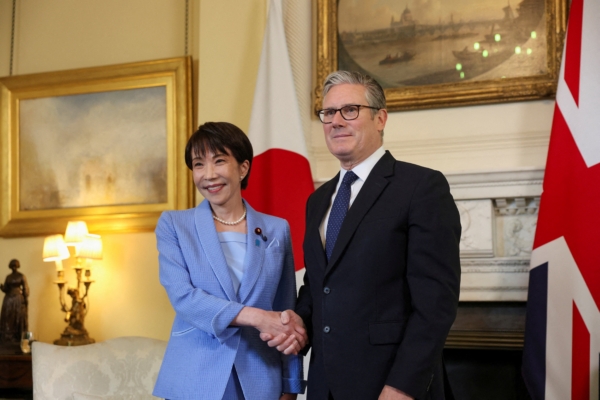
On June 14, British Prime Minister Keir Starmer met with visiting Japanese Prime Minister Sanae Takashi at 10 Downing Street in London. The two leaders announced the elevation of UK-Japan relations to a higher level of strategic partnership and signed multiple cooperation agreements covering investment, technology, economic security, and defense to further expand the cooperation between the two countries.
According to a statement released by the British Prime Minister’s Office, the two nations signed the UK-Japan Frontier Technology Partnership Agreement, which combines the UK’s strengths in research and software development with Japan’s capabilities in advanced manufacturing. They also issued the UK-Japan Joint Declaration on Economic Security Cooperation to enhance cooperation in critical minerals, supply chain resilience, and strategic industries.
As per the announcement from the British Prime Minister’s Office, Japanese companies are expected to invest around £18 billion (approximately $24.5 billion) in the UK over the next few years. This investment includes over £9 billion in infrastructure, financial services, and real estate, with an additional maximum of £9 billion dedicated to offshore wind energy development, expected to create tens of thousands of jobs.
Japanese companies participating in this investment include Mitsubishi Estate, Mitsui Fudosan, and Nomura Real Estate. The UK government stated that this investment will help promote economic growth and enhance the long-term competitiveness of the UK.
Starmer noted that the agreement signifies a “new era of cooperation” between the UK and Japan. Takashi emphasized that the UK is an “essential partner” for Japan.
Regarding economic security issues, the joint declaration expressed serious concerns about “economic coercion” and “arbitrary export restrictions,” particularly mentioning the supply issues related to critical minerals.
Although the document did not directly name China, according to the Japan Broadcasting Corporation (NHK), it is believed that the content aims to address China’s recent export control measures on critical minerals.
The declaration stated that both countries will strengthen cooperation with the Group of Seven (G7) and like-minded countries to promote the extraction, refining, processing, recycling, and strategic reserves of critical minerals to reduce the risks of supply chain disruption.
Both parties are also concerned about the continuing deterioration of the situation in the Middle East and its impact on the global economy. The declaration highlighted that the conflict in the Middle East has added pressure on the energy supply chain, and both countries will enhance coordination between oil-producing nations and consumer countries to maintain stability in the energy market.
Security and defense cooperation were also key points of discussion during the meeting. Takashi mentioned that security cooperation between Japan and the UK has continued to deepen in recent years, with the relationship reaching a level that could be termed a “quasi-alliance.”
Both sides agreed to establish a new bilateral high-level cooperation mechanism, the Defense Capability and Industrial Council, to strengthen institutionalized cooperation in the defense industry sector. Additionally, they reiterated their commitment to expedite the Global Combat Air Programme (GCAP), a joint development project involving Japan, the UK, and Italy to develop the next-generation fighter aircraft by 2035.
GCAP is considered one of the most crucial defense cooperation projects among the three countries in the coming decades. The project aims to deploy a new generation of manned fighter aircraft by 2035 to replace Japan’s F-2 fighter jets and some models in the UK’s active fleet.
Furthermore, the UK aviation engine manufacturer Rolls-Royce announced a collaboration with the UK National Nuclear Laboratory (UKNNL) and Japan Atomic Energy Agency (JAEA) to research and develop next-generation nuclear energy technology.
In addition to bilateral cooperation, the two leaders also exchanged views on issues such as the situation in the Middle East, the Russia-Ukraine conflict, stability in the Indo-Pacific region, global supply chain security, and free trade.
Takashi’s first stop in her European tour was the UK, and she is scheduled to proceed to France to attend the G7 summit. Both sides expressed their anticipation of meeting again at the G7 summit in Évian-les-Bains, France, to further advance the development of the UK-Japan strategic partnership.
In recent years, Japan and the UK have deepened their cooperation in security, trade, and technology fields. During the G7 summit held in Hiroshima in 2023, the two nations signed the Hiroshima Accord, agreeing to enhance cooperation in defense, security, economics, and technology.