
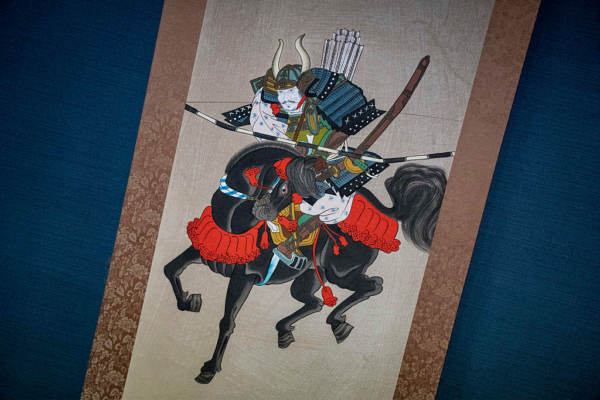
Japanese samurai are renowned for their adherence to Bushido, the way of the warrior, and their exceptional combat skills. In popular culture and museums, they are often depicted as male figures, but history also quietly leaves behind another presence – female samurai.
Professor Sean O’Reilly, a Japanese history researcher at Akita International University, stated that female samurai did indeed exist. This is because “samurai” actually represent a complete social class, and those born into this class are considered “samurai,” regardless of whether they participated in battles or received martial arts training.
He mentioned that female samurai also engaged in combat, although their actual frequency and importance in battles were not high. Women who participated in battles were sometimes referred to as “onna-musha,” meaning “female warrior.”
Even though the samurai class entered history in the 1870s, some traditions of female samurai training have been preserved to this day. Translator of Japanese martial arts documents, Eric Shahan, noted that the traditional martial arts school Yoshin School still maintains the tradition of practicing with a naginata while wearing a kimono, reflecting the need for women in the past to immediately wield weapons in emergency situations without time to change training attire.
In an article published in the journal “War in History” in 2001, Diana Wright, a former professor at the University of Washington, stated that more compelling evidence of female samurai participating in battles appeared before and after the abolition of the samurai class.
During the Boshin War from January 1868 to June 1869 in Japan, conflicts erupted between supporters of the Tokugawa shogunate and anti-shogunate forces attempting to return political power to the Emperor. Records show that in this battle, there were multiple instances of female samurai fighting on the shogunate side.
During the siege of Aizu Castle, a unit known as the “Joshigun” consisting of 20 to 30 female samurai went into battle. Among them, 22-year-old Nakano Takeko was considered the informal leader of the unit. The women only carried swords and naginatas, engaging the enemy forces equipped with rifles in the area near Yanagi Bridge. Takeko was recorded to have killed five to six enemies with her naginata before being fatally shot. The battle ultimately ended in failure, and the surviving members of the female unit retreated into the castle alongside male forces.
Some scholars believe that a mound in Numazu, Japan, may hold the remains of female samurai who died in battle. Approximately 105 skulls were found at the site, with about one-third believed to be female, dating back to the 16th century. Researchers speculate that these remains may belong to those who perished in battle or are connected to the Battle of Senbonhama. The findings were published in Japanese in the “Journal of Anthropology” in 1989.
Thomas Conlan, a medieval Japanese history professor at Princeton University, believes that the mound indicates the presence of female warriors who died in battle during the 16th century. However, Karl Friday, an Honorary Professor of History at the University of Georgia, cautions that interpreting the findings should be done carefully, as it is currently uncertain whether all the remains are from combatants, possibly also encompassing civilians.
Many Japanese legends recount the valor of female samurai in battle, with one of the most famous being Tomoe Gozen from the late 12th century Heian period. Legend has it that she served under Minamoto no Yoshinaka and fought in the Genpei War from 1180 to 1185.
According to the “Tale of the Heike,” it is written: “She (Tomoe Gozen) was a remarkably strong archer, and as a swordswoman she was a warrior worth a thousand, ready to confront a demon or a god, mounted or on foot.”
Another prominent female samurai who frequently appears in folklore is Ohōri Tsuruhime, estimated to have lived from 1526 to 1543. Historian Stephen Turnbull stated that after her father and brothers fell in battle defending against the warlord Ouchi Yoshitaka’s invasion of Oshima, she succeeded as the chief priestess of the Oyamazumi Shrine.
At just 16 years old, Tsuruhime led the resistance against the invaders. She claimed to have received divine protection during battle, often being likened to Joan of Arc. It is said that Tsuruhime’s armor is still preserved and displayed at the Oyamazumi Shrine.
These legendary female samurai serve as a testament to the overlooked but crucial role women played in Japan’s martial history.