
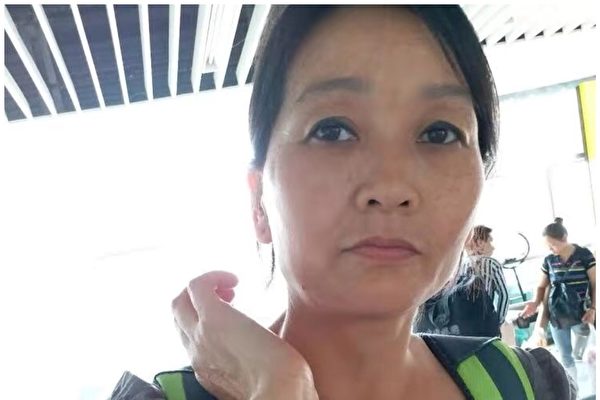
Sichuan and Chongqing human rights activist Wei Wenyuan has been detained by authorities over ten times, serving a total of seven years in prison following two convictions. Even after her release, she continues to be closely monitored by the authorities. Her friend and fellow activist He Jia revealed that Wei Wenyuan was subjected to mistreatment and even forced medication during her detention.
Wei Wenyuan first became involved in human rights activism after her house was forcibly demolished, eventually becoming a citizen journalist for the “June 4th Tianwang” website. She has long been advocating for marginalized rights groups and had been supporting Huang Qi’s mother Pu Wenqing and Li Huaiqing’s family. In September 2015, Wei Wenyuan was arrested and released after an extended detention of two and a half years. In June 2021, she was sentenced to another four years, and she was finally released on June 3, 2025.
He Jia told Epoch Times that for over a decade, the local government not only failed to provide Wei Wenyuan with compensation for her demolished house, but also threatened her parents and underage daughter. After her arrest in June 2021, she was initially held at the First Detention Center of Chongqing and later transferred to the Chongqing Women’s Prison. During her detention, she was frequently subjected to abuse such as being sprayed with pepper spray, solitary confinement, corporal punishment, and hunger for refusing to plead guilty.
“He served time in prison twice, detained more than ten times. Guards sprayed pepper spray at her and beat her inside the prison. It was so severe that she lost control of her bowels,” He Jia said.
The most painful experience for Wei Wenyuan was the forced medical examinations by prison guards on the pretext of her having high blood pressure, leading to pressure to take medication. He Jia mentioned that Wei Wenyuan’s normal blood pressure ranged from 120-130 mmHg. After taking the medications, she experienced abnormal reactions.
At one point, she was forced to take five different medications every day, causing her blood pressure to spike to 190 mmHg. Wei Wenyuan was afraid the medicine was poisoned, so the guards grabbed her neck and cheeks to force her to take it. “It must be poisonous, her feet started turning black,” He Jia said.
After being transferred to the Chongqing Women’s Prison, Wei Wenyuan continued to suffer similar abuses, which left her feeling frightened. Due to her refusal to plead guilty or cooperate, she was often punished with standing confinement and starvation. “After taking medication for so long, whether she had high blood pressure or not, she now has it. I don’t know the reason. Their intentions are unclear,” He Jia added.
Since Wei Wenyuan adamantly refused to take the medication, the prison guards instructed so-called “model prisoners” to secretly put a white powdery substance resembling noodles in her food. He Jia mentioned that Wei Wenyuan had described the substance as white, occasionally tasteless, and sometimes slightly bitter, “They would put those powdery noodles under the rice or vegetables, and after eating, her throat would feel uncomfortable.”
Upon her release at the end of 2025, Wei Wenyuan continued her human rights advocacy. In March 2026, during the National People’s Congress session in Beijing, she was once again detained but later released.
In 2026, Wei Wenyuan was honored with the 12th “Cao Shunli Human Rights Defender Memorial Award.”
(The interviewee’s name is a pseudonym)