
In the northern part of Phoenix, Arizona, as the construction of five million-dollar luxury homes in a development project nears completion, a water well with a flow rate of 15 gallons per minute has started to run dry.
Initially, Tanner Cook, the construction manager at Diamante Homes, took a traditional approach. He drilled multiple test wells on this five-acre desert lot, hoping to find a new water source, but each well turned up empty.
“We have to provide water for the families living here. That’s obviously essential for people’s livelihood,” Cook said, standing next to the original well.
When traditional drilling methods failed, Cook turned to an unconventional solution: he enlisted the help of a water dowser.
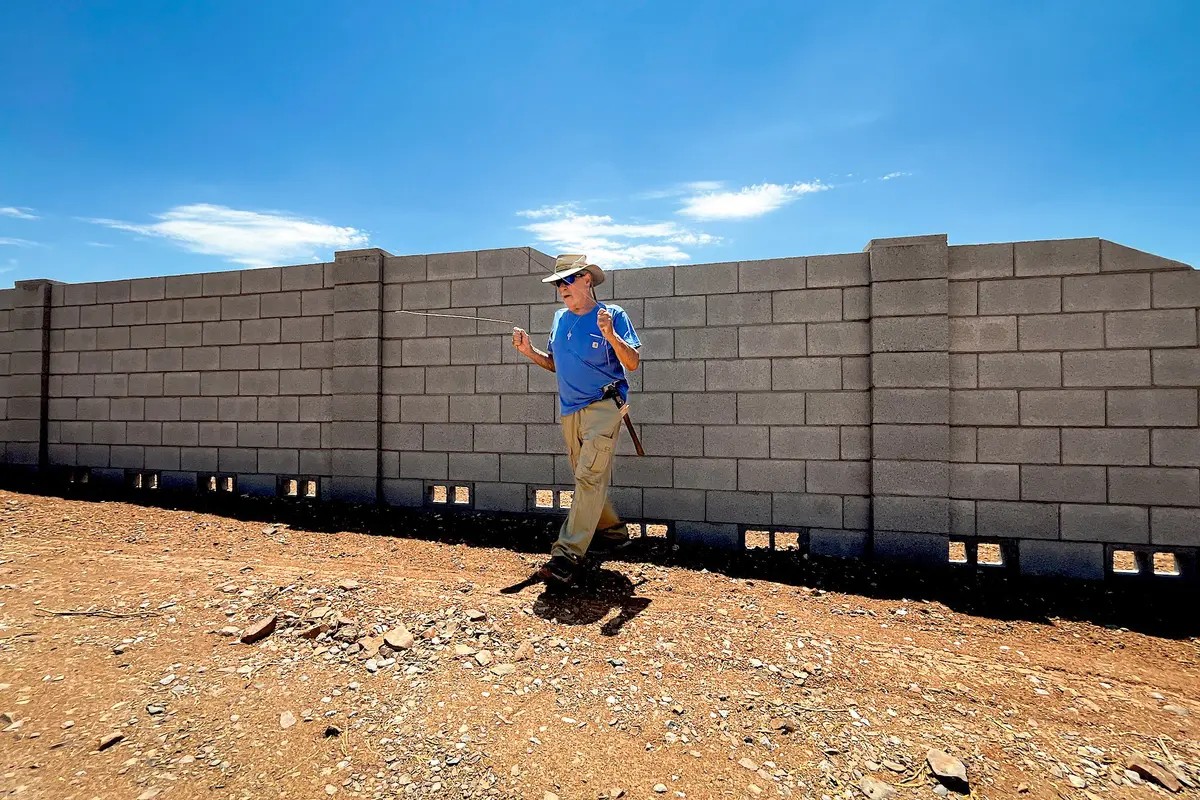
Professional water dowser Jack Coel, clad in a wide-brimmed hat, sunglasses, blue t-shirt, and khaki work pants, arrived in Phoenix from Fort Mohave under scorching temperatures. He carried a pair of L-shaped brass dowsing rods, three wooden stakes, a hammer, and blue tape to mark potential water points as he entered the nearing completion site.
“Accuracy. Objectivity. Water source,” he repeated almost like a chant as he walked around the construction site.
Coel kept the two brass rods parallel to his chest, pacing back and forth on the land until they intersected. He retraced his steps multiple times, counting with each step.
Then he stopped.
Coel held the two brass rods parallel in front of him, pacing back and forth until the rods crossed in his hands (a signal in dowsing indicating the presence of underground water). He walked back along the same path several times, counting his steps.
Then, he halted his steps.
He reported possible depths—100 feet, 200 feet, 300 feet—speaking each number while waiting for the brass rods to react.
At around 500 feet, the dowsing rods reacted.
Coel noted that while not ideal, it was a start.
He kneeled down, drove a wooden stake into the dry ground, and marked it with blue tape.
The search for a water source continued.
At the age of 79, Coel has been practicing dowsing for nearly 50 years, a ancient technique where practitioners use dowsing rods, forked branches or other tools they believe can locate underground water.
He mentioned that he has conducted over 14,000 searches, helping clients locate water sources worldwide.
Coel is not interested in a scientific explanation for dowsing. He only knows one thing—it works for him.
He believes this ability is a gift from God and states that almost anyone can learn this skill.
He often quotes a scripture from the Bible, “Seek and ye shall find.” (Matthew 7:7)
“Dowsing is not just for finding water sources, it can be used to find anything you desire. The method is the same, single-mindedly seeking,” Coel said.
Many people use dowsing to find lost items or answer simple “yes” or “no” questions.
Practitioners often interpret crossed dowsing rods as a positive answer and separated rods as a negative response.
However, Coel believes this practice is not about prediction or divination. He says it’s about the dowser themselves.
In the 1960s, while serving in the United States Air Force in Germany as a cable technician, Coel was introduced to dowsing. A local introduced him to the technique, and he soon began using dowsing rods to locate underground cables.
“We found it quickly,” Coel spoke of his dowsing team he trained and managed.
After his service in Germany, Coel was transferred to Patrick Air Force Base in Florida, where he worked in communication systems related to early space programs.
“The headquarters were at Cape Kennedy,” he said. “I was involved in all the splicing and testing of new audio-video cables for the (first) moon mission.”
“You had to be focused. I was pretty focused to begin with, so this method worked especially well for me.”
During his time in the Air Force, his team members often bent metal coat hangers into L shapes for dowsing. Over the years, Coel has continued to use the same two brass rods.
“People use forked sticks. They use all sorts of things,” he said. “But not all things work the same.”
Coel mentioned he has even dowsed using just his hands. If he was at the location of his target, he could feel his palms warm up.
“I can teach anyone dowsing,” he said. “Some people take longer than others. This isn’t some high theory.”
After retiring from the Air Force in 1970, Coel worked for several telephone companies and later developed dowsing into a business for finding water sources. He plans to continue in this profession until he “drops.”
As a Christian and a full-time water dowser, Coel believes he is called to do this work to help others.
He has developed a method to identify drill targets, estimate depths, and assess potential water quantity and quality. He prefers to discuss with drillers early in the project to ensure everyone is moving in the right direction.
His clients include the U.S. Department of the Interior and its Bureau of Land Management, California, as well as numerous cities and towns.
Some drillers also use water dowsing to locate underground water sources, but this method remains controversial and has not received widespread acceptance.
He mentioned he has assisted private landowners, farmers, ranchers, and developers in finding water sources in the U.S. and around the world.
Coel noted that his celebrity clients include actor Ewan McGregor, musician Peter Wolf, and country singer Merle Haggard.
He also appeared as a guest expert on an episode of Discovery’s “Homestead Rescue” first season, titled “Nevada Thirst.”
Coel mentioned he can rapidly survey large areas—a 100-acre plot can be completed in just two hours.
“If it’s a large area, I’ll pick the best north-south line,” he said. “I have dowsed over 300 wells, all producing over 1,000 gallons per minute. Half of them even exceeded 3,000 gallons per minute.”
One of Coel’s most remarkable discoveries was a well in 2006 on Bureau of Land Management land in Nevada with a flow rate of 8,000 gallons per minute.
Local irrigation management company Aqua Trac was seeking a reliable water source to support wells with a flow rate of 1,000 gallons per minute across 15 wells.
After investing hundreds of millions in hydrological research, satellite imagery, and ground-penetrating radar exploration, only one feasible water source was found.
“Their scientific research didn’t solve their problem,” Coel said. “Then, they contacted me.”
Coel stood on the back of an open-top Jeep, having crossed 1 million acres of rugged terrain within 24 hours, and dowsed 17 underground wells.
The first well had a flow rate of around 8,000 gallons per minute, with three wells ultimately achieving a total flow rate of 20,000 gallons per minute.
“After all the droughts— including the worst in over 800 years—I know what a reliable water source is. So, I am looking for reliable water sources now,” Coel said.
Dowsing, also known as water dowsing, has a history of thousands of years and has been used to find water sources, mineral deposits, lost items, and even human remains.
However, this technique remains unregulated, with no public database tracking the actual effectiveness or success rate of practitioners.
At least five practitioners operate in Arizona. For example, Universal Drilling combines traditional well-finding methods with dowsing.
However, many scientists have questioned this practice, stating there is no measurable evidence showing that dowsing rods or other tools can detect underground water.
The U.S. Geological Survey notes that dowsers typically operate in already known areas with underground water, so successful water discoveries may not be as miraculous as they appear.
The Geological Survey states on its website: “Because drilling and developing a well often costs more than a thousand dollars, homeowners naturally don’t want to risk drilling dry wells, so they turn to water dowsers for advice.”
“In areas with ample rainfall and suitable geological conditions, almost any drilling can yield water.”
The FBI warns that unreliable dowsing methods not only waste resources but also give false hope to people.
However, Coel stresses that experience and actual results are crucial.
“I know what to aim for,” he said. “I understand the performance of this equipment.”
Cook states that the key issue is not whether dowsing can be explained scientifically, but whether people can find water sources in arid regions like northern Phoenix.
His company had previously hired Coel—and successfully found a water source.
“If I didn’t think we had some problems, I wouldn’t have called Jack,” Cook said. “We drilled several wells—but the results were unsatisfactory.”
“The only thing worse than not finding a water source is finding insufficient water,” Coel, on the second location he identified on this five-acre site near the future microchip factory site, with the water source underground at around 396 feet, with an error of about 100 feet.
The estimated flow rate from this water source is the highest so far, with a potential flow rate of about 27 gallons per minute.
“Fantastic!” Cook exclaimed, seeing it as an answer to his prayers.