
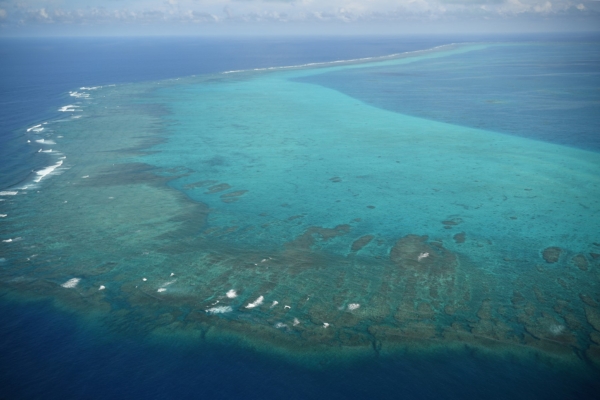
Concerns are growing among the international community as the Chinese Communist Party (CCP) expands its presence in the disputed waters of the South China Sea. US intelligence agencies and the Philippine military are closely monitoring the CCP’s activities at Scarborough Shoal. This move by the CCP is feared to further escalate regional tensions and once again test Washington’s defense commitments to the Philippines, a long-standing treaty ally.
According to a US anonymous official familiar with relevant intelligence, analysts are carefully examining a series of recent maritime activities conducted by the CCP near Scarborough Shoal. Officials stated that the CCP has installed what Beijing refers to as a “scientific structure” at the center of the disputed reef’s reef table, prompting a furious response from the Philippines.
The National Task Force for the West Philippine Sea, a Philippine government agency, confirmed in a statement released on Tuesday that aerial surveillance and monitoring by the Philippine Coast Guard discovered a 6 by 6-meter floating platform operating within Scarborough Shoal. The platform is equipped with devices resembling antennas, and recent images captured Chinese personnel operating above the platform.
Jay Tarriela, a spokesperson for the Philippine Coast Guard, noted that the platform was initially spotted on May 25 at the southeast entrance to the lagoon at Scarborough Shoal. By May 31, monitoring indicated that the platform had been moved to the central part of the lagoon. The military highly suspects that the platform was deployed by two CCP marine scientific research vessels previously active in the area.
The US has engaged in discussions with the CCP regarding the structure. Officials stated that while the CCP’s military claims the structure is not for military purposes, CCP officials have not completely denied the possibility that some components inside the structure may be used by the military.
Chinese embassy spokesperson Liu Pengyu responded to CBS News, stating that Scarborough Shoal has always been Chinese territory and their activities there are legitimate. He also urged the US to stop “sowing discord.”
Known as Bajo de Masinloc in the Philippines, Scarborough Shoal is located within the Philippines’ exclusive economic zone in the South China Sea. However, Beijing seized effective control of the shoal during a tense standoff in 2012 and has since maintained a regular deployment and patrol around Scarborough Shoal.
This development has garnered high attention from US intelligence analysts and military planners who fear a repeat of history such as the gradual militarization and transformation of Mischief Reef by the CCP in 1995. Beijing has transformed several reefs in the Spratly Islands into artificial islands equipped with defense infrastructure, airports, radar systems, and missile bases over the past decade.
Analysis from geopolitical commentary media Asian Times highlights that the CCP has completed significant military buildup in the South China Sea over the past 20 years, establishing large bases on Woody Island, Subi Reef, Fiery Cross Reef, and Mischief Reef. However, these bases have left a monitoring and defense gap near Luzon, the core population center of the Philippines.
If the CCP successfully controls Scarborough Shoal and establishes larger semi-permanent or permanent facilities, it could completely fill this strategic gap, achieving comprehensive sea and air monitoring across the entire South China Sea.
Former Commander of the US Indo-Pacific Command Admiral John Aquilino previously warned in an interview with the Associated Press, stating, “Over the past 20 years, we have seen the People’s Republic of China (PRC) conducting its largest military build-up since the end of World War II. This weaponization and militarization are destabilizing the region.”
The Philippine Department of Foreign Affairs has lodged multiple diplomatic protests and formal protests with Beijing. Deputy Commissioner of the National Maritime Commission, Alexander Lopez, bluntly stated the structure is “unauthorized and illegal” and called on China to immediately remove it. Chief of Staff of the Armed Forces of the Philippines, Romeo Brawner, emphasized that the Philippines is increasing patrols with military aircraft and vessels, and “will not allow the CCP to construct permanent facilities on Scarborough Shoal or turn it into an artificial island.”
This conflict has once again brought attention to the military alliance between the US and the Philippines. Their defense commitments stem from the 1951 Mutual Defense Treaty (MDT). With recent CCP military expansion in the South China Sea and frequent clashes with the Philippine Coast Guard, Washington has repeatedly clarified and reiterated the “red line” applicability of the treaty.
The US State Department and Department of Defense explicitly stated that the MDT’s mutual defense commitment covers armed forces, public vessels (including Coast Guard vessels), and aircraft of the Philippines in any location in the South China Sea. This implies that if the CCP launches armed attacks against Philippine personnel or vessels in disputed areas like Scarborough Shoal, it could directly trigger a US military intervention obligation.
This is not the first time various parties have locked horns at Scarborough Shoal. Last year, Beijing announced plans to establish a “national-level nature reserve” in the region, which was strongly condemned by US Secretary of State Marco Rubio.
Rubio stated in a declaration, “Beijing’s declaration of Scarborough Shoal as a nature reserve is another coercive attempt to advance its broad territorial and maritime claims in the South China Sea, including preventing Filipino fishermen from accessing these traditional fishing grounds. Chinese actions at Scarborough Shoal continue to undermine regional stability.”
Although the Permanent Court of Arbitration in The Hague ruled in 2016 that the extensive sovereignty claims by the CCP in the South China Sea have no legal basis, Beijing has refused to accept this. According to CBS News, the US military formulated plans last year to conduct “shows of force” in response to CCP aggression near Scarborough Shoal, aiming to signal to Beijing Washington’s intent to push back against its expanding presence and defend the Philippines’ sovereignty and long-established fishing rights.