
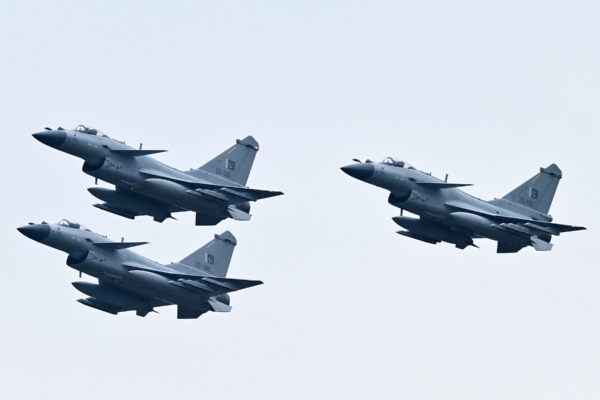
Analysis suggests that Beijing has never been a major player in military weapons sales. Due to a lack of necessary platforms for testing and improving equipment in real combat scenarios, as well as difficulties in establishing close cooperation with other countries, China’s foreign military sales have been stagnant.
A column published by Bloomberg on Monday, June 8, pointed out that despite attractive commercial strategies such as advanced technology, low prices, and unconditional deliveries, Beijing has struggled to expand beyond its existing customer base into mainstream markets.
According to data from the Stockholm International Peace Research Institute (SIPRI), global defense spending has been increasing for the 11th consecutive year by 2025. Concurrently, the global arms industry sales have also reached new highs. China ranks fifth among global arms exporters, but its inability to establish closer cooperation with other countries hinders its ability to capture a larger share of the global arms market.
Moreover, most of China’s weapons have not been tested in modern warfare scenarios. Beijing’s share in weapons exports has seen minimal growth over the past decade, with SIPRI data showing little change in China’s global arms transfer share.
Between 2021 and 2025, China accounted for around 5.6% of global arms transfers, slightly higher than the 5.5% share in the previous five years (2016-2020). During the same period, the US saw an increase from 36% to 42% in global arms transfer share, France rose from 8.8% to 9.8%, and Germany increased from 5.4% to 5.7%. The only exception was Russia, whose global arms sales declined from 21% to 5.7% due to the Ukraine conflict.
Bloomberg’s column highlighted that Beijing’s ambitions in arms exports largely depend on one country – Pakistan, known as a close ally. Data shows that the moderate growth in Chinese arms exports over the past five years can be attributed to the increasing demand from Pakistan, which saw a 66% rise in arms imports during the same period.
On April 22, 2025, Pakistan engaged in a four-day conflict with India, during which a Chinese-made J-10CE fighter jet reportedly shot down at least one Indian Rafale fighter jet. This incident drew widespread attention to China’s arms production capabilities.
The interception of enemy aircraft by the J-10CE fighter jet marked a significant moment, as it was the first reported shootdown involving this aircraft, as well as the first time a Rafale fighter jet was downed. China acknowledged providing ground support to Pakistan during the conflict in May 2026, raising questions about potential violations of international norms.
According to SIPRI data, Pakistan relied on China for 80% of its arms imports between 2021 and 2025, up from 73% in the previous five years. These acquisitions include advanced fighter jets, missiles, radars, and air defense systems primarily used in conflict or friction with India.
Twenty years ago, the US and China shared a similar market share in Pakistan’s arms imports. However, over a decade ago when Pakistan was accused of supporting Taliban militants in Afghanistan, China capitalized on the deteriorating US-Pakistan relations to fill the gap.
Apart from Pakistan, most of China’s arms exports are directed towards South Asian countries. Data indicates that from 2021 to 2025, 61% of Chinese arms were sold to Pakistan, followed by Serbia (6.8%), Thailand (4.7%), Algeria (4.1%), and Vietnam (3.5%).
While China has numerous other clients, their purchase volumes are relatively small. Only Saudi Arabia ranks among the top 20 arms importers from China, but the weapons imported by Saudi Arabia account for only 1% of China’s total exports. Saudi Arabia relies more on its military alliance with the US for security.
Compared to other major arms exporters, China’s growth in foreign weapons sales has been slower. Chinese arms exports increased by only 11% between 2021 and 2025, while the top four global exporters – the US, France, Germany, and Russia – experienced growth, albeit at varying rates or declines, during the same period.
In conclusion, while China has potential as an arms exporter, its weapon sales capabilities still lag behind its dominance in industries like automobiles, ships, and batteries. Additionally, the lack of platforms for testing and improving equipment in real combat environments remains a significant constraint on China’s foreign military sales.