
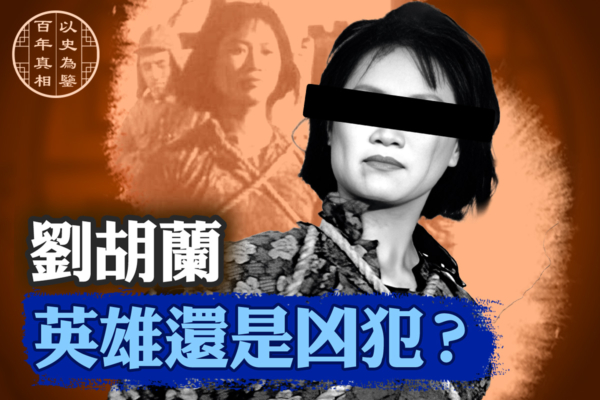
Hello viewers, welcome to “Century Truths”.
One name that has been well-known among friends in mainland China since childhood is Liu Hulan.
According to the Chinese Communist Party (CCP) propaganda, she sacrificed herself for the Party at the age of 15, and Mao Zedong personally inscribed: “Great in life, glorious in death.”
In accordance with the official version, she was captured by the National Army and landlords’ militias, showed no fear in the face of life and death, and even shouted, “If you fear death, do not join the Communist Party.” She was ultimately executed by a saber, becoming a model young martyr for the CCP.
For decades, her story has been written in textbooks, made into movies, and she even has a dedicated memorial hall.
But is this history really as “glorious” as the CCP portrays? How did Liu Hulan really die? Who killed her? And why was she killed?
In today’s episode, we will uncover the truth behind this “red hero” that has been hidden for decades.
Let’s start with Liu Hulan’s background.
Liu Hulan, originally named Liu Fulan, was born on October 8, 1932, in Yunzhouxi Village, Daxiang Township, Wenshui County, Shanxi Province, into a simple peasant family. Her mother, Wang Shan’ni, passed away early, and her father, Liu Jingqian, later remarried to Hu Wenshui. This stepmother not only supported Liu Hulan’s participation in the CCP’s underground activities but also proactively changed the character “Fulan” in her name to “Hulan,” thus calling her Liu Hulan.
Liu Hulan attended primary school at the age of 8, joined the Children’s League at 10, and served tasks such as guarding, scouting, and gathering intelligence for the Eighth Route Army. In October 1945, after Japan’s surrender, she participated in a one-month “Women Cadre Training Class” organized by the Communist Party’s Wenshui County Committee, carrying on her back her father’s wishes and becoming the secretary of the Village Women’s Salvation Association at just under 13 years old.
She showed great enthusiasm in the village, and within a year, in May 1946, she was transferred to the Fifth District of the CCP to work as a women’s activist. In June, she was absorbed as a CCP probationary member, and the party organization sent her back to Yunzhouxi Village to lead the local land reform movement.
In the fall of 1946, the civil war between the CCP and the Nationalists erupted. The National Army under Yan Xishan’s forces regained control of Wenshui County. The CCP county committee officials evacuated urgently, leaving only a few militia members behind. Liu Hulan received evacuation orders but decided to stay, believing she could better conceal herself due to her young age and continue secretly mobilizing the masses in the village to resist the National Army.
However, a detail decades later shattered this narrative.
On the 60th anniversary of Liu Hulan’s death on January 12, 2007, a professor from a university in Beijing published an article on a blog titled “Trembling Villagers Beat Liu Hulan to Death under Duress.”
The article mentioned that China Education Television’s program “Turning the Calendar” once sent a production team to Liu Hulan’s hometown – Yunzhouxi Village, Wenshui County, Shanxi Province. The elderly residents recalled that Liu Hulan was not executed by the Nationalist Revolutionary Army but that they were forced by several villagers beating them with gun butts to beat Liu Hulan to death.
Out of fear and trembling, the villagers killed the young girl they had watched grow up. Some suffered mental breakdowns afterward. These details completely differ from the official story of Liu Hulan.
The article also revealed that the production team found the truth too shocking and decided to temporarily remain silent for fear that the audience would find it hard to accept, planning to reveal it in the future.
A few days later, on January 15, 2007, Shanghai’s “Xinmin Evening News” published the revelations by the associate professor and cited Zhang Yaowu, the village party secretary at Yunzhouxi Village, confirming that Liu Hulan did indeed willingly approach the saber while the villagers were coerced at gunpoint.
This disclosure immediately stirred up controversy. Subsequently, official media quickly “debunked” it, claiming that Zhang Yaowu had never spoken these words and brought in several so-called “eyewitnesses” to retell the official version.
Is it necessary for a program team originally designed to “promote heroes of the Party” and that associate professor to lie?
At the same time, another critical question emerged: why did Yan Xishan’s troops execute Liu Hulan?
The CCP textbooks have never provided a straightforward explanation, and most sources remain ambiguous, emphasizing her “Communist Party status” while avoiding the real reasons for her execution.
Writer Feng Xuerong pointed out in an article titled “Why Did Yan Xishan Kill Liu Hulan” that there is no senseless killing in the world, and there must be a motive behind every execution.
The truth lies in some public records: Liu Hulan participated in the execution of the village chief, Shi Peihuai.
Feng Xuerong cited several examples, such as in the “Shanxi Historical Records: Before and After the Death of the Maiden Liu Hulan,” compiled by the Shanxi Provincial CPPCC. It stated: “… Yunzhouxi Village’s pseudo-village chief, Shi Peihuai, sent grain and intelligence to the bandit Yan, was the arch-enemy of the people. On December 21, 1946, she was executed with the help of Liu Hulan, District Chief Chen Dezhao, and militia members. The news spread; the head of the 215th Regiment, 72nd Division of Yan bandits stationed in Daxiang Town, was outraged and decided to retaliate. So Liu Hulan and seven martyrs were tragically killed.”
In the 10th issue of 2011 of “Literary and Historical Essentials” hosted by the Hebei Political Consultative Conference, an article by Shi Yun entitled “The Killer Who Killed Liu Hulan Paying the Price” also detailed the same content, stating: “… On December 21, 1946, Liu Hulan actively cooperated with the militia to execute the reactionary village chief, Shi Peihuai. Outraged, the Kuomintang troops led by Yan Xishan decided to act in retaliation.”
Although these accounts are presented with a bias labeling Shi Peihuai as the “enemy of the people” and “reactionary village chief,” the underlying facts reveal that Liu Hulan’s involvement in Shi Peihuai’s death led to her execution by Yan Xishan’s forces. There was a motive behind it, not without reason.
Should Shi Peihuai have been executed?
The crimes attributed to Shi Peihuai by the CCP were purportedly “providing grain and intelligence to Yan Xishan.” But were these accusations valid?
Feng Xuerong analyzed that the so-called “providing grain and intelligence” was simply normal tax collection work. As a village chief, it was entirely legitimate and regular to collect taxes for the government during wartime or peacetime, an unquestionable duty. Shi Peihuai did nothing wrong in this regard.
Furthermore, at the time of Shi Peihuai’s death in 1946, mainland China was still under the jurisdiction of the Republic of China government. Yan Xishan was the Shanxi Provincial Governor of the Nationalist government and the equivalent of the current Shanxi Provincial Governor. Shi Peihuai, as a village chief, loyal to the legitimate government, acted reasonably. It was the CCP that resorted to all means to subvert the legitimate government at that time.
Hence, Shi Peihuai was not as guilty as the CCP claimed.
Feng Xuerong also emphasized the questionable act of a 14-year-old rural girl participating in the execution of a lawful village chief merely because he was loyal to the Nationalist government. Was such behavior justifiable?
The event of Liu Hulan participating in the execution of the village chief quickly caused a stir in the Shanxi Provincial Nationalist Government. On January 8, 1947, Governor Yan Xishan ordered the launch of an “eradication of the Communists” operation, led by Lieutenant Colonel Hou Yuyin, surrounding Yunzhouxi Village with the 215th Regiment of the 72nd Division of the National Revolutionary Army.
That day, the Nationalist troops apprehended six individuals involved, including militiamen, cadre family members, and former Eighth Route Army veterans.
By January 12, the Nationalist troops gathered all villagers in front of the Guanyin Temple in the south of the village, where they singled out Liu Hulan. The platoon leader advised her, “As long as you say you won’t assist the Communist Party in the future, you can live today.” Liu Hulan replied, “That’s impossible.” This led to the final scene of Liu’s execution.
According to historical records, Liu Hulan was reported by someone from within—Shi Xiyu, a former CCP Agricultural Association secretary. He had previously interceded for a wealthy landowner in the village, Duann Er, but was criticized by Liu Hulan. Subsequently, he was dismissed from his position and expelled from the Party.
When the Nationalist Army retook control of Wenshui County, a group of revenge squads previously suppressed by the CCP armed forces came to Yunzhouxi Village to investigate. Shi Xiyu reported Liu Hulan, leading to her capture and execution by the Nationalist Army.
Therefore, the truth behind the Liu Hulan case reveals that an underage rural girl was brainwashed by CCP violence and hatred into partaking in the murder of the village chief and was ultimately executed by the Nationalist government.
Liu Hulan committed a murder; she preferred to die for the CCP rather than repent. Was she a female hero? Or a sacrificial pawn of CCP violence and revolution?
Columnist Jiutianjian of Epoch Times lamented in an article titled “Party Property Heroes Are Not Family Property Heroes”: Liu Hulan would not have died if not for being embroiled in CCP class struggle and seizing power. If she had been a gentle and virtuous girl, she would have surely lived a full life surrounded by descendants.
Over 70 years have passed, and the CCP continues to indoctrinate generation after generation of children with the concept of “loyalty to the party, fearlessness of death” using Liu Hulan’s story.
But when we strip away that layer of “glorious righteousness,” what we truly see is a distorted history, a tragedy deliberately fabricated by people. Is such a “party property hero” truly deserving of our remembrance?
That concludes today’s program; thank you for watching. If you enjoyed “Century Truths,” don’t forget to like, subscribe, and share. See you in the next episode!
Production Team of “Century Truths”