
On June 17, the “Wall Street Journal” revealed in an article that in 2025, the Chinese Communist Party’s disciplinary system punished nearly 1 million officials, which is more than five times the number when Xi Jinping took office. The report pointed out that the focus of the CCP’s anti-corruption campaign has shifted from previous corruption and bribery issues to violations such as illegal borrowing for achievement projects, inadequate implementation of central policies, lack of political loyalty, and even belief in geomancy, fortune-telling, and seeking guidance from spiritual masters being listed as offenses. Experts believe that seeking spiritual guidance within the system is a common phenomenon, and using it as a basis for conviction is just a way of political purification, while also aiming to enforce party members’ belief solely in the Party Central Committee.
The “Wall Street Journal” analyzed reports from the CCP’s Central Disciplinary Commission between 2013 and May of this year, involving sanctions against over 940 officials who had fallen from grace. Over 160, or more than one-sixth of these officials, were found to have engaged in feudal superstitious activities, including worshiping deities, fortune-telling, consulting “masters” or spiritual practitioners. There were cases where local officials, based on advice from geomancers, made multiple changes to the location of government squares and fountains, leading to investigations.
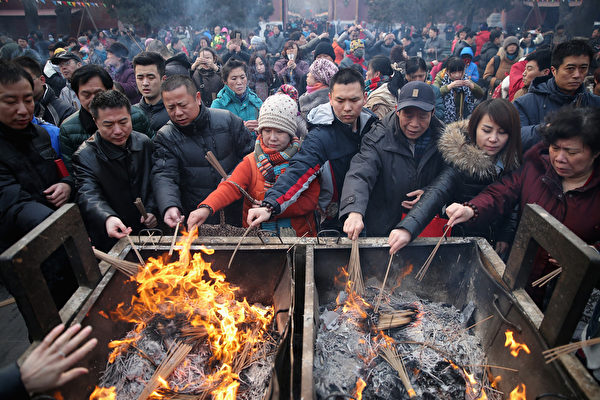
However, CCP leader Xi Jinping himself has been frequently seen visiting temples, such as his visits to Daxi’en Temple in Xi’an in May 2015, Jokhang Temple in Lhasa, Tibet in 2021, Puning Temple in Chengde, Hebei in 2021, Hongjue Temple in Xining, Qinghai in 2024, and Baima Temple in Luoyang, Henan in May 2025, the authorities claim these visits were for studying historical culture.
Veteran media personality Li Su discussed on NTD Television’s program “News Analysis” that throughout Chinese history, various dynasties and imperial courts have practiced faith in religions, predominantly Buddhism, whether Tibetan or Han Buddhism. It is known that high-ranking CCP officials and their families secretly practice Buddhism. While these leaders dare not openly worship, their visits to temples under the guise of research or inspection, such as those visited by Xi Jinping, are all Buddhist temples. This at least demonstrates that they do not shy away from Buddhism if not practicing it.
Li Su pointed out that openly, the CCP claims atheism, requiring party members to only believe in communism. In reality, the so-called belief in communism, lacking sufficient understanding even after reading Marxist-Leninist literature, becomes loyalty to the CCP and the Party Central Committee. Party members must believe in the party and its central leadership for absolute control.
Commentator Cai Shunkun, on NTD Television’s program “Current Affairs Perspective,” also noted that a significant number of individuals within the system engage in seeking blessings from deities. Personal promotion is often not based on merit but connections, reliance on influential figures, and alignment with political directives, failure to do so leading to potential trouble. Hence, fear lingers among CCP officials, resorting to seeking guidance through practices like geomancy and fortune-telling, a prevalent phenomenon.
Cai Shunkun analyzed that this behavior stems from various factors showcasing the lack of security among CCP officials, many accumulating wealth and constantly fearing exposure. With this fear unresolved, resorting to prayers becomes a common coping mechanism and a regular occurrence within the CCP’s circles.
Many question how Xi Jinping’s anti-corruption campaign targets officials seeking blessings. CCP officials using substantial amounts for prayers and worship contradict the party’s atheistic stance, labeling religious practices as feudal superstitions. However, there is no precedent for convicting individuals on these grounds. Cai Shunkun explained that when Xi Jinping assumed office, the purge under the guise of fighting corruption primarily targeted officials from previous administrations led by Jiang Zemin and Hu Jintao. Upon dealing with these key officials, turning to seeking blessings or critiquing the central leadership, including Xi Jinping, became grounds for punishment.
Cai Shunkun elaborated that criticizing the central leadership, especially privately, regardless of someone reporting the act or surveillance detecting it, constitutes a significant offense. In recent years, political loyalty is no longer about absolute loyalty but includes stifling private discussions concerning Xi Jinping or owning certain political books sourced from Hong Kong, leading to incrimination.
While there have been a limited number of convictions based on seeking blessings and prayers, it serves as a means to incriminate individuals lacking substantial evidence in corruption. Consequently, accusing officials of partaking in such practices violates the CCP’s proclaimed principles and beliefs.
Reference video: “News Analysis – Xi Jinping’s Frequent Visits to Major Temples While Cracking Down on Officials Seeking Blessings” – 160 Fallen CCP Officials Sentenced for Altering Feng Shui and Fortune-telling.