
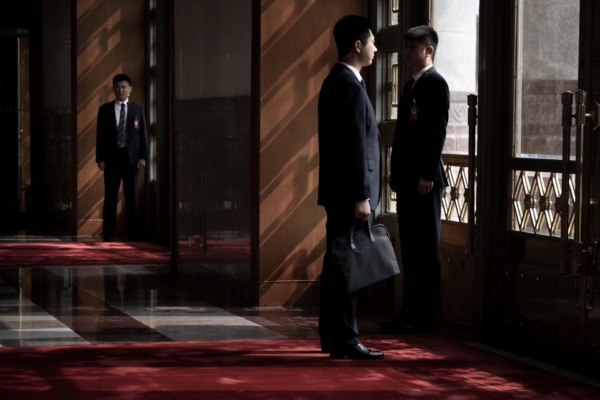
Amid the ongoing stagnation of the Chinese economy, internal power struggles within the top echelons of the Chinese Communist Party have intensified, making the political situation sensitive. Yesterday (June 15) marked the 73rd birthday of the CCP leader Xi Jinping. The National Party Building Work Symposium of the CCP was held in Beijing yesterday for the first time, introducing the so-called “Xi Jinping Party Building Thought.” Xi’s ideologue, Cai Qi, the chief ideologist, called on the entire party to “read the original works, study the original texts, understand the principles,” to uphold Xi Jinping. Experts suggest that this move signifies Xi’s authorities bidding farewell to reforms and embracing a return to the era of the Cultural Revolution. However, the new movement pushed by Cai Qi, ostensibly aimed at consolidating Xi’s power, has yielded contradictory outcomes.
According to reports from official media, Cai Qi, a member of the CCP Politburo Standing Committee and the Secretary of the Central Secretariat, attended the National Party Building Work Symposium yesterday and delivered a speech, while Li Xi, a member of the Political Bureau of the CCP Central Committee and Secretary of the Central Commission for Discipline Inspection, also participated in the meeting. The conference officially introduced the concept of the “Xi Jinping Party Building Thought.”
Chinese affairs expert based in the US, Chen Pokong, told The Epoch Times that the so-called Party Building Thought put forth by the authorities consists of mere slogans, echoing phrases like comprehensive and strict governance over the Party, emphasizing the Party’s leadership in all matters, merely reiterating Mao Zedong’s words. Or stressing statements like, “If a party becomes weak, disintegrated, or collapsed, what significance does economic development hold?” In essence, this marks Xi Jinping’s administration renouncing the era of reform initiated after Deng Xiaoping, Hu Yaobang, and Zhao Ziyang, and halting under Hu Jintao and Wen Jiabao.
This year marks the 60th anniversary of the initiation of the Chinese Communist Party’s “Cultural Revolution.”
Chen Pokong observed that during the era of reform, a departure from the Cultural Revolution, the Mao Zedong era, and revolutionary fervor was sought, attempting to transform a revolutionary party into a governing party. This transformation remains incomplete, as Xi Jinping has comprehensively veered back to the Maoist and Cultural Revolution era, although not explicitly announced. The formal introduction of Xi’s Party Building Thought effectively marks the demise of the reform and opening-up era.
“His Party Building Thought aims to return to the principle of the Party leading everything,” remarked Chen Pokong.
Previously, various so-called ideological thoughts of Xi, such as economic, legal, cultural, ecological civilization, and military ideologies, have been introduced, becoming mocking stock on the internet.
This time, the authorities tout Xi’s Party Building Thought as “making significant original contributions to the development of Marxist Party-building theories.”
Chen Pokong pointed out that Marxism had faded away during the era of actual reform and opening-up. However, during Xi Jinping’s era, Wang Huning catered to Xi’s preferences, providing him with a linguistic facade, suggesting that Xi Jinping is a contemporary Marxist. Thus, the flag of Marxism-Leninism has been hoisted once again. This paradoxical scenario is quite peculiar.
Chen Pokong mentioned that the Soviet Union and Eastern Europe had abandoned Marxism-Leninism, while in North Korea, starting from Kim Jong-il, the abandonment of Marxism-Leninism began. The Kim family prioritized consolidating their hereditary rule. Xi Jinping revives the ghosts of the old era on the stage of the new era. However, according to “The Communist Manifesto,” communists are supposed to abolish private ownership, but the CCP now embraces the largest form of private ownership. The higher the official’s rank, the greater their wealth. The privileged families monopolize China’s economic lifeline. While they claim to uphold socialist, communist, and Marxist ideologies, in reality, they are wolves in sheep’s clothing.
Chen Pokong believes that Xi himself lacks substance, and the entire Xi ideological system is Wang Huning’s creation. Among all the alleged theories put forward by CCP leaders, Xi Jinping’s ideals are the most vacuous. Xi’s ideology serves as a framework into which any content can be fitted, likely a pit dug by Wang Huning for him. If Xi Jinping falls from power in the future, the absurdity of this Xi ideology will become apparent.
An article in Hong Kong’s “Ming Pao” noted that yesterday coincided with Xi’s birthday, and there is a custom within the CCP leadership of not celebrating birthdays. Foreign leaders usually convey birthday wishes to Chinese leaders, but official media remained silent. Nevertheless, CCTV released a 6-minute-20-second political video titled “Communist Party Member Xi Jinping” yesterday, which was heavily promoted across major platforms, serving as a subtle form of birthday celebration. The video emphasized that Xi’s “primary identity is a Communist Party member, and his primary duty is to work for the Party.”
Chen Pokong recounted Mao Zedong’s instruction to Xi’s father, stating “the Party’s interests are paramount,” epitomizing the Party’s primacy. Therefore, Xi Jinping also places the Party’s interests first.
Yesterday, the Party media specifically promoted Xi Jinping as working for the Party. Chen Pokong explained, “He is not working for the country, nor for the people, but explicitly working for the Party. By leveraging the Party machinery, he strengthens his own power while signifying that his power is dedicated to serving the Party. This is a message to all Party members and officials, aimed at preserving their vested interests.”
Cai Qi, during yesterday’s meeting, stressed that Xi Jinping’s Party Building Thought should be a crucial political task for the entire party in the current and forthcoming periods. It calls for organizing and promoting members and cadres to study the original works, understand the principles, and resolutely adhere to the “two safeguards” (safeguarding Xi’s core position and safeguarding the authority of the Party Central Committee).
An article in Hong Kong’s “Sing Tao Daily” expressed the view that the National Party Building Work Symposium was convened yesterday to strengthen ideological and political unity within the Party, marking the formal start of preparations for the personnel arrangements for the 21st National Congress of the CCP in 2027.
Chen Pokong suggested that this move is likely part of the groundwork for Xi Jinping’s re-election at the 21st National Congress, heralding a new round of campaigns. It implies that through anti-corruption measures, Xi Jinping seeks to supplant power struggles, using selective anti-corruption efforts in place of power plays.
“It is a veiled message that Xi Jinping wields power, and you have no choice but to learn and comply with his Party Building Thought. Whether it is hollow or has substance, no one knows for sure. This is a political assignment,” he stated, emphasizing that people are constantly reminded and ingrained to perceive Xi Jinping’s leadership as a given, establishing him as the natural leader for life.
Commentator Li Linyi noted that after Cai Qi took charge of the ideological sphere, there has been an annual brainwashing movement aimed at the entire Party. The new action preceding the 21st National Congress of the CCP appears to be aimed at supporting Xi but results in the opposite. For the party members and cadres below, this might mark the beginning of pain and pushback. Privately, everyone in official circles criticizes Xi, while outwardly, they must cope with brainwashing. In reality, everyone is two-faced and pseudo-loyal; at a certain point, the CCP may reverse its course.