
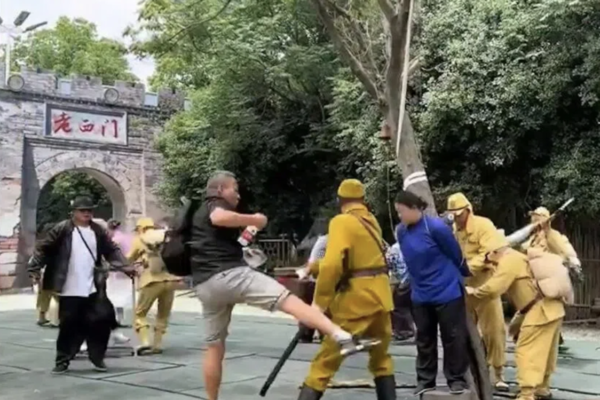
Under the influence of the official anti-Japanese propaganda of the Chinese Communist Party, a man in mainland China allegedly got too immersed in a live performance at a scenic spot in Anhui. He rushed onto the stage and physically assaulted actors portraying Japanese soldiers, sparking a heated debate online.
According to a viral video, at an outdoor performance promoted as “patriotic education” by the CCP, actors were reenacting scenes related to the War of Resistance against Japan. Suddenly, an emotionally overwhelmed middle-aged man in a black top stormed onto the stage, physically attacking the actor playing a Japanese soldier and continuously cursing at him.
Event staff quickly intervened, and the man seemed to realize it was just a performance, calming down and apologizing to the staff before returning to his seat.
The incident was reported by mainland Chinese media outlet “Jimum News”. It reportedly took place at the Hequan Town Resort in Bengbu City, Anhui Province, last Saturday (June 13th), during an immersive stage play titled “Storming the Old Ximen”, depicting anti-Japanese history.
Post-incident, park staff mentioned it was the first time such an incident occurred, and after the relevant actors were checked at the hospital with no serious injuries, the man’s responsibility was not pursued. The lack of a protective barrier in front of the stage was to facilitate visitor interaction, but officials stated they would consider adding barriers in the future.
On Weibo, there were mocking comments: “In peacetime, these people are the bravest.” “Bullying the weak, these people are the most powerful.” “Only those who know it’s fake dare to go up, and these same people are the harshest online critics.” “It’s intentional.” “This education has truly made an impact!”
On overseas platforms, netizens believed that this incident reflects the detrimental effects of years of brainwashing education by the CCP, leading some individuals to struggle to differentiate between performance and reality.
Netizens stated, “Chen Peisi’s father, Chen Qiang, played Huang Shiren and had soldiers in the audience aim guns ready to shoot. It’s surprising that after decades, it’s still the same.” “Brainwashing to this extent is spot on.”
Some netizens said, “Everything you see is what they want you to see. The CCP has developed many ‘sunshine groups’ and other organizations at the grassroots level. This is a patriotic show, in a sense, a performance of loving the party and country. A modern version of the Cultural Revolution, with the boundary of the Cultural Revolution determined as needed!”
Others commented, “Whether it’s intentional hype or extreme national pride, it’s a ridiculous scene.”
After Japanese Prime Minister Takaichi Sanae made remarks last year regarding “Taiwan’s situation,” the CCP exerted various pressures, including economic retaliation and further anti-Japanese propaganda domestically.
Feng Chongyi, an associate professor at the University of Technology Sydney, previously told Dajiyuan that when the CCP’s authoritarian rulers face domestic issues, they typically provoke external conflicts to divert attention and strengthen their position internally.
He mentioned how the CCP had previously balanced communism and nationalism but now relies solely on nationalism, deceiving the people and capturing their hearts. “Its ideological pillar has cunningly shifted to patriotism and nationalism, aiming to maintain its centralized dictatorship.”