
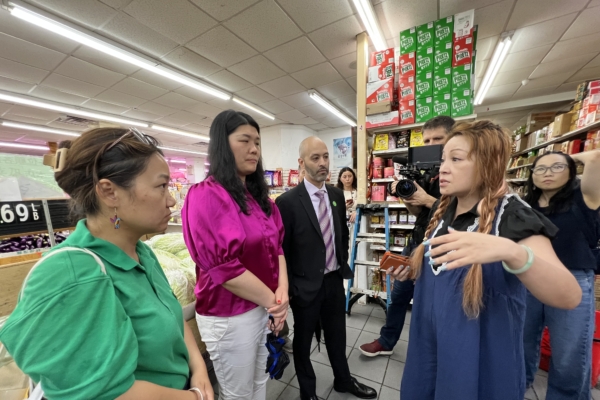
In order to gain a deeper understanding of the operational difficulties faced by small businesses in South Brooklyn, Council Member Zhuang Wenyi invited Kenny Minaya, the Director of the New York City Small Business Services (SBS), to visit the Bensonhurst 86th Street commercial district on July 9. During the visit, they visited a senior center, restaurants, a bagel shop, and a Chinese supermarket to listen directly to the opinions of business owners and bring the small business resources provided by the city government into the community.
The issues reflected by the small businesses visited this time included licensing, government fines, illegal vendors, garbage and rodent issues, water bill discrepancies, and inconsistencies in regulations across different government departments. Zhuang Wenyi expressed hope that through on-site visits, the city government would truly understand the actual difficulties faced by immigrant community businesses and further improve systems to assist businesses in operating smoothly.
The first stop was the 86th Street Senior Center, where Gigi Li, in charge of the center, mentioned that due to fire system and related engineering issues, the opening process had been delayed for over half a year. Despite having all plans approved beforehand, communication issues between the engineering contractor and city government departments had led to a standstill in progress, leaving operators feeling helpless.
Many immigrant business owners, not familiar with regulations and language restrictions, can only hire consultants or contractors for assistance. However, even with high fees paid, problems remain unsolved. Minaya stated that through the “NYC BEST” program, SBS is assisting businesses in communicating with various government departments to expedite permits and complete the opening process. The mayor recently allocated an additional $4 million to the program in hopes of reducing business opening times and providing more comprehensive cross-department coordination services.
Zhuang Wenyi proposed that besides government department efficiency, contractor responsibility mechanisms should also be reviewed to avoid situations where operators pay but are unable to complete projects in a timely manner.
Next, at the “Hongxiang Banquet Restaurant,” owner Chen Yongjin informed the director that the restaurant had accumulated over $100,000 in water fees and fines erroneously imposed by the Department of Environmental Protection (DEP) due to historical combined water meter issues. Chen explained that the landlord merged two parcels of land with two water meters to enable the restaurant to operate, only to receive a hefty bill afterward. Despite multiple attempts to contact the DEP, inspections carried out had all indicated no issues; yet, the restaurant later received a $60,000 fine. Chen subsequently hired an inspector who failed to conduct a proper check, leading to escalating fines that he could not afford.
Restaurant landlord Michael highlighted that despite paying over $270,000 in water fees over the years, the burden of substantial outstanding debts, coupled with a high 16% interest rate, was putting intense pressure on operations. Minaya promised to personally follow up on the case and assist businesses in coordinating with relevant departments through SBS to provide violation explanations and compliance guidance to prevent similar problems from recurring.
At the bagel shop operating for over 20 years, owner Patrick Tarano pointed out that the biggest issue on 86th Street was not the business itself but rather the street’s garbage, odor, and environmental hygiene. He mentioned that the strong smell of garbage in summer, along with some people littering indiscriminately, was affecting customer perceptions, and urged the government to enhance cleanliness and enforcement measures.
Zhuang Wenyi mentioned ongoing efforts to increase littering fines and extend enforcement hours, alongside community cleanup activities and education to raise residents’ environmental awareness. Minaya expressed that improving the neighborhood environment required not just enforcement but also education and resident participation to truly enhance the quality of the commercial district.
Finally, at the Guojian Supermarket, owner Ms. Liu raised concerns about inconsistent regulations on outdoor product displays (porch stalls) by different departments, creating confusion for businesses. Liu stated that the Department of Consumer and Worker Protection (DCWP) and the Department of Sanitation (DSNY) had different distance requirements for outdoor displays, causing businesses to face penalties for following one department’s instructions yet being fined by another, leading to seizure of goods and losses in thousands of dollars.
Minaya admitted that SBS had not yet provided complete compliance education related to porch stalls. They plan to incorporate relevant content into training programs and assist businesses in better understanding various regulatory requirements.
Minaya emphasized that the purpose of this visit was to directly listen to the voices of business owners and grasp the real difficulties faced by small businesses, which would be taken back to the city government as a crucial basis for policy improvements. Besides aiding in business openings, SBS offers free compliance education, violation notice explanations, and cross-department coordination services in their efforts to help businesses avoid fines and operate smoothly. He urged business owners to make the most of the “NYC BEST” program and SBS’s various free resources.
Zhuang Wenyi highlighted that while the City Council could demand improvements in systems through legislation, lacking direct enforcement power made it more vital to act as a bridge between the community and the city government, bringing issues to relevant departments to encourage collective problem-solving.
Helen, the chief of staff from Assemblyman Cody’s office who accompanied as the translator, expressed that small businesses are vital pillars of the immigrant community’s economy and hoped for more city department heads to enter communities in the future, understanding grassroots challenges firsthand rather than solely crafting policies in offices. Only by truly understanding the root of problems can effective solutions be proposed.