
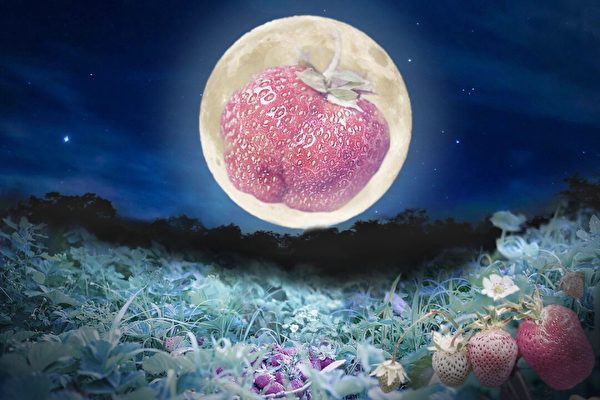
As the first gentle breeze of summer brushes by, a full moon carrying a sweet aroma is quietly making its way towards us. The 2026 “Strawberry Moon” is set to appear on June 29th, but what makes this full moon special this year?
The “Strawberry Moon” is about to illuminate the night sky. While this full moon may not visually resemble the beloved summer fruit in all its vibrant glory, the whimsical name reminds us that this time marks a season of sweet and juicy harvest and picking. Apart from the romantic tales in the Western culture, the rich and colorful traditional Chinese culture also holds unique names and profound interpretations for this midsummer full moon.
According to the “Old Farmer’s Almanac,” names of full moons traditionally track the seasons and phenology. The nickname “Strawberry Moon” originates from the Algonquian tribe in the Northeastern United States, as well as the Ojibwe, Dakota, and Lakota peoples. This is because it’s the time when wild strawberries in the area are ripe and ready for picking.
Apart from this popular name, this moon goes by different renowned names among other Native American tribes and Western cultures, such as the Haida referring to it as “Berries Ripen Moon,” the Anishinaabe calling it “Blooming Moon,” and the Europeans naming it “Honey Moon” or “Rose Moon.”
This moon, symbolizing maturity and abundance, carries reverence and insights into life in different civilizations, both in the East and the West:
In Western spiritual traditions, the Strawberry Moon is usually the closest full moon to the summer solstice, hence it is inseparable from the concepts of “abundance, prosperity, and gratitude” towards the Earth. Many practitioners believe it to be a perfect moment to celebrate the fruits of labor, let go of the past, and infuse the spirit with abundance energy.
Astrologers point out that this moon will illuminate the path ahead, making it a suitable time for people to pause, reflect on their journey thus far, and deeply introspect on their long-term plans and commitments.
Interestingly, in the Chinese lunar calendar, the 2026 Strawberry Moon (June 29th) aligns with the fifteenth day of the fifth lunar month in the Bingwu year. In the traditional Chinese lunar calendar, May falls in the season when pomegranate flowers bloom in vibrant red, making this full moon the authentic “Pomegranate Full Moon.”
In terms of spiritual significance, Chinese culture emphasizes the “alternation of yin and yang and inner reflection.” This occurs right after the summer solstice, a turning point where the “yang reaches its peak and gives way to yin.” In the eyes of ancient people, this bright midsummer full moon holds the power to dispel the damp and heat of May, bringing forth coolness and brightness.
Ancient literati often sought solace in the moonlight to cope with the summer heat and find inner peace amidst the bustling summer. Just as Tang Dynasty poet Meng Haoran wrote in “Thoughts at the South Pavilion on a Summer Day,” during a moonlit summer night, “The mountain light suddenly falls to the west, the pool moon gradually rises in the east. The lotus wind carries the fragrance, the bamboo dew drips a clear sound.”
In the midst of hot summer nights, feeling the intoxicating scent of lotus in the gentle breeze, watching the bright moon slowly rise from the east of the pond, finding solace and tranquility in the purity and coolness, this reflects the unique detachment and spiritual comfort in Eastern aesthetics.
According to the astronomical calendar, this Strawberry Moon will reach its fullest on Monday evening (June 29th) at 7:57 PM Eastern Time (which is 7:57 AM on June 30th in Beijing Time). Therefore, the optimal viewing time for readers in Asia will be from sunset on the evening of June 29th until late at night.
It’s worth mentioning that the 2026 Strawberry Moon holds significant astronomical value, subtly echoing the profound wisdom of ancient interpretations of seasonal changes and the cultivation of mind and spirit:
Unique Amber Golden Glow:
Following closely after the summer solstice, it is one of the lowest trajectories of a full moon in the night sky in decades. Hanging low near the southeastern horizon for an extended period, the moon, affected by atmospheric scattering, will display an incredibly soft, warm golden or amber color, rather than the cool white.
Eastern Interpretation (the fusion of fire and earth): May in the lunar calendar (midsummer Bingwu) belongs to the element of fire, representing extreme heat, while yellow is associated with the earth element. The low-hanging amber golden moon at this time is akin to the earth and heaven harmonizing with gentle “earthly virtues” to temper and embrace the scorching heat of midsummer, symbolizing the maternal radiance of “cultivating virtues to bear the world” as depicted in the Book of Changes.
Mini Micro Moon:
This is also the last “Micromoon” of 2026, indicating that the moon is currently positioned at its apogee, visually appearing delicate and diminutive.
Eastern Interpretation (the wisdom of moderation and restraint): The Chinese value the concept of “the moon waxes and wanes, water overflows when full.” Although this mini full moon will reach its fullest “lookout day,” it appears subdued and modest due to its distance, embodying the perfection of Confucian “moderation and restraint” and echoing the Taoist wisdom of purifying the mind in the full moon, reminding us to retain composure amid the frenzy of all things.
In traditional folklore, the fifth lunar month is a time of breeding mosquitoes and humid heat, termed as the “poisonous month” by the ancients, who hung wormwood and drank realgar during this period to ward off diseases and evil spirits. Taoist health practices particularly advocate for the wisdom of “purifying the mind, cultivating restraint, and staying content” during this period.
Although the external environment is filled with intense heat and activity, the moon in the night sky voluntarily recedes, tucking away its grandeur and dominance of a super full moon, transforming into a restrained mini full moon. This celestial event undoubtedly serves as a reminder from the universe: during this challenging midsummer period of numerous temptations, the wisest way to cultivate oneself is to mimic this mini full moon – remaining composed, holding back sharp edges, and practicing the art of subtraction within.
To catch a glimpse of the beauty of this “Pomegranate Strawberry Full Moon” in 2026, you can refer to the following viewing guide:
Stay informed of the weather forecast:
Before heading out, be sure to check the local weather conditions, avoiding areas with significant cloud cover or stormy weather; a clear and sparse night sky provides the best observation backdrop.
Choose an observing location:
Opt for a location with a broad view to the southeast, away from severe light pollution in parks, outskirts, or elevated areas.
Prepare for stargazing:
As summer nights outdoors tend to attract mosquitoes, it’s advisable to apply insect repellent and dress appropriately according to the weather. Bring along a blanket, sleeping bag, or outdoor folding chair to gaze at the beautiful imprint of this midsummer night in the most comfortable posture.