
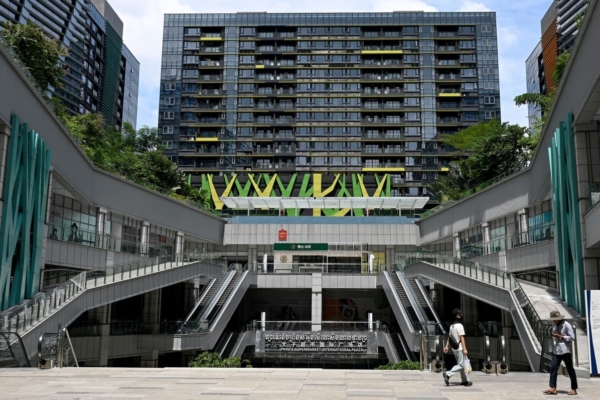
On Tuesday, June 23, the U.S. Department of the Treasury announced further sanctions against 9 high-ranking members and 26 entities of the Southeast Asian fraud group known as the “Prince Group”, which includes the leadership of the Prince Group, fraud group investors, and front companies. It is reported that the number two figure in the Prince Group has been arrested in Japan.
The Prince Group is headquartered in Phnom Penh, the capital of Cambodia, and has multiple large specialized fraud parks within Cambodia to lure people from various countries with high salaries, induce them, and imprison them when they arrive at the park, making them participate in transnational telecommunication fraud activities, affecting victims globally.
Among the sanctioned individuals, the most prominent figure in Tuesday’s sanctions is Hu Xiaowei (Hu Xiaowei), also known as Hu Shi, the number two figure in the Prince Group, referred to as the “big brother” by the head of the Prince Group, Chen Zhi.
Hu Xiaowei had previously been listed on the sanctions list by the U.S. Department of the Treasury’s Office of Foreign Assets Control (OFAC) in October 2025 under the alias “Chen Xiaoer.” It is reported that he has also used the names Hu Shi and Wu Anming.
On Monday, June 22, Japanese authorities announced the arrest of Hu Xiaowei in Tokyo. It was confirmed that Hu Xiaowei was born in China and was arrested while holding a Cyprus passport in Japan. He was arrested by the Tokyo Metropolitan Police for making false statements on an electronic notarized document.
Hu Xiaowei’s whereabouts had been a mystery. Investigators revealed that the Japanese authorities had obtained clues about Hu Xiaowei’s activities within the country and, through investigation, identified criminal clues related to false declarations and began tracking him. During the investigation at several high-end hotels in Osaka, the police identified Hu Xiaowei’s movements through surveillance footage and eventually arrested him in Osaka. Currently, the authorities are further clarifying the criminal facts of the entire organization.
According to the announcement by the U.S. Department of the Treasury on Tuesday, Hu Xiaowei, on behalf of the Prince Group, was involved in criminal activities including establishing and supervising some subsidiary companies of the Prince Group outside Cambodia, conducting Prince Group business related to airplanes, participating in transnational real estate activities of the Prince Group, engaging in illegal gambling activities, and acting as a nominal holder for Chen Zhi’s company.
Chen Zhi was arrested by Cambodian authorities in January 2026 and deported to mainland China. Both were on the list of 146 individuals and entities related to the Prince Group announced by the U.S. in October 2025.
The U.S. and UK governments have both considered the Prince Group as the largest organized crime group in Asia and announced economic sanctions against them.
The Treasury Department estimated that by 2024, Americans had lost at least $10 billion due to Southeast Asian fraud activities, a 66% increase from the previous year. These fraud activities use various means to deceive victims, with one of the most common and lucrative scams being digital asset investment fraud.
Fraudulent centers based in Southeast Asia often recruit individuals under false pretenses to work at the fraud centers, such as claiming to offer false technical or customer service positions associated with fraudulent centers, casinos, resorts, and front companies. Once these individuals arrive at these centers, criminals confiscate their passports and use methods like debt bondage, physical violence, coercion for prostitution, to force them into online scams of strangers. These fraudulent organizations tend to recruit individuals with English proficiency to target victims in the U.S.
Some former fraudsters reported that they were instructed to specifically target Americans, with some even being asked to achieve a certain number of fraud targets every day. In some cases, American victims have lost their life savings.
Hu Xiaowei controlled three companies based in the British Virgin Islands, Eagle Fortitude Limited, Leisure Focus Limited, and Future King Inc., used to manage funds and assets. These companies were used to receive funds from victims of cryptocurrency investment fraud amounting to millions of dollars.
Also sanctioned were several of Hu Xiaowei’s subordinates, who were also executives or directors of the Prince Group. They include: Ho Ho Ming, Kong Ka On, and Li Hui. Ho Ho Ming was an executive of China Reserve Securities, Future Wing, and Future Oasis; Kong Ka On was an executive of Future Cosmos; Li Hui was an executive of Future Wing. Kong Ka On also controlled a Hong Kong company – Big Harbor Yachts (Hong Kong) Limited – and 11 British companies.
Brendon Luo and Qiu Weiren, as principal investors in the TCO Fraud Center under the Prince Group, were also included in the U.S. Treasury Department’s sanctions list.
In addition, Dai An, who holds a key position at Prince Universal Real Estate (Cambodia) Group Company Limited, responsible for money laundering and payment affairs at the Prince Group’s scam center, Fang Zhizhen, and Chen Bo, a director of six companies under the Prince Group, were also sanctioned. Yang Yanming, an executive related to the Prince Group and based in Thailand, was included on the sanctions list of WHITE HORSE HOTEL MANAGEMENT GROUP COMPANY LIMITED.