
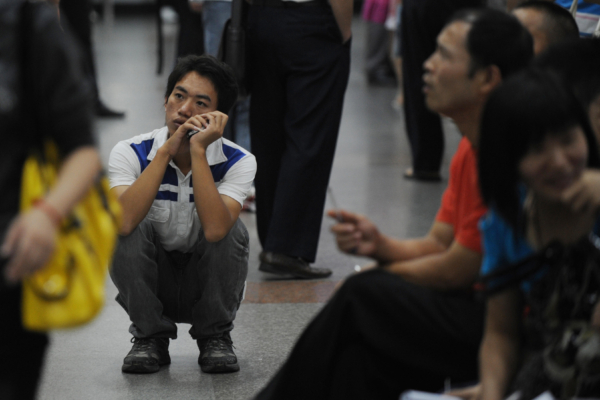
In the early hours of the night, 33-year-old Gao Zhixuan stood alone on a dimly lit bridge, facing the river with tears in her eyes. “Every day, I think about ending it all here. This bridge is high enough, capable of… but I dare not jump,” she said hoarsely, expressing her inner despair.
Gao Zhixuan hesitated slightly before speaking to a video channel called “Unpublished China,” revealing, “I used to be a small boss with assets worth tens of millions. I had three toy factories, two cars, two houses… Now I owe over two million, and I can’t even afford a bowl of noodles.”
Her choked voice was swallowed by the night wind. In present-day China, her story is not an isolated tragedy. She is one of the 110 million unfortunate ones trapped in a debt crisis, yet their fates have been completely erased in the cold official data.
According to official statistics from the Chinese Communist Party, the non-performing loan ratio of Chinese households is “less than 3%”, lower than the U.S.’s 4.8%, seemingly suggesting that all risks are under control. However, behind the accounting indicators lies a huge microeconomic gap. Bloomberg reported that by the end of 2025, out of a population of 1.1 billion adults, as many as 10.6%—approximately 110 million individuals, had fallen into a state of overdue debt, accumulating personal non-performing loans exceeding 2.22 trillion yuan.
Although the official publication of aggregate data on individual defaults was discontinued in the summer of 2025, these 110 million individuals in overdue status are becoming the most realistic portrayal of China’s tangible economy.
In banking records, as long as borrowers continue to pay interest on time or transfer non-performing loans through debt rollovers and refinancing, those loans still appear as “healthy” on paper. American economist Huang Dawei bluntly stated in an interview with Da Ji Yuan that the significant gap between official data and public perception is a complete “data illusion.”
“It masks the ‘technical bankruptcy’ of Chinese household balance sheets,” Huang Dawei pointed out. He noted that Chinese household wealth is heavily locked in real estate, and when the property market crashes and asset liquidity is lost, the real risk is not reflected in the non-performing loan ratio (NPL), but in the permanent loss of consumption capability.
Xu Zihang, a middle-aged man, fell victim to this “technical bankruptcy.” In 2019, he spent 1.35 million yuan to buy an apartment, with a down payment of 420,000 yuan and a loan of 930,000 yuan, resulting in a monthly payment of 5,360 yuan.
He shared his story on the channel “The Bottom of Society in China.” In the video, he stood outside the sealed apartment late at night, sighed deeply, and said, “Two years ago, my business failed, and I had to default on the mortgage. But I paid back for over three years, a total of over 180,000 yuan, only to find out that nearly 160,000 yuan went towards interest, and I paid back just over 20,000 yuan.”
The extravagant real estate feast only left him with severe depression and a court summons. Half a year after defaulting, Xu Zihang was sued by the bank. The court informed him that the assessed value of the house was 1 million, with a starting bid of 70% off at 700,000 yuan. The remaining few hundred yuan in his WeChat wallet were frozen by the court.
Xu Zihang lamented that not only did he lose the down payment and over three years of hard-earned monthly payments, he also owed the bank over 200,000 yuan. In addition, there were tens of thousands of legal fees, litigation costs, and preservation fees from the lawsuit. “Now that the house is gone, my losses amount to over 800,000 yuan. It’s really helpless and heart-wrenching. I fall into deep depression every day.”
A video on the internet from the “People’s Daily” showed a middle-aged man running a lending intermediary expressing his regret, “More and more middle-class individuals are falling back into poverty. Many clients I used to work with, with assets worth 5 million or 10 million yuan, are now heavily indebted, and it’s really too many.”
“China still lacks a nationwide ‘Personal Bankruptcy Law,’ which will result in a large number of bad debts,” noted Wu Shaoping, founder and chairman of the Overseas Chinese Human Rights Lawyer Alliance, in an interview with Da Ji Yuan. He stated that in a healthy market economy, the bankruptcy system serves as a “way out” for those who have failed in business. However, in China, individuals who cannot repay their debts are often simply added to the “dishonest debtor blacklist” by the system, restricting high consumption and freezing accounts, almost making them “permanently unable to recover” on the fringes of society.
“This rigid system set by the Chinese Communist Party is mercilessly marginalizing these individuals who have lost the ability to help themselves,” said Wu Shaoping.
Similarly, in the midst of struggling in the low point, there is a 28-year-old woman from Anhui born in 1997. “I might not be able to survive this,” she cried in a video on the self-media channel “People’s Daily,” “Thinking back to the good old days when I had tens of millions in assets, owned three restaurants, a mask factory, and a company incubating online celebrities. Now I’m bankrupt, with nothing left, and I’ve become a ‘deadbeat’ in debt of 2.27 million yuan.”
When these former entrepreneurs and middle-class individuals lose their normal living space, the “withdrawal of loans (premature repayment of loans)” measures commonly taken by financial institutions often become the final straw that breaks the funding chain, leading to collective anti-debt sentiment.
Chen Zhixiang, 32, from Nanjing, Jiangsu, showed extreme resistance towards debt struggles. He revealed in an interview with Da Ji Yuan that he had accumulated loans totaling 450,000 yuan from platforms like “Jiebei,” “Douyin,” and “Meituan” as well as credit cards, and is now one year overdue.
“I could have repaid normally, but the bank suddenly reclaimed the loan, directly causing the breakdown of my funding chain,” Chen Zhixiang explained. He has now adopted an attitude of “lying flat,” ignoring calls. What infuriates him the most is the subsequent action of the collection agencies, such as revealing his debt to friends and family. “Since they are unreasonable with their interest rates, and have harassed people around me, ruining my reputation, and I have recordings, I absolutely will not repay this debt,” Chen Zhixiang declared.
This kind of “you are unkind, then I am unjust” violent backlash mentality is spreading among the debt-ridden population. Another mother, Wang Siyu, who is wandering alone with more than 3 million debts, expressed on the channel “Unpublished China,” that she can no longer bear it as her debt has adversely impacted her family, and now she can only wander aimlessly, tearing down her pride.
When back in China, Wu Shaoping has helped many debt-ridden individuals who were pushed to the brink seek consultation. He pointed out that in response to these enormous debts, numerous brutal debt collection companies emerged, using violent methods to collect debts and harassing the debtors’ friends and family like crazy. “Under the Chinese Communist Party’s system, instead of aiding these individuals to get out of debt, they have worsened their plight. When more and more people like these are in society, despair will spread in the air, eventually leading to severe social incidents such as family disintegration and violent acts of revenge.”
Data circulating on online forums cruelly confirms this sense of hopelessness in the air. With soaring debts after the pandemic, intertwined with recent collapses in the real estate and stock markets, countless ordinary people are being pushed to the brink. Estimates suggest that the most concentrated reasons for suicides in recent years are: being trapped in the stock market, temporary unemployment, abandoned housing projects, falling into a ‘four no’ predicament, and heavy debts. These most distressing social issues have erupted in the span of a few years, pushing the debt-laden groups to the edge.
As Wu Shaoping mentioned, this vast and cornered debt-ridden group is “like a timed bomb in society, which could trigger collective social events at any moment.”
Faced with the stagnation of the real economy and the decline in domestic demand, the Chinese government has introduced various consumer loan subsidies for automobiles and home appliances to try to reinvigorate domestic demand. However, data from the National Bureau of Statistics shows that in May 2024, the total retail sales of consumer goods decreased by 0.6% year-on-year, marking the first monthly decline since December 2022. These policies seem to be like “casting pearls before swine,” failing to produce any ripple effect.
“The lackluster effect is due to the economy falling into the trap of ‘balance sheet recession’,” analyzed Huang Dawei. When the public’s expectations for future income plummet to freezing point and they face the risk of potential layoffs and pay cuts at any time, individuals’ rational choice is to ‘deleverage (repay debt)’ rather than ‘leverage (consume)’.
“For consumers, the pain point isn’t about high financing costs, but about whether they have money in hand and a job tomorrow,” said Huang Dawei frankly.
Ironically, government subsidy funds often have credit thresholds and can only flow to those with credit capability, while the 110 million grassroots “untrustworthy persons” who are deeply in debt and urgently need cash flow cannot cross the credit threshold to benefit from subsidies, thus failing to stimulate bulk consumption. There is a serious mismatch in policies at both supply and demand ends.
Ye Ziqing, a woman burdened with a debt of 1.77 million yuan, voiced an almost hopeless question in a video on the channel “Unpublished China”: “I don’t know what I need to do for society to treat me kindly. I am not afraid of hardship, nor afraid of working hard. What I fear most is that I struggle to the end and end up with nothing! What do I need to do to survive this ignored low point?”
Despite the accumulation of bad debt risks drawing widespread attention, online lending business remains a core monetization channel for digital payment and short video giants. On these mainstream app interfaces, advertisements for “instant loans” and “low-threshold” credit are still appearing frequently, targeting vulnerable groups.
“This is a delay in technology and a cruel game of commercial interests,” Huang Dawei uncovered the big players’ regulatory compliance façade. In the backdrop of a weak advertising market, online lending is one of the few “rigid businesses” that can convert massive traffic into stable cash flow. More discreet is the big tech’s “precise algorithmic harvesting” – big data automatically filters out the vulnerable groups who have already built up a ‘debt wall but still retain some repayment capacity and weaknesses,’ delivering high-frequency precision credit boosts.
Many young people who are inexperienced and vulnerable are becoming targets of this unrestrained capital hunting. Zhang Qian, in her twenties, had her entire salary deducted by the platform the moment it hit her Alipay account to repay online loans, and in “Unpublished China,” she cried uncontrollably: “I have no money to eat now, no money to pay rent… they don’t offer any room for negotiation.”
In this bottom layer of algorithmic hunting, more and more debt-ridden individuals like Chen Zhixiang and Zhang Qian are transitioning from initial panic to a systematic ‘lying flat’ and rebellion.
Liu Hongtao from Jinan, Shandong, is one of them. In an interview with Da Ji Yuan, he stated that he owes over 30,000 yuan in online loans, with 20,000 from “Fangxinjie” and 5,000 from “Dewu.” After collection personnel harassed him and even caused a scene at the village committee, Liu Hongtao, filled with anger, chose another extreme debt resistance strategy: “Not repaying, not staying in touch, and standing firm till the end.”
“I haven’t paid a penny, and I don’t plan to pay it back. I answer their calls, as my reputation has been ruined, and they can’t do anything to me.” Liu Hongtao declared.
Market sources indicate that the regulatory authorities have mandated that interest rates be reduced to below 20% and subjected to a 12% stress test, a rare administrative intervention that is under scrutiny for its intent.
Both Wu Shaoping and Huang Dawei point out that this anxiety is essentially a fear of the underclass order spiraling out of control. With such a massive debt volume from 110 million individuals, once structural collective defaults occur, the chain reaction will far exceed the financial realm – the uncontrolled violent debt collection, limitless spread of the untrustworthy blacklist, and the subsequent surge in extreme social tragedies could transform the lower-class discontent and resentment into a direct challenge to the system’s public safety crisis. Therefore, the regulatory authorities are attempting to test whether the platforms have enough capital buffering to “withstand” this tsunami.
Wu Shaoping is concerned that as the rigidity of the system reaches its limit, this technical patching may not be sustainable in the long run.
He predicts that in the face of an extreme crisis of continuous economic decline, to prevent the explosion of this 110 million people’s “timed bomb,” the authorities may eventually abandon all market rules and resort to an “across-the-board” executive order. “Either force partial forgiveness of individual debts or directly use administrative means to forcibly remove these untrustworthy individuals from the credit system. However, this is not out of kindness but out of extreme fear of a regime crisis erupting.”
The increase in financial supervision intensity and the adjustment of individual debt size are ongoing. Until the redemption pressure on these 110 million overdue individuals is substantially relieved, the effectiveness of the tens of billions in fiscal subsidies to stimulate consumption and macro-control measures will ultimately depend on the degree of repairing grassroots consumer leverage.