
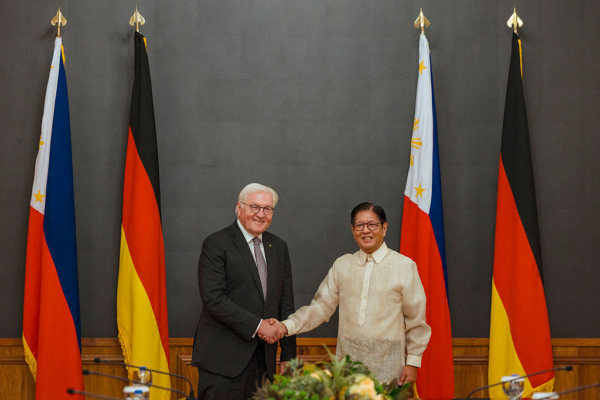
German President Frank-Walter Steinmeier expressed concerns over the tense situation in the South China Sea, warning that a major conflict could jeopardize freedom of navigation, similar to the situation in the Strait of Hormuz.
During his state visit to the Philippines on Tuesday, Steinmeier, together with Philippine President Ferdinand Marcos Jr., mentioned the blockade of the Strait of Hormuz due to the Iran war and highlighted European leaders’ worries about the ongoing territorial disputes in the South China Sea, especially the disputes between the Philippines and China.
The United States has repeatedly warned that it is obligated to assist in defending the Philippines if Filipino troops, ships, and aircraft are attacked by Chinese forces. The U.S. and the Philippines signed the Mutual Defense Treaty in 1951, which outlines a collective defense system.
On the other hand, Beijing has warned the U.S. several times not to interfere in the South China Sea disputes. China not only has disputes with the Philippines but also with neighboring countries or regions surrounding the South China Sea, including Vietnam, Malaysia, Brunei, and Taiwan.
During a meeting with Marcos, Steinmeier, through a translator, stated, “The situation in the South China Sea continues to be tense, which deeply concerns us, as the Indo-Pacific region, especially Southeast Asia, is one of the most economically vibrant regions in the world.”
“If any event occurs in that region, Europe also feels equally concerned,” he said. “Actions that violate international maritime law jeopardize freedom of navigation, and the recent blockade of the Strait of Hormuz has vividly demonstrated this.”
The issue of the Strait of Hormuz was also one of the topics discussed during the closed-door meeting between Steinmeier and Marcos. The recent blockade has led to a surge in global fuel and fertilizer prices.
While Steinmeier did not specifically name which country has caused tensions in the South China Sea, Germany has previously stated that Beijing’s actions in the disputed waters infringe on the rights of coastal countries like the Philippines and pose a threat to freedom of navigation.
Steinmeier pledged on Tuesday that Germany will continue to support the Philippine Coast Guard. Chinese military forces have clashed with the Philippine Coast Guard multiple times in the South China Sea.
Steinmeier and Germany have consistently openly supported the Philippines in upholding the rule of law in the South China Sea and urged all parties to abide by the legally binding arbitral ruling of 2016. Marcos expressed gratitude for this support.
The 2016 arbitral ruling invoked the 1982 United Nations Convention on the Law of the Sea, rejecting Beijing’s extensive claims in the South China Sea. However, Beijing refuses to accept the arbitration outcome and continues to disregard the ruling.