
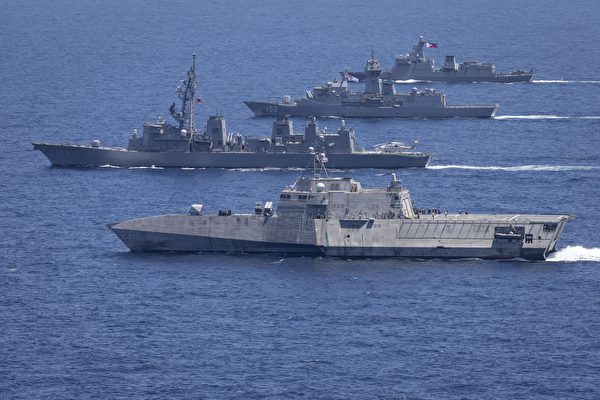
After the Japan-Philippines summit, it was announced at the end of May that negotiations would begin for the Exclusive Economic Zone (EEZ) and continental shelf boundaries, involving the maritime areas east of Taiwan. Experts say that the Japan-Philippines talks will not impact Taiwan’s interests, but it will make China very nervous.
It is evident that as soon as Japan and the Philippines made this announcement, even before the negotiations started, China used this as an excuse to launch the so-called “Special Maritime Enforcement Action in the Waters East of Taiwan” and deployed coast guard vessels to harass passing ships in the eastern waters of Taiwan.
According to Ming Juzheng, a renowned political science professor at National Taiwan University, on the New Tang Dynasty TV program “Breaking News,” the negotiations between Japan and the Philippines for their Exclusive Economic Zones and continental shelf boundaries have garnered attention from marine law experts domestically and internationally, stressing that these talks will not affect Taiwan’s interests.
From the southernmost island of Japan to the northernmost island of the Philippines, the distance is less than 400 nautical miles, leading to overlapping EEZs due to countries extending their economic zones outward by 200 miles. This necessitates discussions on fishing rights and potentially mineral extraction in the continental shelf, highlighting the importance of negotiations between Japan and the Philippines.
In accordance with the principles of maritime law, negotiations between Japan and the Philippines will only be binding for the two countries and not have any impact on the maritime rights of third parties like Taiwan. Third parties, such as Taiwan, that already have fishing agreements with Japan and the Philippines can separately negotiate with them based on the existing agreements. Japan has also stated that under international law, these negotiations will not affect any other country.
According to a report from Xinhua News Agency, from June 6 to 10, China’s Ministry of Transport organized maritime authorities and rescue agencies to conduct special maritime law enforcement operations in the waters east of Taiwan, inspecting 198 passing vessels and surveying important anchorage areas, construction zones, high-risk collision zones for fishing boats, and areas where submarine cables are laid. Taiwan condemned China for violating international law, labeling its actions as “false enforcement, real expansion” with the aim to “island-chain Taiwan.”
Furthermore, China has seized the opportunity to launch a cognitive warfare campaign against Taiwan. Messages circulating on programs, websites, and mobile phones suggest Taiwan has been partitioned without any response or protest from the government. Some media outlets and pro-China individuals in Taiwan have criticized the government for being weak, accusing it of being unable to defend its territory or of having pro-Japanese and anti-Chinese sentiments.
Ming Juzheng emphasized that the Japan-Philippines border negotiations themselves are not the main concern; rather, it is China’s cognitive warfare tactics. Many individuals on TV discuss this issue with a stack of graphics that basically mirror China’s narrative, directly aligning with Beijing’s viewpoints and spreading misinformation within Taiwan.
He pointed out that the maps circulated online are conceptual and not official statements from Japan or the Philippines. Even if Japan and the Philippines reach an agreement, it will not affect Taiwan, as these are entirely separate matters. China is using this situation to strengthen its narrative of “One China” across the Taiwan Strait, attempting to legitimize its control over Taiwan’s waters and bypass Taiwan’s sovereignty, which violates maritime laws.
Ming Juzheng urged every Taiwanese person to be aware that they are being targeted by China’s cognitive warfare tactics and should refrain from disseminating such information. He highlighted that this is a fundamental way for Taiwanese people to defend the Republic of China.
Regarding China’s frequent intrusions into Taiwan’s waters by its coast guard vessels, Ming Juzheng believes that such incidents will continue to occur, potentially leading to more visible and intense conflicts. Taiwan cannot afford to back down; otherwise, it could send a signal legitimizing China’s actions and presenting it with an opportunity to strengthen its foothold. Taiwan’s maritime patrols need to be reinforced to deter such provocations.
Concerning the negotiations for the Exclusive Economic Zones and continental shelf boundaries between Japan and the Philippines, Ming Juzheng introduced a study conducted by the Hudson Institute, highlighting two key points:
Firstly, it is about concerns related to China. The Japan-Philippines negotiations are not directed against Taiwan but rather in response to concerns regarding China’s actions in the East China Sea, South China Sea, and areas around Taiwan. If China claims Taiwan as its own, stating that the Taiwan Strait and surrounding waters are under its control, it would put Japan and the Philippines in a weakened position, which is why they are publicly announcing negotiations for border delineation.
Secondly, the Japan-Philippines border talks indirectly assist Taiwan. The waters of the Taiwan Strait are relatively shallow, making it unsuitable for submarine activities. On the other hand, the Pacific waters east of Taiwan are deep, providing an ideal environment for submarine operations and potential ambush areas. By defining their respective economic zones, Japan and the Philippines indirectly enhance the protection on Taiwan’s eastern side, indirectly supporting Taiwan in potential security scenarios.
On June 11, China announced sanctions against the Philippines’ defense minister, to which the Philippines responded, calling it an unfriendly action causing significant harm to international relations. Ming Juzheng pointed out that this indicates China understands that if Japan and the Philippines join forces, Taiwan being in the middle, cooperation between Japan, Taiwan, and the Philippines would be inevitable in the event of any crisis. With all three countries possessing considerable military capabilities, China realizes it would face strong opposition if it attempts to disrupt Taiwan from the east, making it a tense situation for China.
Reference Video: “Breaking News – The Island Chain to Prevent Red Infiltration for 80 Years! Who wants to rewrite? How long until the evil axis crumbles?”