
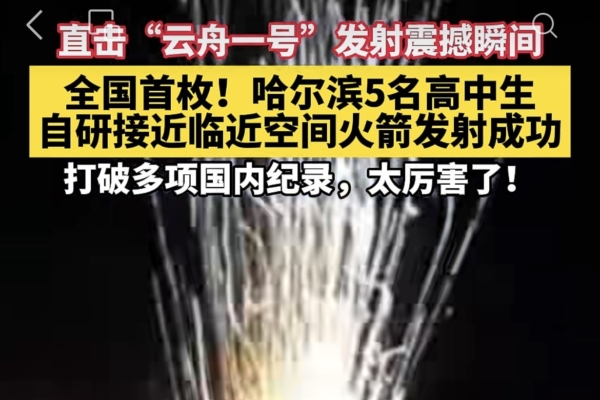
Several Chinese media outlets including the Central Radio and Television Networks of China (CCTV), People’s Daily, and “Harbin Daily” reported on June 9th that the “Cloud Boat I” rocket developed independently by five high school students from Heilongjiang Provincial Experimental Middle School was successfully launched at the Qinghai Lake Rocket Launch Base. The related reports have sparked skepticism among space enthusiasts and netizens.
According to “Harbin Daily” on June 10th, telemetry data from the “Cloud Boat I” rocket showed that it reached an altitude exceeding 15 kilometers and a speed of 2.2 Mach. Media outlets such as “Yangcheng Evening News” published a report titled “Successful Launch of ‘Cloud Boat I’ Rocket Made by 5 High School Students ‘By Hand,'” quoting project commander and chief designer Yan Hao as claiming that the “Cloud Boat I” utilized a team-developed dual-stage dual-pulse engine, achieved staged ignition and rocket recovery, and all subsystem components of the rocket were independently developed by the team including fuel, avionics, and inertial guidance systems.
Mr. He, a Chinese aerospace engineering enthusiast, told Dajiyuan that it is not unusual for high school students to participate in rocket science projects, but the reported altitude, speed, and technical specifications by the Chinese official media go beyond typical campus science activities. He stated, “If it were a low-altitude model rocket where students assemble the shell, print a few parts, and install sensors under teacher guidance, that can be understood. But claiming to reach 15 kilometers altitude, 2.2 Mach speed, with avionics, telemetry, inertial guidance, and recovery systems, it’s not just simple assembly. Even with mature products, it’s not as easy as piecing together blocks. If the media claims it’s self-developed by high school students, at least clarify who provided the technology, where the equipment came from, and who approved it.”
The related reports have also led to skepticism among netizens. From the 12th to the 13th of June, space enthusiasts and netizens began questioning the source of fuel, technical difficulties, and airspace approvals on various online platforms. Some netizens commented, “Which young master got ‘recommendation admission’?” Others sarcastically remarked, “Shouldn’t bragging consider reality?” Some inquired, “Where did the high-energy fuel come from? Such fuel is regulated, why is no one questioning this?”
In a report by Red Star News on June 13th, a “Cold Lake Laboratory” was mentioned in related videos. Public information indicates that the institution is operated by Mars Camp (Beijing) Education Technology Co., Ltd., offering science education services to teenagers. Mr. Yang, a staff member of the Cold Lake Laboratory, told Red Star News that he supervised the launch in collaboration, and certain components of the rocket used mature products. Students learned 3D modeling, 3D printing, and then added their ideas for assembly at the launch site in the unmanned area of Qinghai, with all procedures completed.
Red Star News also discovered that Cold Lake Laboratory has an online store named “Cold Lake Educational Equipment,” showing products such as solid rocket launchers, solid rocket engines, and mobile satellite ground stations. The “Solid Rocket Material Kit” is priced at 5,656 yuan (RMB), with a matching course “Principles and Design of Rockets” priced at 24,860 yuan. Public reports did not clarify the correspondence between these online products and the engines, fuel, and launch systems actually used by the “Cloud Boat I” rocket.
Regarding the exaggerated reports by Chinese official media about the “self-developed rocket by high school students,” retired professor Wang Hao from the Communication University of China told reporters that such publicity exposes the lack of fact-checking in technological news reporting by China’s official media.
He said, “This project involves rockets, fuels, engines, and launch approvals, not just typical campus activities. Media like CCTV and “China Youth Daily” should at least verify what the students actually did, what the institution provided, where the engines and fuels came from, and who handled the approvals. Many media outlets now almost publish reports following the publicity materials, spreading ‘self-developed by high school students’ as fact, only to later discover the involvement of academic institutions and mature products behind the scenes, which naturally raises doubts about the credibility of the reports by Chinese official media.”
Former school teacher Li Li also believes that the core of this controversy is not about the students’ excellence but the basic lack of verification in the face of Chinese official media’s propaganda. He told reporters, “Journalists, editors should have the most basic common sense. Even CCTV and People’s Daily reprint such reports that are obviously problematic to normal people, it’s like the Great Leap Forward period with ‘record-breaking grain yields.’ This kind of ‘fake, exaggerated, empty’ news reporting is still happening now. It shows that Chinese media have collective amnesia; they just listen to the Communist Party and fail to think critically or fact-check the report content.”
As of now, Heilongjiang Provincial Experimental Middle School, Cold Lake Laboratory, and relevant authorities have not publicly disclosed the technical division of labor for the “Cloud Boat I,” the source of fuel, launch approval documents, and the definition of “self-development.” Interviewees believe that this controversy illustrates that the Chinese official media’s actions are not mere errors but continue to create propaganda templates under the narrative of China’s “technological powerhouse,” packaging commercial research institutions and mature equipment as “self-developed rockets by high school students,” once again exposing their operation mode of serving political propaganda and disregarding fact-checking.