
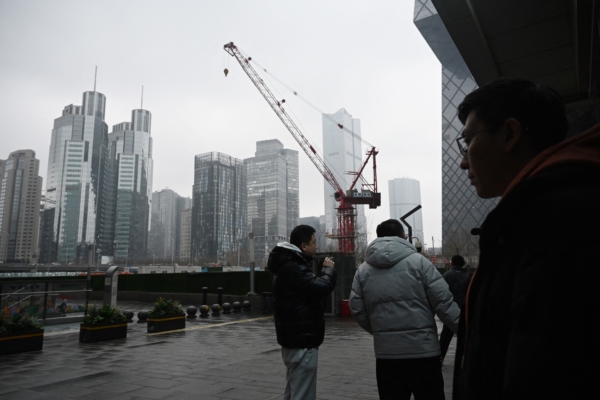
In recent years, the Chinese Communist Party (CCP) has been emphasizing the so-called “Economic Bright Theory” while suppressing speech that exposes the truth about the economy. As the economy continues to stagnate, CCP media have recently started to demand a “counterattack” against the narrative of the Chinese economic “collapse theory”. Experts believe this highlights the anxiety of Beijing’s top leadership over the economic narrative; the authorities are politicizing economic issues, thereby further undermining trust in the official CCP data.
The CCP’s official media outlet “Seeking Truth Net” published a commentary on March 16 criticizing the mentioning of the Chinese economic “collapse theory” and “threat theory” by foreign media, calling for a timely “counterattack” against these viewpoints.
The article claims that some arguments that criticize the Chinese economy domestically and internationally mislead some producers and consumers, affecting macro-control effectiveness and economic stability. It urges the strengthening of expectation management, stating that “confidence is more important than gold” and emphasizes the effective promotion of key issue guidance to “sing the bright theory of the Chinese economy”.
The article concluded by emphasizing the need to strengthen external propaganda and guide international public opinion to timely counter the narrative of the “peak of the Chinese economy”, “excess Chinese production capacity”, and “foreign capital withdrawal from China”.
Sun Guoxiang, a professor at the Department of International Affairs and Business at Nanhua University in Taiwan, told Epoch Times that the article expresses the growing anxiety of CCP’s top leadership over the economic narrative.
“When official media are not talking about how policies can improve their own economy, but instead emphasize the need to counter the collapse theory, it reveals that Beijing is now more concerned with how the outside world interprets the Chinese economy, and whether this interpretation will further affect investment confidence and even the legitimacy of CCP’s rule.”
Sun Guoxiang believes that the article sends three signals. Firstly, the CCP still views economic issues as a highly politicized topic. When faced with doubts from the outside world, Beijing’s first reaction is often not to increase information transparency but to strengthen public opinion control. Secondly, this article is a case of protesting too much, indirectly indicating that the pressure on the Chinese economy still exists. Thirdly, “China’s current most vulnerable point may not necessarily be a single economic indicator, but the overall confidence structure”.
Since the lifting of pandemic control measures at the end of 2022, CCP’s propaganda chief Cai Qi has repeatedly emphasized that the propaganda department should “sing the bright theory of the Chinese economy”. In contrast to the official CCP’s vigorous praise of continuous economic growth in China, the general living standards of the Chinese people have declined, and consumption has downgraded.
Zhao Jian, director of the West Jing Research Institute, published an article titled “Mystery of Economic Temperature Difference” on Cai Xin Network at the end of December last year. It pointed out that China’s economy shows extreme disparities, with a significant temperature difference. The article was quickly deleted.
During this year’s Two Sessions, Premier Li Keqiang stated in the government work report on March 5 that the GDP growth target for 2026 was adjusted to 4.5%-5%, slightly lower than the previous years’ expectation of around 5%, indicating significant pressure on China’s economic growth.
In recent years, the CCP has continued to crackdown on scholars who dare to expose the true state of the economy. Among them, Gao Shanwen, Chief Economist of Guotou Securities, resigned from the company earlier. His viewpoint at the end of last year was that the actual GDP growth figure of China over the past two to three years may be around 2% (official figures are close to 5%).
Lin Song, a political science Ph.D. from the University of New South Wales in Australia, told Epoch Times that the shift from promoting the bright theory to demanding a counterattack against the economic collapse theory from the CCP indicates their anxiety. As the three-year pandemic period has passed, the economic situation in mainland China is deteriorating.
Lin Song criticized that Xi Jinping has undertaken many abandoned projects, including high-speed rail stations in some underdeveloped areas that have been left deserted, and many new buildings have been abandoned halfway. The situation of unemployment among the lower class is also very serious, with people struggling to survive. Now, the CCP wants to promote the bright theory and counter the economic collapse theory, but facing the actual economic collapse, how they can counter remains a big question.