
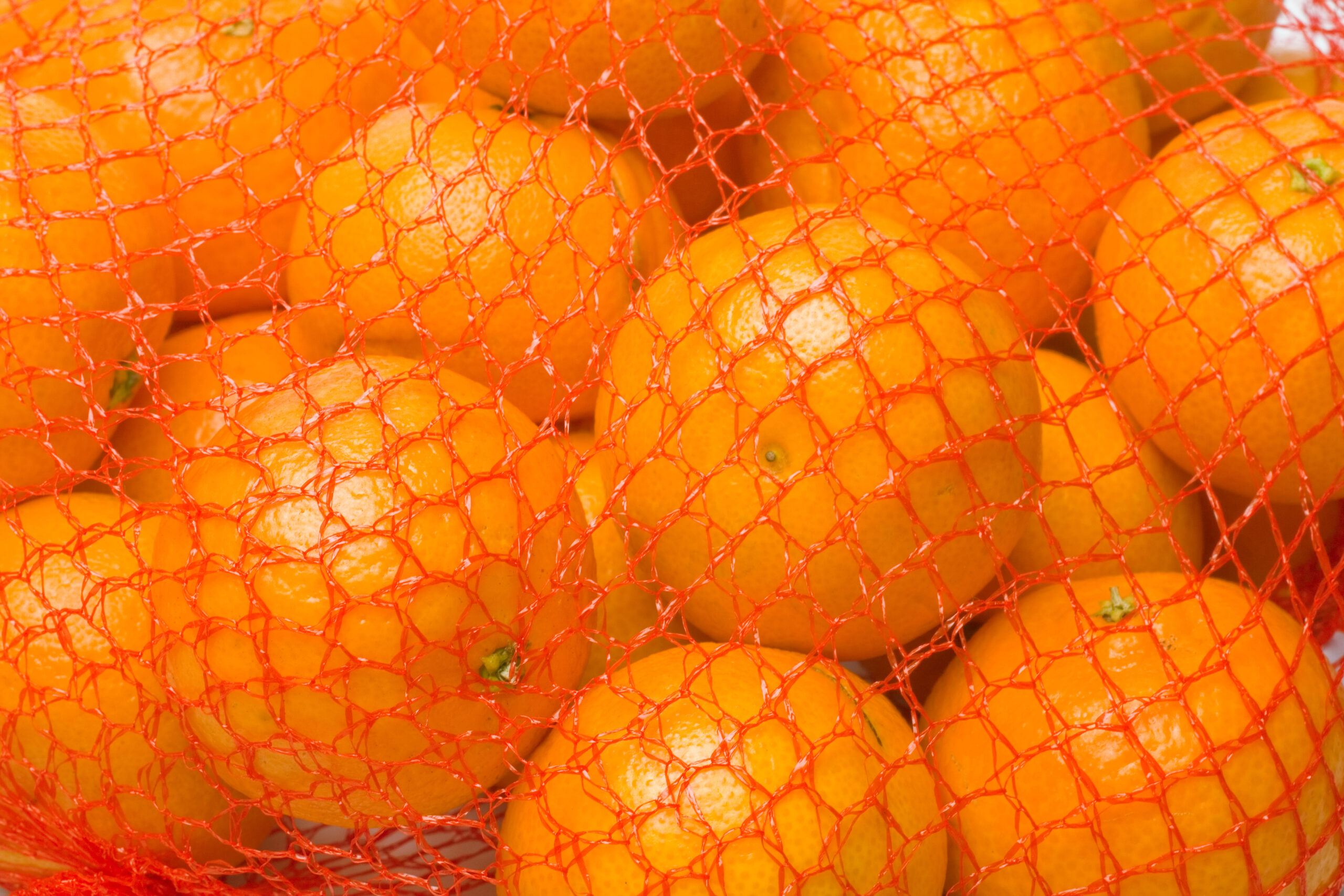
When you walk through a supermarket, you may come across oranges and mandarins displayed in red mesh bags for sale. At first glance, you might think that the fruit is placed in these bags for ventilation or easier customer access. However, the reality is that this is a sales technique that utilizes optical illusion. Those unaware often fall into the trap set by businesses.
According to a report by Scientific American, when you see oranges in mesh bags at the supermarket, they appear ripe and tempting. But once you bring them home and remove them from the bag, you may be surprised to find out that they are not ripe yet!
The reason for this visual deception lies in a phenomenon called “color assimilation” or “confetti illusion”. Objects tend to take on the color of the patterns covering them.
In this case, even though the oranges are not ripe and their peels are green, when placed inside a red mesh bag, they appear redder and more mature than they actually are.
Similarly, lemons are often packaged in yellow mesh bags to enhance their natural color. If they were placed in red bags, they would appear more orange and less appealing than usual.
When fruits are packaged in mesh bags of colors similar to fully ripe fruits, they tend to sell better. This phenomenon is well-known in the fruit and vegetable trade industry and now has scientific backing.
In a study published in 2024 by Karl R. Gegenfurtner, a psychologist from Giessen University in Germany, it was explained how red mesh bags in supermarkets use the “confetti illusion” to create misleading sensory stimuli for consumers.
Gegenfurtner noticed many ripe oranges in red mesh bags at the supermarket, which seemed convenient. However, upon bringing them home and taking the oranges out of the bag, he was surprised to see that the appealingly colored oranges turned out to be green!
After the initial disappointment, this color researcher became highly interested in the phenomenon. To eliminate the possibility that this visual effect was solely due to light reflection between the bag and the fruit, he simulated the bag with striped patterns and placed a picture of an unripe green orange behind it using graphic techniques. The result showed the orange instantly appearing much darker.
The researchers concluded that simply through the process of “color assimilation,” the appearance of colors can significantly be altered, transforming the originally green-looking oranges into visually appealing oranges. It goes without saying that fruit sellers have long been aware of this.
Researchers pointed out that in regular supermarkets, it is not difficult to notice fruits and vegetables (such as lemons, onions, cucumbers, and even potatoes) being packaged in mesh bags, often showcasing the perfect color of such agricultural products. The light reflection between the mesh bag and the fruit may further enhance the saturation of colors.
The research report explained that “color assimilation” is based on the principle that our brains have specific mechanisms for processing peripheral vision and color perception.
Essentially, our brains strive to provide us with a fluent, seamless, and easily understandable visual experience. When oranges are covered in red mesh bags, the brain combines the neighboring colors, simplifying our visual perception.
Despite the fact that placing oranges in red mesh bags may lead consumers to mistake their ripeness, whether this trick actually increases the overall sales of oranges remains uncertain. Perhaps researchers could delve into this further.
It’s worth mentioning that if oranges are not placed in red mesh bags, how can you choose to ensure you buy sweet oranges? Japanese nutritionist Reiko Fukushima suggests five tips for selecting sweet, juicy oranges, including firm touch, small navel, flat shape, substantial weight and fine texture, and slightly smaller size.
In case you end up with sour oranges, there is a simple trick to make them sweet. By slightly heating the oranges in a microwave and then cooling them, the acidity diminishes, making the oranges taste sweet!
Extend your reading with: How to choose the best-tasting oranges? 1 trick to make sour oranges sweet.