
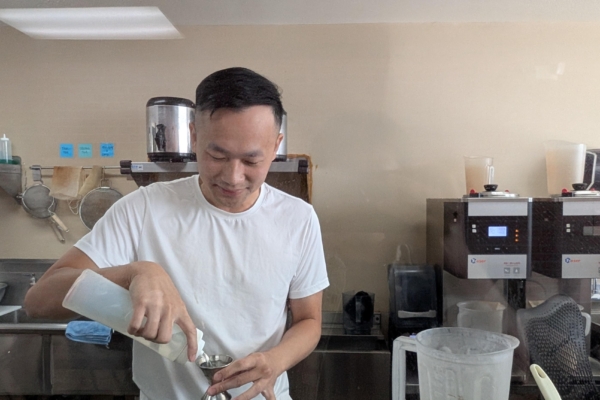
In the surrounding cities of San Gabriel Valley in Southern California, young people can be seen holding cups of pearl milk tea everywhere, and drinking “hand-shaken drinks” is no longer exclusive to the Chinese community. Huang Yongsheng, the founder of Nest Tea House, who immigrated to the United States with his family at the age of 14, has witnessed the transition from “Asian nostalgia” to a “global lifestyle.” To him, the tea shop is not just a business, but also holds the warmest social memories of his growth experience.
Looking back on his student days, Huang Yongsheng found that the most unforgettable moments were not in upscale restaurants but in beverage shops, where he would order a cup of milk tea, open his textbooks, and do homework with classmates. Even though he did not immediately enter the food and beverage industry when he grew up, the feeling of “tea combined with socializing” always stayed with him.
In 2016, Huang Yongsheng decided to start a business with a few like-minded friends. He admitted that the team had no knowledge about the tea beverage industry at the beginning, only diving in headfirst fueled by their love for boba milk tea.
During the early stages of their entrepreneurial journey, they started from the basics of selecting ingredients and operating machines, testing flavors repeatedly in the shop every day. Huang Yongsheng mentioned that their mindset at the time was both that of entrepreneurs and consumers. They continuously analyzed consumer preferences, moving beyond simply “tastes good” to precise control of aroma levels and quality.
In the United States, most Taiwanese chain brands tend to focus on “quick takeout” models to reduce rent and management costs. However, Huang Yongsheng took a different approach. He believed that for bubble tea to thrive in America in the long run, it needed to align with the local coffee culture and become a “third space” outside of home and work.
Huang Yongsheng emphasized: “We want our storefronts to be more than just transaction places; they should be living spaces.” Therefore, Nest Tea House deliberately set up more seating areas, provided high-speed WiFi, and chose locations away from overly crowded or difficult parking areas, instead looking for community corners where customers can relax. This “service-oriented” model turned the beverage shop from a grab-and-go window into a social hub where students can study and remote workers can work.
To bridge the consumption gap brought by cultural differences, Huang Yongsheng required his staff to adopt proactive service models. With green tea and oolong tea as the main focus in the shop, they emphasize the flavor of the tea itself rather than blindly following the overly sweetened market trends. When dealing with non-Asian customers unfamiliar with tea beverages, the staff would first ask about their drinking habits and then provide customized recommendations on sweetness levels and ice.
In recent years, with chains like CoCo, 50 Lan, and Gong Cha aggressively expanding in the U.S., the tea beverage market has entered a “highly competitive” era. Huang Yongsheng observed a significant brand differentiation in the market: the preferences of the younger generation are shifting from traditional milk tea to products with more visual impact and suitable for social media check-ins, such as the currently popular matcha series, which blends fashionable appearance with a healthy image.
Facing competition from chain brands, Huang Yongsheng insisted on maintaining stable operation with standalone stores rather than adopting a franchise system. He believed that independent operation could better embody cultural characteristics and brand concepts. Despite inflation post-pandemic leading to increased raw material and labor costs, he strived to maintain stable prices and expand customer base through school orders, catering for weddings, and other means.
Huang Yongsheng analyzed: “The key to retaining a stable customer base is to continuously attract new consumer groups, not just sticking to existing loyal customers.”
Recently, Nest Tea House has also collaborated with the Overseas Community Affairs Council of the Republic of China. Customers using the iChiao card can enjoy a 15% discount; they will continue to deepen interaction with the community in the future and expand service scope through the iChiao card platform, using this opportunity to give back to the community for their long-term support and to further root and develop Taiwanese tea culture in overseas markets.
The development of Taiwanese tea beverages in the United States has evolved from testing the waters in Asian communities to a globally branded bubble tea market across different ethnic groups. Huang Yongsheng believes that the success of Taiwanese bubble tea lies in its “highly customized” and “diverse options,” which align well with the American consumer culture’s emphasis on personal choices.
Now, this cup of pearl milk tea served in a transparent cup is no longer just a “Taiwanese beverage” but a lifestyle drink that can compete with coffee and has endless possibilities for extension. In the fiercely competitive land of Southern California, entrepreneurs like Huang Yongsheng, by persisting in quality and deep understanding of the local community, are allowing Taiwan’s tea culture to bloom more vibrantly in the American soil. ◇