
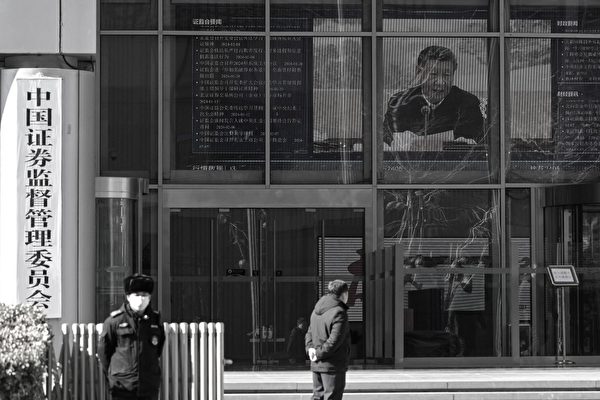
Two Chinese economists, Gao Shanwen and Fu Peng, recently faced censorship after addressing domestic economic issues in a lecture. Reports have emerged that regulatory authorities in multiple regions of China are restricting public statements from chief economists, securities analysts, and fund managers, sparking discussions among netizens.
According to a report by Caixin on December 19th, insiders revealed that regulatory authorities in various regions of China have started imposing supervision requirements on securities firms to strengthen the management of public opinions within the industry, particularly from chief economists, securities analysts, fund managers, and other external spokespersons.
Insiders mentioned that some securities research institutes have internally emphasized that research reports should be based solely on perspectives, instructing analysts not to make outrageous statements for attention-grabbing purposes. Analysts are urged not to lower their standards to attract clients or follow market trends, and they are warned against testing regulatory boundaries with a sense of opportunism.
The regulations also prohibit staff members from providing research notes on listed companies to clients in any manner, stating that such notes should only be stored internally or used as material for research reports.
On overseas platforms, many netizens find the Chinese authorities’ actions bewildering, mocking them by saying, “Regulating statements? Is it necessary to be so troublesome? Just provide a template for public statements, and anything outside the template is forbidden. The financial sector is the lifeblood of the nation; how can we allow people to point fingers at will?”
“Creating false prosperity, a false sense of superiority, singing the praises of economic brightness, and creating a spectacle of peace and prosperity.”
“A specter is haunting China – the specter of Chinese economic brightness. It hovers above the quagmire of contemporary human societies.”
“Next step: ‘Guidelines on Chief Economists and others proactively issuing positive forecasts and praises regarding market conditions and economic development.’”
“What kind of society has degenerated to such a level, treating fundamental human rights so poorly, it’s akin to handling cattle. Where does this confidence come from? What is confidence?”
“Eliminating all the roosters that crow leaves only the hens.”
“Go to China to experience chaotic traffic, littered streets, shared bicycles scattered around, reckless cyclists, plastic garbage everywhere – how can the Chinese economy recover amidst these scenes? Accompanied by high unemployment rates and scenes of decay and filth, this is clearly the prelude to a collapse.”
These developments are reminiscent of the recent silencing of economists Gao Shanwen and Fu Peng due to their outspoken remarks.
During the 2025 Investment Strategy Conference held by Guotou Securities in Shenzhen on December 3, Gao Shanwen, Director of the Guotou Industry Research Institute and Chief Economist of Guotou Securities, delivered a speech that was live-streamed by various Chinese domestic platforms.
Gao summarized the post-pandemic Chinese society in three phrases: “Energetic elderly, lifeless young people, and hopeless middle-aged individuals.” He also estimated that the country’s Gross Domestic Product may have been overestimated by ten percentage points over the past three years. “If we make a three-percentage-point correction, from a global perspective, China would become a relatively normal country.”
Fu Peng, Chief Economist of Dongbei Securities, stated during a conference at HSBC Private Wealth in Shanghai on November 24 that China’s economy had already encountered “major problems” before the pandemic in 2019. In recent years, the situation has not only failed to improve but has further deteriorated. China’s economic issues are far more severe than they appear superficially, with the core problem being insufficient effective consumption. The decline in purchasing power is not a short-term phenomenon but a structural change. The most significant challenge at present is the sharp contraction of the middle class.
Fu Peng boldly criticized the prevailing public opinion environment, stating, “Whoever says it’s not working becomes a traitor, whoever says it’s not working is unpatriotic, and those who dissent online will be attacked. It’s truly terrifying that if nobody speaks out, at critical junctures, all the feedback loops of information will form fallacious misconceptions, leading even the decision-makers to make mistaken judgments. It will be disastrous in the end. At that point, who causes the national and public detriment? History will provide a correct evaluation.”
After their speeches went viral online, both Gao and Fu had their WeChat and short video platform accounts blocked. Some analysts speculate that the censorship of Gao Shanwen and Fu Peng on social media platforms may be related to the repeated emphasis by Xi Jinping, the paramount leader of the Chinese Communist Party, and Cai Qi, a member of the Politburo Standing Committee in charge of propaganda, to propagate the “economic brightness theory.”
Current affairs commentator Wang Jian, when speaking to Radio Free Asia, pointed out that the economic challenges in China are widely known, making it difficult for scholars to align with official narratives promoting economic prosperity. Banning scholars who tell the truth will only lead to silencing experts and scholars, making it harder for the general public to know the truth.
Media personality Shen, a self-media figure, mentioned that the silenced experts’ opinions are not politically sensitive but are still censored by the authorities, reflecting a sense of unease and the fragility of the regime regarding the current social conditions. The authorities fear that any discourse might impact the stability of the regime.
Over the past year, numerous Chinese economists have been censored for voicing opinions that do not align with the official line. This includes individuals such as former Dean of the School of Business at China University of Political Science and Law, Liu Jipeng; Chairman of Shenzhen Oriental Harbor Investment Management Company, Dan Bin; financial blogger Hong Rong; Founder of Glorum Investment Research Institute, Chen Shouhong; well-known commentator Shui Pi; economist Ma Guangyuan; finance writer Wu Xiaobo; and former senior investment consultant at China Jinmao Wealth Securities, Xu Xiaoyu.