
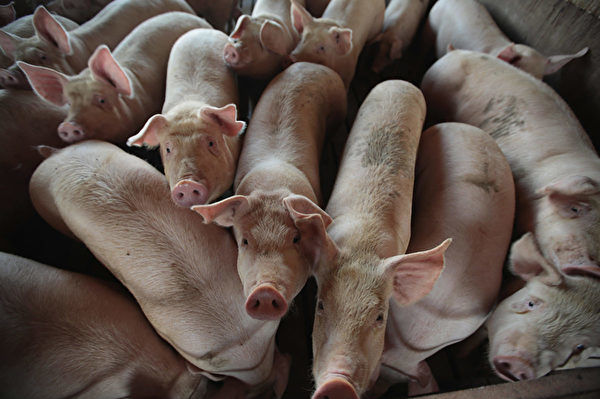
In the second week of June, the price of live pigs in China continued to decline, marking over 20 months running at the bottom. According to data from the Ministry of Agriculture and Rural Affairs of the CCP, for the second week of June (June 8-14), the national average price of live pigs was 10.08 yuan (RMB) per kilogram, a decrease of 0.6% compared to the previous period. The price of pork in the market was 19.77 yuan per kilogram, down by 0.4% compared to the previous period. Additionally, based on monitoring and surveys in 200 wholesale markets, the average wholesale price of pork was 14.53 yuan per kilogram, a decrease of 0.8% compared to the previous period and a 28.1% year-on-year drop.
In response to this trend, China’s Caixin reported on June 15th that the downward cycle in the live pig market started in 2022, and it has been ongoing for over 40 months since it entered the declining phase in December of the same year. The market struggled within a 10% range around the bottom price for more than 20 months, breaking historical records for the downward and bottoming phases. In mid-April of this year, some provinces saw prices drop below 8 yuan per kilogram, with the average price hitting a new low not seen since June 2009.
The continuous decline in pig prices has led to a persistent decrease in profits for pig farming enterprises, pushing them into losses. According to the financial reports of listed pig companies in China for the first quarter, all of them reported losses. For instance, leading companies like Muyuan Co., Ltd. reported losses of 1.2 billion yuan, Wens Foodstuff Group suffered losses of 1.07 billion yuan, and New Hope Group incurred losses of around 900 million yuan. In May, these three pig companies continued to experience a decline in sales revenue, with Muyuan Co., Ltd. recording sales revenue of 8.565 billion yuan, down by 30.13% year-on-year; New Hope’s revenue from commodity pigs sales was 1.386 billion yuan, a 20.10% decrease; and Wens Foodstuff’s revenue reached 3.24 billion yuan, a decline of 39.13%.
Concerning the long-running bottoming phase of the pig market cycle, researcher Zhu Zengyong from the Institute of Animal Husbandry and Veterinary Science at the Chinese Academy of Agricultural Sciences expressed that, based on an average cost of around 13 yuan per kilogram for live pigs, highly efficient farms have production costs of approximately 11-12 yuan per kilogram, resulting in small to moderate losses for them. However, for farmers with costs ranging from 13 to 14 yuan per kilogram, they are facing moderate to severe losses.
In terms of the current period of the pig cycle remaining at the bottom, Zhu Zengyong believes that historically, the overall rising time of the live pig market is shorter than the declining time. Since September 2024, the price of live pigs has been on a downward trend, hitting a recent low in April this year. While there have been slight rebounds recently, the market is mainly showing narrow fluctuations.
Wang Ligang, a researcher at the Institute of Animal Husbandry and Veterinary Science at the Chinese Academy of Agricultural Sciences, stated that there have been changes in the Chinese live pig market: the number of offspring per sow has increased by 20% to 30%, the average litter size per sow has risen from about 2.1 to 2.3-2.4 litters, and the mortality rate of piglets has decreased. These factors have contributed to an improvement in the efficiency of pig farming enterprises.
Zhu Zengyong further commented that the fluctuations in live pig prices are more characterized by narrow, oscillating rebounds with limited magnitude, rather than a significant turning point as expected by many. The future of the pig cycle in China is likely to exhibit cyclical features, with no clear turning points, and more likely to see seasonal or localized periods of price increases or declines driven by supply and demand.
Regarding the prolonged period of the live pig market remaining at a low level in China, analysts generally attribute this to abundant market supply and the downturn in the Chinese economy, leading to sluggish consumer spending. Chinese commentator Wang He previously pointed out to a media outlet that the demand side in China is stable with a slight decline, but rapid expansion in supply has led to a situation of oversupply, reflecting the problem of insufficient domestic demand.
However, some netizens speculate that the significant decrease in demand may be a result of a genuine decrease in the Chinese population.