
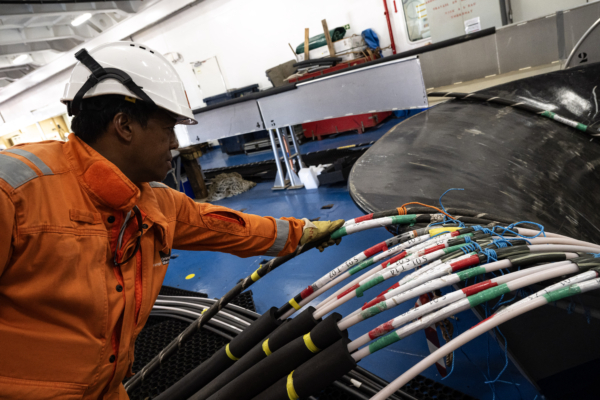
On Saturday, May 30th, at the Shangri-La Dialogue held in Singapore, defense ministers and representatives from 17 countries gathered to discuss defense cooperation on key maritime infrastructure such as undersea cables, with both the U.S. and China absent. The purpose was to establish international norms to prevent intentional harm to these critical infrastructures.
Singapore, Brunei, Malaysia, the Philippines, Thailand, Australia, New Zealand, Qatar, Estonia, Finland, France, Italy, Latvia, Lithuania, the Netherlands, Sweden, and the United Kingdom participated in the release of the “Undersea Infrastructure Defense Exchange Guidelines,” but the U.S. and China were notably absent from the list.
In recent years, a series of incidents involving the sabotage of undersea cables has become a focal point of this year’s conference. The threats of cable damage are often attributed to China, Iran, and Russia.
Australian Defense Minister Marles stated that the ocean is currently the most complex and competitive strategic environment. He highlighted the unprecedented scale and frequency of attacks on critical undersea infrastructure, emphasizing the vulnerability of global key infrastructure.
Incidents such as the cutting of fiber optic cables connecting the Baltic Sea countries and cables around Taiwan, Japan, and the Philippines have been reported in recent years. There are suspicions that China may be behind some of these damages, using “gray zone” tactics to test boundaries.
Furthermore, in April, Chinese state media and research institutions confirmed the successful testing of a self-developed undersea cable cutting device at a depth of 3,500 meters, raising international concerns and condemnation.
On another front, in April, the Islamic Revolutionary Guard Corps of Iran threatened to disrupt undersea cables in the Persian Gulf region as retaliation if the U.S. and Israel continued bombing the Iranian regime and lifting the blockade on Iranian ports.
The risk of undersea cable disruptions poses a severe threat to Australia, where up to 99% of network traffic relies on these cables for various critical services, including financial transactions, medical services, communication, intelligence cooperation, and the functioning of the modern economy and the nation as a whole.
Marles pointed out that Australia is not the only country facing such challenges and highlighted the importance of safeguarding undersea cables as vital arteries of modern civilization, connecting regions with cloud services, global markets, and the digital economy.
He stressed that the response to these threats has been delayed and needs to be prioritized strategically. The competition on the sea surface is reshaping the maritime domain.
The “shadow fleets” operating between commercial shipping and state coercion have not only been involved in cable sabotage but have also been utilized for evading sanctions, transporting sanctioned oil, illegal fishing, human trafficking, and drug smuggling.
The transformation of the maritime domain is imminent, with the seabed becoming a battleground and shadow fleets turning into weapons. The vital chokepoints maintaining regional prosperity are facing unprecedented pressure in modern history.
Marles urged countries to collaborate with partners in Southeast Asia, the Northeast Indian Ocean, and the Pacific region to prevent conflicts and ensure the security and prosperity of the region.
Analysts believe that the guidelines and the range of countries involved might attract more global attention and promote specific policies to safeguard infrastructure security. Chris Gardiner, the Executive Director of the Australian Strategic Policy Institute, believes that cooperation among medium-power nations can combine economic efficiency and advanced technology to protect critical undersea infrastructure collectively.
Moreover, experts assessed that the absence of major powers in the cooperation initiative may hinder optimal technical capabilities and capacities. However, excluding major powers at times could facilitate easier communication and collaboration among like-minded small and medium countries, forming a form of “soft balance” against major powers.