
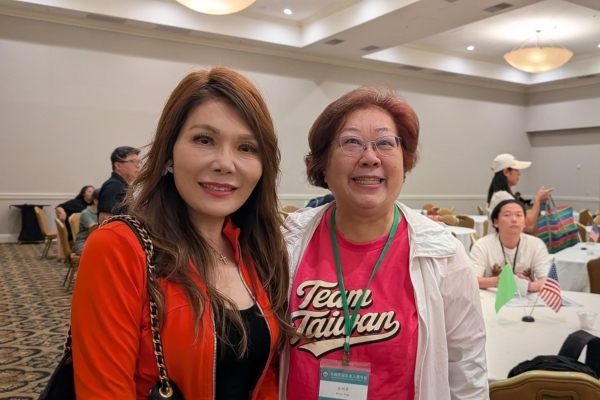
Taiwanese veteran news anchor Zhang Yaqin recently embarked on a cross-city speaking tour in the United States at the invitation of Song Mingli, the president of the All-American Taiwanese Association. She participated in the “2026 American West Taiwan Summer Conference” held in San Diego from July 10th to 12th. Zhang expressed her hope that through face-to-face exchanges with overseas Taiwanese, she could share frontline news observations from Taiwan and understand the concerns of overseas compatriots about the current situation in Taiwan.
Zhang Yaqin revealed that shortly after completing her news work in Taiwan, she immediately took a late-night flight to the United States, visiting cities such as Philadelphia, Chicago, Los Angeles, before finally arriving in San Diego to attend the summer conference.
She mentioned that the key purpose of her invited speeches was to establish a more direct connection with overseas audiences. Witnessing the continued passion of overseas Taiwanese for Taiwan and their willingness to care about Taiwan’s development deeply touched her.
During the summer conference, Zhang Yaqin shared insights on Taiwan’s current situation from a media perspective. Topics ranged from the Taipei mayoral election, the attack on media personality Yata Itamio, to China’s recent legislative measures related to Taiwan such as the “National Unification Promotion Law” and their potential impact on Taiwan.
In recent times, the Chinese Communist Party has been frequently taking legal actions against Taiwan, aiming to expand beyond the “sovereignty red line” to include “daily identity” and “transnational governance.” This legal warfare aims to normalize deterrence and jurisdiction through specific legislation, significantly affecting Taiwanese people and the international community. Zhang Yaqin stated that these laws carry a sense of “long-arm jurisdiction” seeking to suppress global pro-Taiwan voices. Such ambiguous political definitions may lead to a chilling effect across borders, increasing pressure on Taiwan.
Discussing cross-strait relations, Zhang Yaqin observed a noticeable “perceptual gap” between Taiwanese people at home and abroad regarding the military pressure from China. While overseas Taiwanese often feel highly anxious when witnessing Chinese military activities, some Taiwanese locals, accustomed to similar situations over the years, exhibit relatively subdued reactions.
Zhang emphasized that while Chinese military aircraft circling Taiwan is indeed a form of pressure, it does not necessarily signify an immediate threat of war to Taiwan. She highlighted that it is essential to pay attention to the broader impact of China’s influence on Taiwan, extending beyond the military domain to include legal, political, and social aspects.
Citing examples of Chinese-related legislative measures targeting Taiwan, Zhang pointed out the dual nature of Beijing’s Taiwan strategy, with actions often contradicting their public statements. She stressed the need for Taiwanese society to remain vigilant and understand the potential long-term implications of these measures.
In particular, Zhang highlighted the assault on media personality Yata Itamio following his speech in Taichung as an example illustrating how Chinese pressure on Taiwan has transcended military aspects, infiltrating political, legal, and social spheres. Following the subsequent arrest of a suspect by the authorities, this incident has reignited strong concerns from observers regarding political violence, freedom of speech, and cross-border interference by external forces.
Regarding Taiwan’s party politics, Zhang noted a shift in attitudes among some political figures towards cross-strait issues. She criticized the past practice where politicians, when questioned about their pro-China stance, would typically emphasize maintaining distance from the Chinese Communist Party. However, in recent years, some have adopted more direct rhetoric sparking public discussions.
Addressing the evolving landscape of Taiwan’s party politics, Zhang also mentioned recent statements from Kuomintang Party Chairwoman Cheng Liwen during her visit to the United States. Cheng, while attending a community banquet in San Francisco in early June, mentioned that without the “Cheng-Xi meeting,” she might have remained just an “ordinary chairwoman of the Kuomintang,” sparking discussions among the public.
Zhang expressed surprise and confusion at Cheng’s remarks, indicating a noticeable shift in the discourse on cross-strait relations among some Taiwanese political figures. She highlighted that while politicians used to rush to clarify and avoid being labelled as “pro-Beijing” amidst such allegations in the past, some are now more straightforward in their statements.
Zhang suggested that these “highly” pro-Beijing political stances may trigger debates within Taiwanese society and the Kuomintang regarding different approaches towards cross-strait relations. She believes that continued observation is warranted to monitor potential adjustments and reactions within party ranks in the future.