
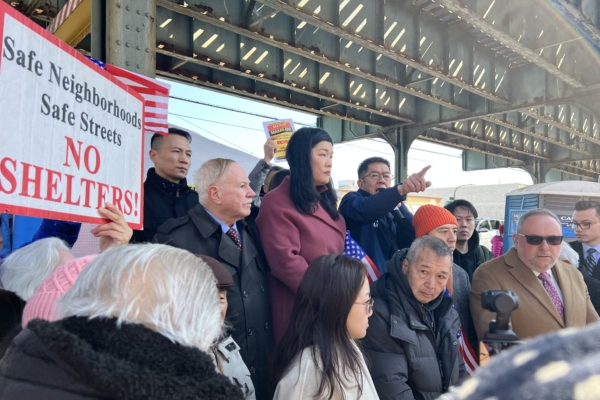
In the legal battle over the homeless shelter project on 86th Street in Brooklyn, new developments have emerged. On June 22, lawyers representing several local elected officials who were sued by the developers filed a counter-motion in court to dismiss the lawsuit. The developer, 86 St. NY LLC, filed a lawsuit in the New York State Supreme Court in March, alleging that years of protests against the homeless shelter had disrupted construction operations and sought a temporary restraining order (TRO) and preliminary injunction to prevent individuals from obstructing construction and interfering with access to the site.
The defendants in the case include State Assemblyman William Colton, State Senator Steve Chan, Councilwoman Emily Chau, State Assemblyman Lester Chang, Congresswoman Nicole Malliotakis, as well as Chinese property owners and unnamed individuals adjacent to the property at 2501.
The joint representative lawyer for the four elected officials, except Emily Chau, Jimmy Wagner, requested the dismissal of the developer’s injunction application and related lawsuit. Emily Chau was individually represented by lawyer Eric Hiatt, who also sought the dismissal of the plaintiff’s lawsuit but planned to focus on procedural disputes.
According to the counter-motion documents, lawyer Jimmy Wagner first argued that although the developer filed a notice and application for injunction on March 26, they have yet to formally file a complaint as required by the court, therefore the case should be dismissed.
The counter-motion further argues that this case qualifies as a Strategic Lawsuit Against Public Participation (SLAPP), which is typically a lawsuit aimed at pressuring critics, advocates, or community opponents through legal means to silence speech and discourage public participation. In simpler terms, it is a way of “shutting you up by suing you.”
The defendants’ lawyers pointed out that the reason the four elected officials were sued was mainly due to their public opposition to the 86th Street homeless shelter project over the years, and their organization, promotion, or participation in related demonstrations. These actions involve public policy discussions, political expression, and petitioning the government, all of which are protected under the First Amendment of the U.S. Constitution and New York’s anti-SLAPP laws.
The counter-motion argues that even though the developer claims the lawsuit aims to prevent intrusion and disruption of construction, the specific allegations against the four elected officials primarily focus on their public advocacy and mobilization against the homeless shelter, rather than actual obstruction of the construction site. The lawyers believe that speaking at public gatherings, organizing demonstrations, and expressing political stances do not constitute wrongful acts.
Furthermore, the counter-motion questions that the plaintiff failed to specifically demonstrate instances where William Colton, Steve Chan, Lester Chang, and Nicole Malliotakis personally engaged in acts such as intruding on the construction site, blocking pathways, or impeding construction. Instead, all defendants were broadly generalized, making it impossible to establish causes of action such as trespass, private nuisance, or interference with business relations.
Additionally, the defendants’ lawyers argued that state legislators and congress members, when performing their duties as representatives of the public, overseeing the government, and speaking out on public affairs, are protected by legislative immunity and related constitutional principles. The court should not restrict their communication with constituents or participation in public discussions through injunctions. Legislative immunity ensures that lawmakers can “speak freely and supervise without fear” without being harassed by the law for carrying out their duties.
Based on these reasons, the defendants requested the court to dismiss the plaintiff’s injunction application and the lawsuit against the four elected officials, and demand that the plaintiff cover the litigation costs and reasonable attorney fees as per New York’s anti-SLAPP laws. The defendants also argued that if the court determines that this case aims to suppress speech or public participation, the plaintiff should also bear additional responsibility for damages.
According to the current court schedule, the court will first handle the defendants’ dismissal motion and related procedural disputes before deciding whether to further review the developer’s application for injunctive relief.
Emily Chau’s motion filed by her lawyer independently will be heard on August 6, arguing that the plaintiff failed to timely file a formal complaint and did not provide sufficient factual basis to support the injunction application. The joint counter-motion by the remaining four elected officials is scheduled for August 12, asserting that this is an anti-SLAPP case and invoking constitutional defenses such as the First Amendment and legislative immunity to request the case be dismissed.