
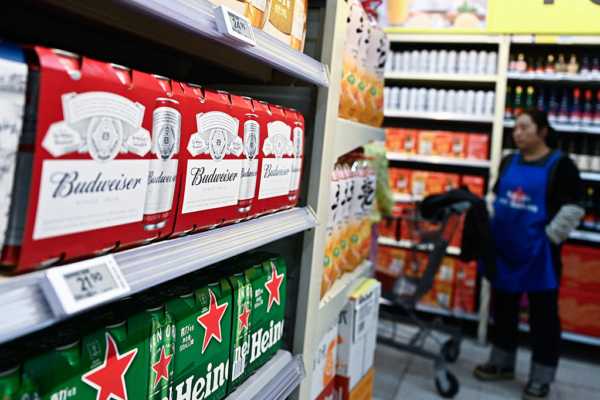
After the opening of the 2026 FIFA World Cup in the United States, Canada, and Mexico, the event failed to reverse the downward trend of Chinese beer stocks. Multiple beer stocks experienced significant declines. At the same time, the Baijiu (Chinese white spirit) sector continued to decline, with pressures on indicators such as the number of corporate clients, unit prices, revenue, and profits.
According to a report by the “Daily Economic News” on June 21st, within the week ending on June 18th, five Chinese beer stocks saw declines of over 10%.
Among them, Huiquan Beer fell by 20.16% in a single week; Budweiser APAC, Tsingtao Brewery, Yanjing Beer, and Zhujiang Beer all experienced weekly declines exceeding 10%. The World Cup did not lead to a strong performance in the beer sector.
The beer sector had previously been expected to benefit from consumer spending during the World Cup matches. The report cited by the “Daily Economic News” referred to a review by Changjiang Securities of the last three World Cups in 2014, 2018, and 2022, stating that the beer sector usually attracts attention before the tournament starts but does not perform significantly during and after the event.
In the 2018 World Cup, for instance, the beer sector saw a 21.71% increase in the 90 days leading up to the tournament, but experienced declines during and after various periods throughout the event.
Changjiang Securities analysis pointed out that beer consumption peaks typically occur from May to August, with companies starting stocking up in late March. The World Cup coinciding with the peak stocking season may have caused the market to anticipate consumer spending on watching the matches in advance; however, as matches progressed, the related expectations were gradually met, and the distribution channels then moved into destocking phases.
An article by mainland media Ǒuxùe Net on June 21st stated that the World Cup this year was jointly hosted by the United States, Canada, and Mexico. Due to the time difference, many key matches for Chinese viewers fall between 3 am and 9 am.
The article mentioned that the time difference weakened China’s common consumption scenes like late-night snacks, barbecue, beer, and watching games. The absence of the Chinese national football team in the World Cup also resulted in a lack of enthusiasm among mainland consumers due to not having their own team to cheer for.
Some shop owners set up projection equipment in advance, stocked thousands of yuan worth of beer and snacks, and sent out match-viewing notifications to customers, yet the opening match held at 3 am did not bring the expected customer traffic.
Some craft beer pub operators opted out of overnight operations, believing that the costs incurred by extending hours, such as labor and utilities, might outweigh the revenue from watching the games.
While the World Cup failed to drive consumption, the Chinese beer industry itself is facing sales pressures.
The Ǒuxùe article mentioned that in 2025, China’s industrial enterprises above a certain scale produced 35.36 million kiloliters of beer, a 1.1% decrease year-on-year. From March to April 2026, beer industry data showed a gradual weakening, with beer sales in May significantly dropping compared to April.
By the end of 2025, Tsingtao Beer saw a 7.68% year-on-year decline in contract liabilities. According to Ǒuxùe’s analysis, the willingness of distributors to advance payments and take deliveries may have decreased.
The Baijiu sector is also struggling. The “Daily Economic News” reported that financial data and analysis service Wind data showed a 3.55% decrease in the Baijiu index by the closing on June 18th. After a temporary rebound at the end of May, the Baijiu sector saw a continuous three-week decline in June.
In terms of individual stocks, apart from delisted Yangshiku rising due to fund speculation, only the stocks of Jiugui Liquor and Shede Liquor recorded gains; Wuliangye, Kweichow Moutai, and Gujing Gongjiu, leading Baijiu stocks, all saw weekly declines of over 5%.
The Baijiu industry is also facing weak consumer demand, inventory pressures, and the issue of some products being wholesaled below the market-guided prices. Previous reports in Chinese media indicated that premium Baijiu brands like Feitian Moutai saw significant price declines compared to the previous year, and e-commerce’s low-price sales further impacted offline sales channels.
Citing a report from the China Alcoholic Drinks Association, the “Daily Economic News” mentioned that among surveyed companies, 61.2% reported a decrease in the number of customers or users, 74.1% reported a drop in unit prices, 74.8% reported a decrease in revenue, and 86.7% reported a decrease in profits.
These relevant data reflect that amid sustained weak consumption in mainland China, the short-term viewing demand brought by the World Cup failed to reverse the decline in the beer sector and the operational pressure on the Baijiu industry continues to intensify.