
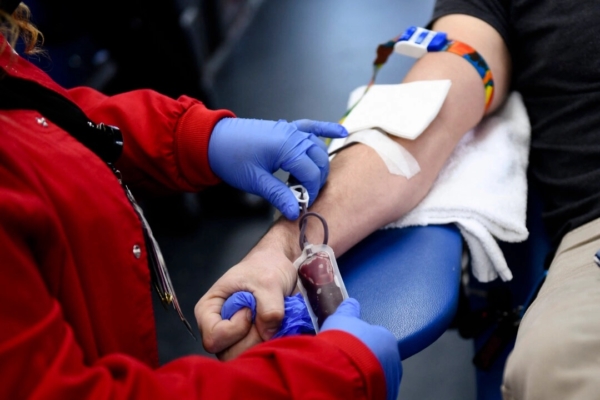
【Epoch Times June 19, 2026】 “National blood banks are in urgent need, but people are no longer willing to donate blood” has become a hot topic on June 19th, sparking widespread attention on the internet.
June 14, 2026, marked the 23rd World Blood Donor Day.
Recently, an article published by “Half Moon Talk” exposed the current “dilemma of voluntary blood donation.” The article mentioned concerns ranging from health issues to the fundamental trust of the public in the system of voluntary blood donation and blood fees, highlighting an unprecedented crisis of trust and mobilization within the voluntary blood donation system.
The Chinese Ministry of Health also acknowledged that the proportion of blood donors over 50 years old is very small. Meanwhile, China is facing problems of low birth rates and accelerated population aging. With a sharp decline in the number of newborns and a continuous decrease in the proportion of the young population, the seemingly stable age group eligible for blood donation is actually facing structural pressure due to the narrowing supply.
According to data released by the Chinese National Health Commission, by the first quarter of 2025, blood inventory had fallen below the warning line in 18 provinces, leading to urgent calls for blood donation in many areas. In 2024, the national clinical blood usage reached 78 million units, an 8.6% increase year-on-year, while voluntary blood donation only increased by 1.3%.
As reported by “Southern+,” Ren Jun, the deputy director of the Blood Transfusion Department at Sun Yat-sen University Affiliated First Hospital, mentioned that he and his colleagues receive calls daily from clinical departments to coordinate blood supplies for major surgeries and blood transfusions for patients with blood diseases.
“After over 20 years in this profession, I have noticed a significant change. The demand for blood is now more urgent than before, and even non-emergency surgeries may require advance blood reservation,” he said.
Guangzhou, as a medical center in South China, attracts a large number of out-of-town patients for treatment. Liang Huaqin, the director of the Guangzhou Blood Center, stated that currently, over 50% of blood usage comes from out-of-town patients. He mentioned, “Approximately 1300 people are needed to donate blood daily to meet the basic demand.”
The pressure to ensure platelets and rare blood types for critically ill patients, major surgeries, and long-term transfusion patients continues to increase due to their higher concentration.
For conditions such as bone tumors, cardiovascular surgery, doctors need to assess blood requirements and priority conditions in the outpatient stage. When blood supply is tight, some elective surgeries may be forced to be postponed.
However, for certain patients, blood transfusions are not a one-time need but a necessary condition for maintaining life in the long term.
Huo Chuan, the father of a 23-year-old patient with severe thalassemia, shared that his son, who was diagnosed at 4 months old, needs a blood transfusion approximately every two weeks, involving about 4 units each time. He helplessly mentioned, “There was once we had to wait for over two weeks extra.”
On June 10th, college student Xiaocen went to a blood donation center on Sports West Road in Guangzhou. With his sister about to undergo surgery, Xiaocen hoped that his voluntary blood donation record could entitle his sister to priority blood usage rights.
However, according to current regulations, the equal priority for blood usage among direct family members mainly includes parents, children, and spouses, but not siblings.
Xiaocen was surprised and disappointed by this revelation.
This perceptual deviation reflects the long-standing confusion among the public regarding who among the family members can have priority blood usage rights after blood donation and whether these related benefits can genuinely be realized.
As reported by “Southern+,” on a weekday morning, the blood donation center on Sports West Road in the bustling commercial district of Guangzhou appeared quite deserted.
Currently, there is a downward trend in blood donation from the streets and universities.
Several interviewees believe that lifestyles such as takeout and online entertainment have reduced outdoor activities for young people. Moreover, staying up late and suboptimal health conditions have made many young people lack confidence in their physical condition.
Deeper reasons lie in young people increasingly valuing health risks and personal rights.
Huang Jingya, deputy director of the Blood Donation Service Department at the Shenzhen Blood Center, mentioned that young people today tend to confirm first: Is blood donation safe? Can related rights be realized?
She stated, “Once negative cases of voluntary blood donation emerge, the spread is rapid.”
For example, incidents like “family members facing difficulties in acquiring blood despite multiple blood donations” continue to circulate on social media platforms, further intensifying public doubts about the system of voluntary blood donation.
Discussions on blood bank shortages have been prevalent since last year. In September last year, microblogger “Jiaojiao Talks Life” mentioned visiting a friend hospitalized due to a car accident and seeing a prominent banner at the Blood Transfusion Department: “Blood bank in urgent need of A-type, O-type blood.”
The article quoted the head nurse lamenting, “There used to be many blood donors, but now there are fewer.”
According to blood center staff, the number of blood donors in 2025 decreased by nearly 35% compared to five years ago.
A person named Xiao Li, who had donated blood three times, expressed, “I heard that hospitals charge a lot, which made me feel somewhat at a loss. I donated blood for free, but the hospital charges so much money, which doesn’t seem fair.”
According to a certain hospital’s public fee schedule, the cost of a 200ml whole blood transfusion is about 1000 yuan, but blood donors do not receive any compensation. Consequently, many question, “Why do patients have to pay a high price for blood donated by others for free?”
A survey released by a consumer rights protection organization in March 2025 revealed significant differences in blood transfusion fees among different hospitals and regions, with variations of more than 40% between the highest and lowest charges. This lack of transparency and uniformity in fees not only confuses patients but also further diminishes public trust in the voluntary blood donation system.
Apart from fee disputes, interviewees also mentioned several real-life factors influencing the willingness to donate blood.
Zhao, a 25-year-old, expressed concern, “I worry that donating blood may affect my health. After the last donation, I felt particularly tired and took several days to recover.”
Insufficient convenience is also a significant factor. Mr. Wang, 35 years old, said, “Working is usually too busy; it’s challenging to find time specifically for blood donation spots. Moreover, blood donation now requires appointments, which is troublesome.”
Some interviewees expressed concerns about personal privacy issues.
Li, a 40-year-old woman, said, “Blood donation requires registration of many personal details, and I worry about information leakage.”