
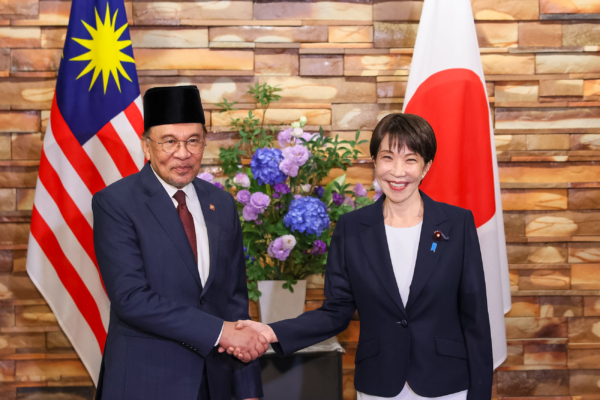
Japan’s Prime Minister Sanae Takashi held a summit meeting with visiting Malaysian Prime Minister Anwar Ibrahim at the Prime Minister’s official residence on Wednesday, June 10th. The two leaders engaged in in-depth discussions on security, energy security, critical mineral supply chains, and economic cooperation, affirming their commitment to further strengthen the bilateral “comprehensive strategic partnership”.
Before the meeting commenced, a welcoming ceremony with a guard of honor was conducted by the Japanese side in accordance with diplomatic protocols. Subsequently, the two leaders held formal talks, a joint press conference, and then proceeded to have a working lunch together.
During the press conference, Prime Minister Sanae Takashi stated that Japan and Malaysia, as important partners sharing fundamental values and principles, play significant roles in advancing the vision of a “free and open Indo-Pacific” (FOIP).
2027 marks the 70th anniversary of the establishment of diplomatic relations between Japan and Malaysia. Both sides affirmed their commitment to further deepen the longstanding friendly relations based on Malaysia’s former Prime Minister Mahathir Mohamad’s “Look East Policy” from the 1980s, expanding bilateral exchanges and pragmatic cooperation.
In the realm of security, both parties agreed on the vital importance of maritime security cooperation. Prime Minister Takashi mentioned that the Japan Maritime Self-Defense Force and the Royal Malaysian Navy will continue joint exercises, with Japan also supporting Malaysia in enhancing relevant capacity building through the “Government Capability Enhancement Support” (OSA) mechanism.
Additionally, new cooperation agreements were signed between the maritime law enforcement agencies of both countries to further enhance coordination in joint training and enforcement cooperation. Prime Minister Takashi emphasized that as nations reliant on key sea lanes, Japan and Malaysia reinforcing cooperation in the maritime domain will contribute to maintaining regional maritime security and stability.
In recent years, Japan has been strengthening security cooperation with Southeast Asian countries to tackle the increasingly complex security landscape in the Indo-Pacific region. Malaysia holds a strategic position in the regional maritime security framework, guarding the vital sea lanes of the Malacca Strait that connect the Indian Ocean and the Pacific Ocean.
Regarding economic and energy cooperation, Prime Minister Takashi highlighted that Malaysia is an essential trade and investment partner for Japan. She pointed out that Malaysia’s “Malaysia MADANI” development concept under the leadership of Anwar Ibrahim’s government aligns closely with Japan’s economic growth strategy, and both sides will further enhance cooperation between governments and businesses.
Facing rising uncertainties in the global energy market, Prime Minister Takashi emphasized that as a crucial supplier of liquefied natural gas (LNG) to Japan, Malaysia’s role in Japan’s energy security landscape is increasingly significant. Both sides agreed to strengthen cooperation in LNG, fertilizer materials, and other energy resources under the framework of Japan’s proposed “POWERR Asia” initiative, enhancing energy security capabilities.
They also reached a consensus on enhancing the resilience of critical mineral supply chains. Prime Minister Takashi mentioned that Japan and Malaysia will collaborate with like-minded countries and international institutions such as the Asian Development Bank (ADB) and the World Bank to promote the development, recycling, and supply chain construction of critical minerals. Several cooperation agreements were signed during the meeting in areas such as energy security, energy transition, and sustainable utilization of critical mineral resources.
Prime Minister Takashi stated that in the current increasingly challenging international environment, whether in security, energy cooperation, or supply chain infrastructure, enhancing cooperation will contribute to boosting the strategic autonomy and resilience of Japan, Malaysia, and the entire Indo-Pacific region. She underscored that both sides will leverage this summit meeting as an opportunity to further cement the comprehensive strategic partnership between the two countries, advancing cooperation to higher levels.
Japan and Malaysia elevated their bilateral relationship to a “comprehensive strategic partnership” in 2023. In recent years, the two countries have seen closer interactions in defense cooperation, supply chain security, semiconductor industry, and energy transition. Amid intensifying geopolitical competition and global supply chain restructuring, both nations aim to enhance regional stability and economic security through deeper cooperation.