
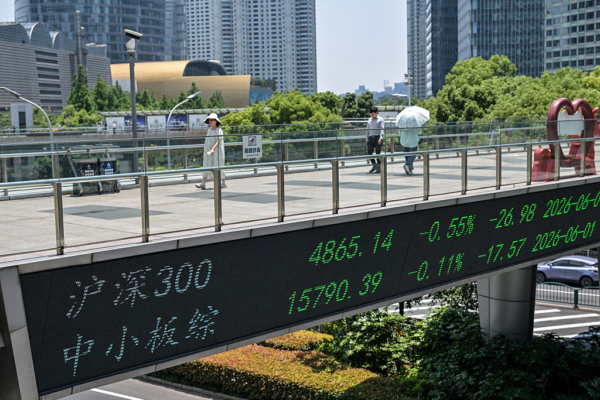
On June 10th, the A-shares market in mainland China experienced a full-day decline with all four major indexes closing down collectively. The Shanghai Composite Index fell below 4000 points, while the Shenzhen Component Index and the ChiNext Index both dropped by over 2%. Out of the total 3878 stocks traded that day, most of them showed a downward trend, with only a few sectors such as major financial companies and breweries seeing some gains against the overall market weakness.
According to a report by “Daily Economic News” on June 10th, at the close of trading, the Shanghai Composite Index was at 3993.23 points, a decrease of 0.42%; the Shenzhen Component Index was at 14954.10 points, down by 2.06%; the ChiNext Index stood at 3854.79 points, marking a 2.70% decrease; and the Sci-Tech Innovation Index reported 2014.20 points, down by 0.78%.
As reported by “The Paper” on the same day, the three major A-shares indices opened lower collectively, continued to fluctuate downwards in the morning session. Although there was a slight rebound towards the end of the day, the market still ended mostly in negative territory. Statistics from Wind, a Chinese financial data and analytics service, revealed that out of a total of 1556 stocks traded that day, 3878 stocks fell, while 1556 were flat.
The data further indicated that the total trading volume for the day in both markets was 2.6193 trillion yuan, a decrease of 210 billion yuan compared to the previous trading day. Specifically, the trading volume in Shanghai was 1.2271 trillion yuan, while in Shenzhen it was 1.3922 trillion yuan.
In terms of sector performance, most sectors experienced declines except for a few like major financials, breweries, industrial gases, PCB manufacturing, and semiconductor materials. Sectors such as machinery, communication equipment, coal, electronic components, power generation equipment, and precious metals were among the top decliners.
Within the declining sectors, coal, machinery equipment, and power equipment suffered considerable losses. Coal stocks showed overall weakness, with companies like Antaeus Group, Haohua Energy, Liaoning Energy, and Shaanxi Black Cat falling by over 6%. The machinery equipment sector witnessed significant drops in many stocks, with Huachen Equipment, Taijin New Energy, Plitec, and Qiaofeng Intelligence hitting trading limits or falling by over 9%. Similarly, the power equipment sector faced pressure, with companies like Sanray Intelligent, Jinsht, Megmeister, and Xiongtao falling by trading limits or over 10%.
Technology-related sectors also faced downward pressure. Previously active sectors like liquid cooling servers and data center power supplies saw declines, with stocks like Dayuan Pump, Tenglong Stock, and Megmeister hitting trading limits. The computing power sector fluctuated downwards, with noticeable declines in companies like Tianfu Communication and Kehua Data. Although stocks related to the robotics concept strengthened during the day, some eventually fell back.
Regarding the market outlook, several institutions believe that the market might continue to be dominated by fluctuations in the short term. “The Paper” cited a view from Zhongyuan Securities suggesting that external market fluctuations, interest rate expectations, and geopolitical tensions could continue to influence market sentiment, keeping the indexes in a volatile pattern. Hualong Securities indicated that overall, the market may continue to show alternating performance among different sectors.
Caixin Securities suggested that the short-term risk of a sharp decline in A-shares is low, but cautious sentiment among investors remains strong, and it is not yet confirmed if the market has rebounded. Everbright Securities also noted that the continued decrease in trading volume indicates cautiousness among in-market funds, suggesting that the market may continue to fluctuate in the short term, with potential alternating performances among different sectors.