
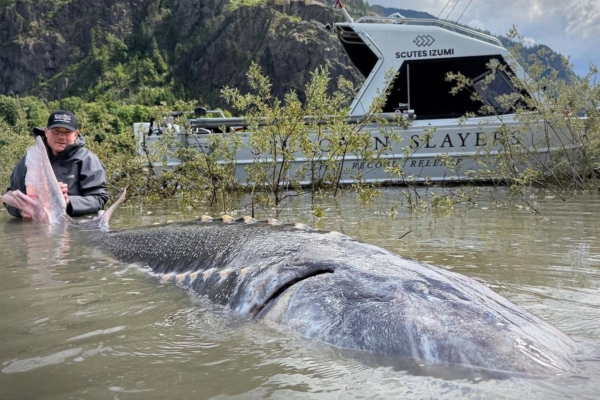
On a quiet morning along the Fraser River, near Chilliwack in British Columbia, the day seemed unremarkable. A thin mist enveloped the swollen river, freshening the air with a sense of serenity.
At 4:30 a.m. on a June morning, Kevin Estrada, aged 44, plunged into the sauna to warm up for a day of fishing for prehistoric monster fish. As the owner of Sturgeon Slayers, he had been a fishing guide for 18 years and was set to host some corporate guests that day. Around 7 a.m., he arrived at the departure point, firing up the 22-foot Thunder Jet aluminum boat, eagerly awaiting the arrival of special guests from the Alberta company Diamond Truck Centres around 8 a.m.
Estrada assured them that they would catch a sturgeon that day. How big? Well, that part remained uncertain.
Split into two boats, Estrada led Shawn North and Elvis Penton, truck transport managers from Fort McMurray, while his employees took the others. Estrada mentioned a good fishing spot north of Chilliwack, one he had taken NHL defenseman Nick Leddy to in 2024, where Leddy landed a remarkable 10-foot sturgeon, a once-in-a-lifetime catch for many fishing enthusiasts.
Estrada shared with The Epoch Times, “This place is known for big fish.” However, he chose not to disclose the exact location to avoid overcrowding and potential impact on their fishing business.
Many guides go a lifetime without seeing fish over 11 feet, what Estrada referred to as “unicorns.” In his career on the Fraser River, he had already caught two 11-footers. The company’s record stood at 11 feet 6.5 inches, caught by another client, NHL goalie Pete Peters, back in 2021, a record that remained unbeaten until that day.
The tranquil morning quickly changed when Estrada felt a tug on the line. Around 10 a.m., they reeled in a substantial catch, guiding the fish downstream to a predetermined spot strategically. The two truck drivers took turns reeling in the line.
During this time of year, snowmelt raised the river level, making navigation challenging with debris floating around, requiring skillful maneuvering. The guides had to guide the sturgeon to shallower waters for measurements and tagging, crucial for government research.
Estrada masterfully handled the situation. After a 40-minute struggle, he guided the exhausted fish to a sandy bar where he immobilized the giant, flipping it over to measure. The tape barely did justice to the size: 11 feet 8.2 inches long, with a girth of 60 inches, estimated to weigh between 1,100 and 1,200 pounds. This century-old giant broke the company’s 2021 record by nearly two inches, albeit without a tracking tag.
“Congratulations, folks,” Estrada said to the men, “We are witnessing a historic moment.”
As a leader in Fraser River conservation, Estrada had access to exclusive data, including sturgeon size records dating back decades. While acknowledging it wasn’t a world record, he recognized its historical significance, deeming it the “new record” for Sturgeon Slayers.
The boats converged, and everyone posed with the fishermen and the tranquil giant for pictures. Non-alcoholic beers were raised in celebration.
For Estrada, the capture symbolized more than a new record. Previously honored with the Order of the Crown of Charles III for his fisheries research and flood rescue work, the untagged sturgeon bore witness to the river’s vitality.
Estrada stressed, “The most profound lesson here is that conservation efforts do work.” He highlighted British Columbia’s strict catch-and-release model, emphasizing the sustainable fishing practices that support both fish populations and the industry.
White sturgeons, ancient creatures that survived two hundred million years and two ice ages, boasted an astonishingly low 0.012% mortality rate through catch-and-release practices. “They don’t have tongues, so they don’t bleed from tonguing hooks,” Estrada explained, lauding it as one of the most sustainable fisheries globally.
By recording critical data for free, volunteers like Estrada maintained fishery stability. “Understanding fish abundances is crucial; we have a deeper insight into the size range of different classes of fish. Otherwise, you’d have no idea how many fish are in the Fraser River,” he commented.
After implanting a microchip for registration, the team guided the sturgeon back to deeper waters. As the record-breaking giant disappeared into the murky depths with a powerful flick of its ancient tail, the two truck drivers from Fort McMurray stood in awe.
Estrada watched the river calm, remarking, “The sheer size of this fish shows that they can survive and indeed grow to be this big.”