
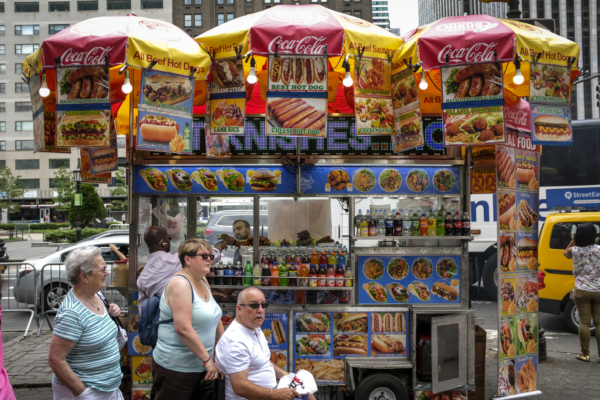
In the Flushing Meadows-Corona Park in Queens, New York, the bustling street food vendors will soon become quiet and refreshing. The New York City government officially launched the six-month “NYC Clean-Powered Carts Challenge” pilot program on July 7, aiming to equip two street food vendors’ carts with large capacity batteries for free, replacing traditional high-noise, high-pollution fuel generators.
Led by the city government and jointly initiated and funded by multiple non-profit organizations and the startup PopWheels, the program aims to demonstrate to the public how switching to battery power can significantly improve the working environment for street vendors.
Louise Yeung, Chief Climate Officer of the New York City Climate and Environmental Justice Office, pointed out that there are currently about 20,500 mobile food vendors in New York City, with up to 96% being immigrants, of whom 97% are still using diesel or gasoline generators.
“If we can electrify every food cart in New York City, it could reduce over 120,000 metric tons of carbon dioxide emissions annually – equivalent to taking 30,000 cars off the road each year,” said Louise Yeung.
In fact, an attempt was made by private organizations in 2024 to pilot electric food carts, but it failed due to batteries not lasting a full day and difficulties in charging the vendors’ carts at night.
To overcome these challenges, the pilot program has introduced the mature “battery-swapping cabinet model”. The startup company PopWheels has set up two charging and swapping cabinets in the park. Vendors only need to insert the depleted battery into the cabinet for a few seconds and can immediately pull out a fully charged battery to continue operating. If the project becomes commercially popular in the future, a monthly membership fee similar to that of delivery couriers (around $75 to $95 per month) is expected, which is more cost-effective than purchasing and maintaining a fuel generator.
William Arevalo, the first participating food cart owner in the pilot program, cooked his Ecuadorian-style fried potatoes with sausage using battery power during the press conference, with no noise throughout the process.
Being a street food vendor who works intensively for 12 to 14 hours a day, Arevalo praised the new technology, stating, “When we used generators before, the exhaust would float into the cabin, which is very bad for our health; and the machine was too noisy, we couldn’t even hear what the customers were saying. Now it’s much better, there’s no noise at all!” He added that previously, just buying gasoline for the generator would cost $15 to $20 per day, and they also had to change the oil weekly, but switching to batteries has saved them this expense.
However, batteries are not a one-size-fits-all solution. For special food carts like ice cream trucks that require high power to maintain refrigeration, the current battery capacity is still unable to replace generators. The city government stated that in the coming weeks, the program will further expand to eight more vendors (including those near the Corona Plaza), serving as a crucial reference for city-wide promotion.