
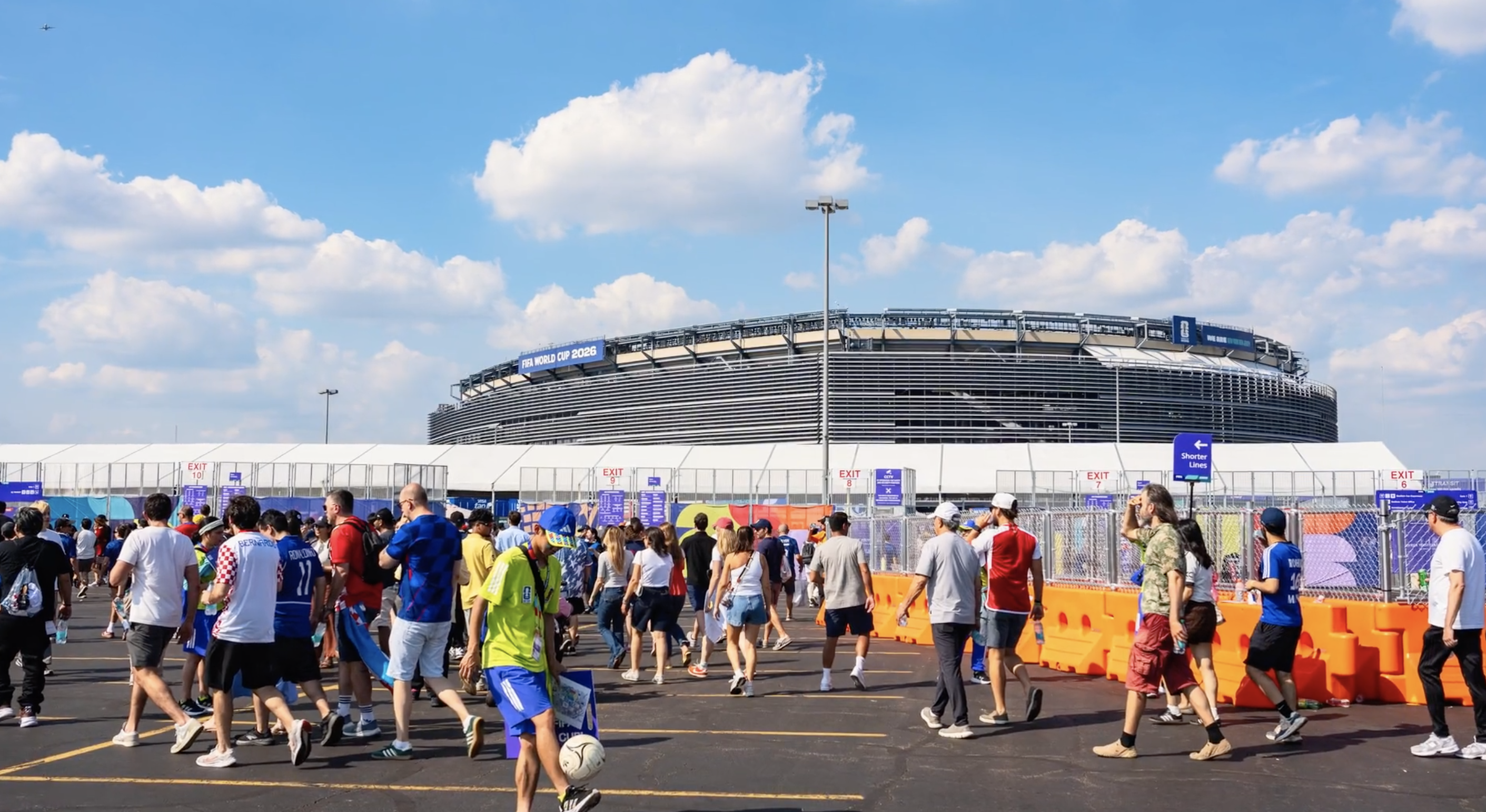
In the midst of the blazing North American summer, the FIFA World Cup in the United States, Canada, and Mexico is in full swing. In the “City of Brotherly Love” of Philadelphia, Pennsylvania, fans from the fiercest rivals in world football gathered at the FIFA fan zone to enjoy beer, friendly soccer matches, and the fervor of the tournament.
Rory Prenter from Belfast, Northern Ireland, dressed in a USA team jersey, joined his father Paul, brothers Patrick and Oliver, and some new international friends in a mini soccer match. “This place is great,” Rory said, representing the national team in youth-level competitions with Oliver. “I love the atmosphere here.”
Even though their country did not advance in this World Cup, the Prenter family expressed their joy at being in the United States to experience one of the world’s most popular sporting events.
Paul Prenter mentioned that the vast skyline of the city was surprisingly welcoming, and they had a blast at the FIFA fan festival held at Lemon Hill Park in Philadelphia on June 30. The free event offered various soccer-related games and simulators, entertainment performances, and live game broadcasts on big screens.
“Clare and I promised the kids years ago that we would one day go somewhere to watch the World Cup,” he shared with The Epoch Times. “I’m glad we chose to come here to see the tournament.”
According to Tourism Economics, a UK-based travel data analysis company, around 1.24 million international visitors traveled to the United States to watch World Cup matches and participate in celebration activities, similar to the Prenter family.
Their story is just one of many shared by international visitors who discovered, appreciated, and fully immersed themselves in the United States during their stay for the World Cup.
Celebrating the 250th anniversary of the nation’s founding, foreign fans took to social media to express their amazement at their American experiences – from Texas BBQ and large travel centers to massive supermarkets, oversized meals, and giant sports stadiums – these posts quickly went viral.
Halvor Francke and his three sons, donning Norway national team jerseys, boarded a tour bus in Philadelphia. Passengers could enjoy unlimited rides for just $5 a day. Having already visited New York and Boston and watched Norway play against France in Boston, their final stop was Washington to join in the July 4th celebrations.
“Boston is great for walking around and has a European vibe,” he told The Epoch Times, “and the people there are very friendly.”
Boston also became a favorite American city for another group of fans – the Tartan Army from Scotland. Despite their team not making it past the group stage, their fans, clad in kilts, “conquered” Beantown.
In bars like the Sam Adams Taproom, songs echoed, drinks flowed, and every available space was quickly filled. Streets turned into impromptu parade routes with cones placed on movable statues. Eventually, the city embraced its visitors, with Boston Mayor Michelle Wu announcing Glasgow as Boston’s sister city.
Back in Philadelphia, Francke noted his enjoyment of the sunny weather and warm temperatures, not minding getting caught in the rain during the matches. He mentioned that American sports venues were much larger than those he had seen in Norway and the UK, and getting used to the lively atmosphere inside took some time.
“In Europe, fans naturally create the atmosphere – no help needed,” he said, explaining how fans spontaneously cheer or sing to support clubs with over a century of history. “Here, the atmosphere feels a bit more orchestrated. You see prompts on the big screen to ‘make some noise.'”
Their Norwegian counterparts did not hesitate to entertain themselves either. This group of touring Scandinavians quickly became internet sensations as they showcased Norway’s popular “Viking rowing” cheer (Ro!) in various random locations, including Times Square in New York City.
“Even though it’s different here, it’s really good,” he remarked. “America has always been great.”
In New York and Miami, visitor Alejandro Barrantes from Colombia enjoyed his time immensely. He planned to visit two more World Cup host cities, Philadelphia and Dallas.
Barrantes, a Colombian living in Mexico, expressed his desire to one day live and work in the United States. He shared that Latin Americans see the U.S. as a country full of opportunities.
“You can do anything you want, and you feel the energy that you are capable of doing anything you want,” he shared during his visit to New York with The Epoch Times. “That’s what’s magical about this city.”
Some visitors didn’t come to support their home teams but rather seized the opportunity to come to the U.S. and witness the thrilling World Cup matches.
Professional coach and former Gornik Zabrze player David Ozga and his wife Patricia traveled from Poland to the Philadelphia area to celebrate the World Cup with their American relatives. Due to Poland’s defeat by Sweden in the World Cup qualifiers, they ended up supporting the French team.
The family fully immersed in the charm of Philadelphia, the first capital of the United States. They ran up the “Rocky steps” at the Philadelphia Museum of Art and indulged in Philadelphia cheesesteaks.
“The cheesesteak is a bit greasy,” Patricia Ozga told The Epoch Times, “but it tastes great.”
Meanwhile, Francke mentioned that Boston had become his favorite American city so far, with lobster rolls possibly being the “best thing” he had ever tasted.
Cheesesteaks and lobster rolls showcased another significant discovery of European visitors in the U.S.: the food.
Whether dining at Waffle House, Chick-fil-A, or any alfresco American BBQ restaurant, visitors flooded social media with praises for the quantity, taste, and overall quality of American food they had encountered.
As the group stage ended, fans began to make their way back home, eager to bring back some American culinary treasures. The Transportation Security Administration released guidelines on how foreign travelers could bring ranch dressing and other items through airport security. Videos on social media showed some Brits barbecuing with seasonings bought from Texas in their backyard.
Regarded as one of the greatest Polish players, Robert Lewandowski is set to join the Major League Soccer’s Chicago Fire, which greatly excited visitor David Ozga upon hearing the news. He mentioned that this further solidified the close connection between many Poles and Americans, particularly in cities like Chicago with a strong Polish community.
“I really like it here,” he said. “I like everything here.”
A 3-0 victory for France over Sweden on June 30 did not dampen the enthusiasm of Axel Insulander. His only complaint was the high cost and longer distances of public transportation to the game venues, compared to Europe.
The Swedish fan made his way to MetLife Stadium in New Jersey to watch the France vs. Switzerland game. He also watched other matches, including Norway vs. Iraq in Boston, and toured Philadelphia.
Even though bus fares were cheap, Francke was surprised by the high costs of accommodations (mostly hotels), food, and transportation in the major American cities he visited so far.
Colombian citizen Nicolás Martinez, who had visited the U.S. before, noted significant price increases since his last visit, especially for beer.
Nevertheless, he remarked on the high enthusiasm, grand celebrations, and rich culture demonstrated by people from different countries in restaurants and public places – truly a fabulous sight.
Insulander felt that the people in the three cities he visited were all very friendly, but Boston and Philadelphia provided him with “a really surprising experience.”
“Boston feels completely different. At least compared to New York, I think it’s calmer,” Insulander shared with The Epoch Times.
“Philadelphia also surprised me. I thought it might be poorer, with a different atmosphere.”
A Cambodian visitor named Tara (who only disclosed his first name) fell victim to a fraudulent online ticketing portal that sold tickets for a Portugal vs. Uzbekistan match. However, he and his family made the most of their U.S. trip, exploring Texas, Washington D.C., and New York City.
They particularly appreciated the often-overlooked security measures and thorough preparations, expressing their feelings of safety, comfort, and attentiveness throughout their journey.
“I like the food here,” Tara’s son Drago shared in New York with The Epoch Times.
It wasn’t just the major cities that attracted visitors. Pre-tournament friendly matches drew foreign fans to other regions in the U.S., such as Oxford, Mississippi, and Auburn, Alabama.
With 16 tournament venues spread across 16 cities in North America among three countries, including 11 venues on U.S. soil, many spectators decided to rent cars and plan to spend weeks exploring the United States due to the extensive tournament schedule. During breaks between matches, they would visit state parks, national parks, beaches, historic sites, Walmart stores, and chain convenience stores. An Australian visitor commented on social media that the Florida beaches he visited were just as good as any beach in his home country.
As they bid farewell to their beloved city of Boston to follow the Scottish team to Miami to face Brazil, members of the Tartan Army documented their travels along the East Coast, noting when they crossed the Mason-Dixon Line and visited landmarks like Fort Sumter in South Carolina, ultimately touring Miami’s South Beach and Little Havana like they did in the North.
Maurice Smith, a tourism and hospitality strategy consultant from Atlanta, Georgia, noted that although the U.S. lacks the deep historical roots and grandeur of other countries, it successfully crafted a distinct and comfortable World Cup experience with its unique features compared to European and Latin American cities – using his city as an example.
“For example, the design, technology, and dining options at Mercedes-Benz Stadium are one of a kind in the world,” he described to The Epoch Times.
“Stadiums can be part of the attraction, not just a venue for matches,” he explained.
Transport planners in Atlanta and other host cities acknowledged that foreign fans relied on reliable and easily accessible public transportation and railways, so their collaborative efforts drew clear and positive responses. Furthermore, America’s advanced ride-sharing services helped bridge transportation gaps.
Smith praised the police and security personnel for their non-threatening presence upon arrival and their embodiment of a city ambassador role, alongside transportation workers and hotel staff.
“For visitors from other countries, especially during major events, visible and supportive measures make it easier for them to understand the city. It’s not just about safety, it’s about city positioning,” he stated.
“My main takeaway is that World Cup visitors judge the experience of the entire city, not just the matches themselves. While the sports venues are impressive, it’s the food, traffic safety, service, and local culture that determine whether people leave with a positive impression of the host city.”