
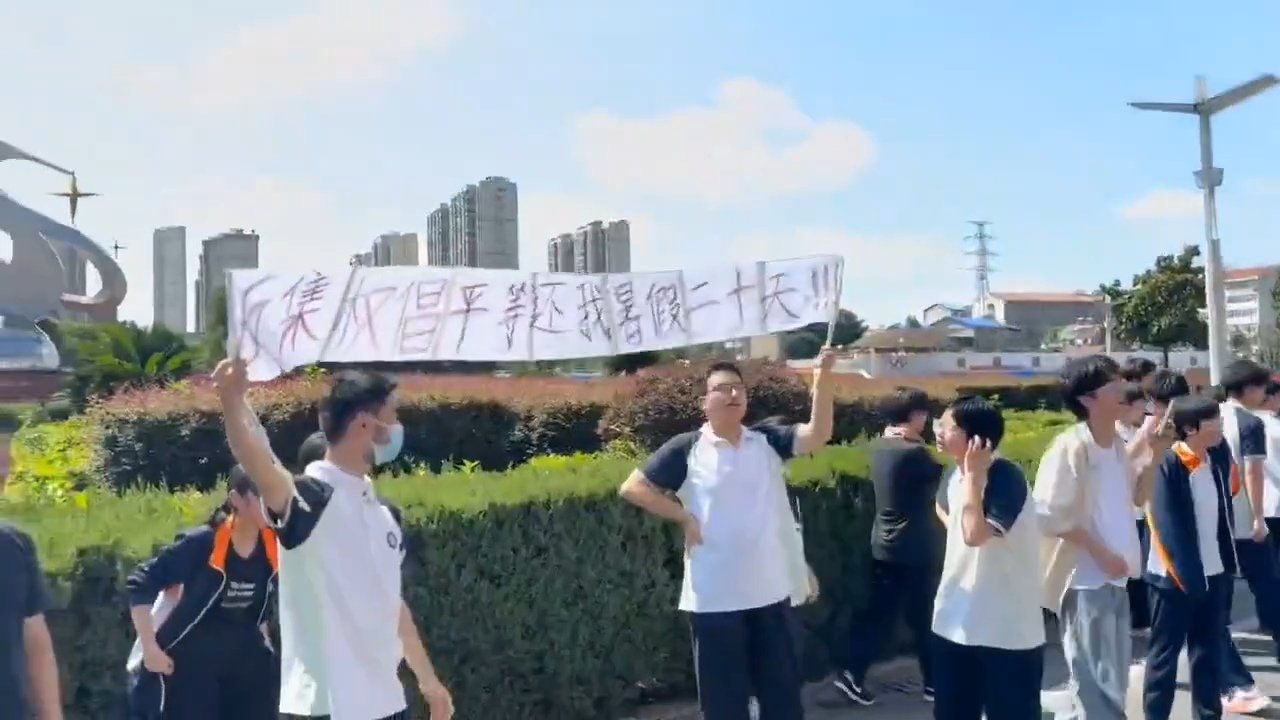
Recently, students from the “Provincial Demonstration School” Anlu No.1 High School in Hubei Province staged a collective strike due to the reduction of their vacation period, holding up a banner that read “Oppose Centralization, Advocate Equality” and questioning the school’s decision-making with the slogan “Why do people rebel every year.” Informed students revealed that the school eventually gave in, mainly because the students had uncommonly united in collective action.
On July 10, first-year students at Anlu No.1 High School in Anlu City, Hubei Province, initiated a collective strike in protest against the school’s drastic reduction of the summer vacation period from the originally scheduled 20 days to just 5 days.
Videos taken by students at the scene showed a large group gathering in the school square and the first-floor lobby of the teaching building, loudly chanting “Give us a longer break.” Teachers and school leaders upstairs stopped to watch.
Some students held up signs with their class names, while others raised exam papers with the words “long vacation” written on them above their heads. The group marched through the campus corridors, making a powerful statement.
Former student Chen Haotian, who studied at the old campus of Anlu No.1 High School and is currently on an internship, revealed to Dajiyuan that the trigger for the protest was the school’s sudden change in the summer vacation period, sparking a backlash from all students.
Chen Haotian explained that according to the prior school notice they received, the summer vacation was supposed to be about 20 days, but as the holiday approached, the school suddenly required students to return on July 15, leaving only about 4 and a half days of actual break.
He believed that because the school’s change was too sudden and affected all students, it quickly sparked widespread dissatisfaction. He said, “Who can bear a summer vacation of only 4 and a half days?”
Of particular note, students erected a handwritten banner in front of the teaching building with the words “Oppose Centralization, Advocate Equality, Give us back our 20-day summer vacation!!!”
The atmosphere heated up instantly upon the display of the banner, and the school authorities immediately sent people to the scene to try to control the situation.
As the student strike escalated, school personnel engaged in “dialogue” with the students on-site, but their strategy was not to directly respond to the collective demands. Instead, they attempted to divide and weaken the students.
Video footage showed a school staff member offering to grant personal leave to a few leading protesting students who dared to speak up, saying, “I can grant you leave right now, and you can leave immediately,” in an attempt to indirectly satisfy the few students’ demand for a “long break,” while maintaining the original decision of “only 5 days” for the rest of the students.
However, this “divide and conquer” tactic did not work. The leading students were unmoved and continued to stay on-site to protest. Onlookers also saw through the school’s attempts to brush off the issue.
As the standoff continued, the students’ demands shifted from merely fighting for a longer break to directly questioning the logic of the school’s governance.
In a video from the scene, a male student loudly asked the school staff present, “Teachers, have you ever thought about why there are rebellions every year?!”
This question quickly went viral on the internet and was considered the most impactful moment of the entire protest.
Faced with the students’ questioning, the school staff member claimed he “does not represent Anlu No.1 High School.” The students then refused to engage in further conversation with him and instead called out to the staff upstairs, demanding that a representative be sent down for formal negotiations. Subsequently, another school staff member came down to continue negotiating with the students.
According to subsequent online disclosures by netizens, with the continued pressure from students and the constant spread of the incident’s videos, the school was eventually forced to compromise on the same day and announced arrangements for an extended break for the students.
Analyzing the outcome of the incident, Chen Haotian believed that the key reason the school ultimately gave in was the rare unity of the students in taking collective action. “As long as students unite, schools usually compromise.”
He thought that the effectiveness of this action was closely related to the large number of participants. “First and second-year students were involved, while the third-year students had already finished their exams and were not at school.”
Although Chen Haotian had left school in June to intern at his father’s shop and did not attend the protest in person, he had stayed active in several student online groups and participated in discussions.
He mentioned that the protest was not planned by individuals but rather quickly emerged spontaneously among the students. He explained that since it was the last day of the semester, everyone had their phones, and the news spread rapidly through various student groups.
“In the groups, students began discussing where to gather, hold up signs, and chant slogans. I joined several groups, and many people were discussing where to gather and what slogans to chant.”
He revealed that the protest mainly took place in front of the teaching building at the new campus, which is larger in scale, with about over a thousand students per grade. The old campus, locally known as “Old No.1 Middle School” and formally named Anlu Fenghuang Boarding School, had fewer students per grade, with a few hundred students participating in the protest, but on a smaller scale. He noted that “Old No.1 Middle School also protested, but most of the videos circulating online were from Anlu No.1 High School.”
Before taking collective action, some students had hoped to file complaints with the educational authorities, but most were not hopeful.
“We originally planned to report to the Education Bureau or relevant departments, but last year, we called to report and got no response, they simply don’t care. It’s always ‘under consideration’ at the Education Bureau.”
Due to the lack of response from previous complaints, many students believed that merely reporting the issues would not solve them.
“Calling to report last year was useless, so some of us, including me, told them that reporting won’t help because it’s so corrupt here. So later, everyone thought of protesting offline.”
He also mentioned that similar incidents had occurred in other parts of Hubei in recent years. “There was such an incident in Qianjiang one year, also in the largest school, where students protested, and eventually all the schools compromised. Xiaogan High School had also organized offline protests in the past, so many people now say they want to learn from Qianjiang and Xiaogan.”
It is worth noting that Anlu No.1 High School is not an ordinary school. According to publicly available information, the school was founded in 1942 and is one of the first key high schools in Hubei Province. In 2005, it was rated as a model high school in Xiaogan City and in 2011, passed the supervision and evaluation of the Hubei Provincial Government’s education authorities, being promoted to a provincial-level demonstration school, with 66 teaching classes and over 4,400 students.
Just before this incident occurred, on May 9, Xinhua News reported that the school had organized teachers and students to go to Zhaopeng Town for practical activities such as planting rice seedlings in the “field classroom.” The massive strike protest at a model high school has drawn considerable attention.
Chen Haotian revealed that he attended the old campus of Anlu No.1 High School, Anlu Fenghuang Boarding School, which collaborates with Anlu No.1 High School in terms of policies, showing synchronous practices.
He mentioned that the new campus has a higher enrollment rate, while the old campus has relatively worse conditions. “The school has a lot of ridiculous rules. I couldn’t stand that school, so I started my internship in June.”
He also expressed dissatisfaction with the accommodation environment. “Generally, we prefer renting off-campus because the school’s accommodations are particularly poor.”
Chen Haotian believed that this incident reflected the accumulated discontent of students, which erupted in a concentrated manner due to the sudden shortening of the summer break. It also demonstrated that when students form a unified demand, the school authorities ultimately had to make adjustments.