
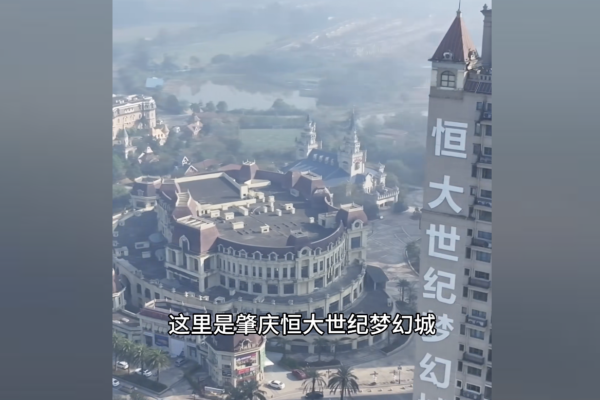
China Evergrande Group’s debt crisis continues to escalate, and the once-considered “century gamble” by Xu Jiayin, Hainan Danzhou Haitang Island, is also caught in a quagmire. This super-large artificial island project was touted as a 160 billion yuan investment, benchmarking Dubai’s Palm Islands.
Chairman Xu Jiayin of Evergrande Group pleaded guilty in April this year to charges related to illegal fundraising, among others, and is awaiting sentencing. With the total collapse of the funding chain, several projects on this “Chinese version of Palm Island” have been halted. The vibrant commercial streets are now desolate and barren, with large residential buildings dark at night, only sporadically illuminated, resembling a “ghost domain.” What was once packaged as a “world-class sea new city” is gradually becoming a “migratory bird island” relying on seasonal residency of retirees from the north.
Haitang Island Number One was originally positioned as an “international large-scale comprehensive tourism service area,” planned to include an international conference center, a group of museums, a children’s world, and other core projects. The symmetrical Number Two and Number Three islands on either side were designated as residential areas. The Danzhou municipal government had high hopes for the project, expecting it to create 100,000 job opportunities and attract 2 million visitors annually, boosting the economic development of western Hainan.
During China’s real estate craze, Haitang Island was once seen as Evergrande’s most representative super project in the cultural and tourism sector. However, with the Evergrande crisis and the funding chain breakdown, the once grand blueprint quickly shattered.
According to a report by Ming Pao in Hong Kong on June 21, a large number of unfinished giant buildings on the island have now become a spectacle of abandonment. The largest tax-free shopping center in the country, which has never been officially opened, still has construction materials piled up inside closed doors. The “largest large-scale fairy tale myth theme park in the world,” known as Fairy Tale World, also remains closed for years.
An employee stated, “Activities are only held on the main street at the entrance during holidays, and many of the amusement facilities inside have been idle for many years.”
The employee further revealed that some salaries for April 2023 and September 2024 remain unpaid, and they have been unable to reach anyone for salary inquiries.
After the Labor Day holiday, the commercial street on Haitang Island quickly returned to its deserted state, with only a few restaurants and cultural innovation shops still operating in the area.
An employee at a tea shop said, “Many shops are hardly ever open, they only come back to operate during peak seasons.”
She disclosed that most businesses on the island operate on a revenue-sharing model, and due to low income in the off-season, many business owners prefer to close down or even directly terminate their leases.
Distinctive street blocks like “Jiangnan Water Color,” constructed by Evergrande with significant investment, have also failed to attract a stable flow of visitors and a lively atmosphere.
On the primary tourist service-focused Number One Island, the bleak scene is more vivid. The “China’s largest single building hotel,” Europo Hotel with over 5,000 rooms, has never been fully occupied since its opening. The hotel lobby sees minimal foot traffic on weekdays, with tour buses occasionally stopping to pick up passengers.
A stall employee mentioned, “Sometimes during the off-season, we don’t see customers the entire night.” The front desk staff stated that they primarily rely on tour groups for guests and that “individual guests don’t even fill up 100 rooms.”
It is noted that the hotel, which initially had two to three thousand employees at the opening, has now reduced to a few hundred. Due to long-term low visitor flow on the island, the other landmark twin towers, Hilton Hotel, only has one building open till now.
In contrast, Number Two Island is gradually becoming a winter refuge for retirees from the north.
From Number One Island to Number Two Island, numerous high-rise residences can be seen, but at night, only a few households are lit up, with very low occupancy rates.
Throughout the area, real estate agencies with “For Rent” and “For Sale” advertisements can be seen along with electric scooters. During the off-season, rental prices have plummeted: open-plan residences of 22 square meters rent as low as five to six hundred yuan per month, and even sea-view homestays are priced at less than a hundred yuan per night.
The low rent prices attract a large number of northern “migratory bird” retirees every winter to Haitang Island. However, most of them only briefly stay for a few months and then return to the north, with few young people seen on the island.
Corresponding to this population structure is a unique “elderly economy.” Mrs. Wang, a retiree from Hunan with her family, rented a three-bedroom sea-view unit for 1,300 yuan per month. She mentioned that this is her second winter on Haitang Island.
However, the “migratory birds” only stay for a season. With the arrival of summer, a large number of retirees begin to return north again.
The plight of Haitang Island is seen by many observers as a microcosm of the end of China’s real estate frenzy era.
For over two decades, Chinese real estate developers relied on high leverage financing, large-scale land acquisition, and pre-sale systems to rapidly expand, resulting in numerous super-large cultural tourism and residential projects. However, as the property market cools, population declines, and regulatory scrutiny tightens, many projects dependent on continuous financing and high turnover are beginning to reveal risks.
Today, from being a symbol of China’s real estate ambition as a “new city on the sea,” Haitang Island is gradually becoming a low occupancy, commercially quiet island relying on seasonal support from retirees, reflecting the harsh reality post the bursting of China’s real estate bubble.