
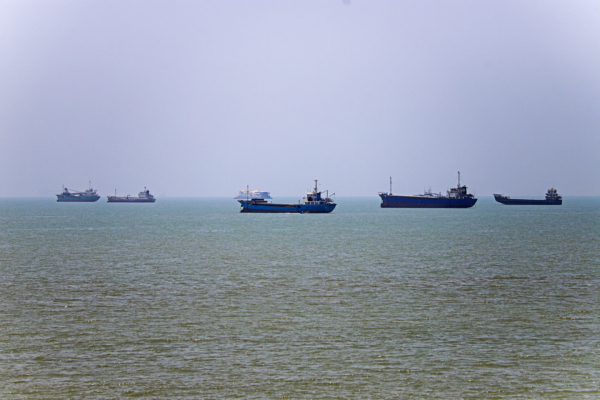
As tensions rise once again in the region following Iran’s decision to close the Strait of Hormuz and impose strict new registration controls on passing vessels, the signing of the US-Iran memorandum of understanding has seen a surge in traffic through the strait, reaching record highs. The uncertainty deepened on Friday as Iran refused to attend nuclear talks in Switzerland and announced the closure of the strait, while a new round of bloodshed erupted in Lebanon, leading to the cancellation of diplomatic talks set to take place in Switzerland.
The signing of the memorandum of understanding between the US and Iran last Wednesday marked a turning point as traffic flow through the Strait of Hormuz began to rebound from months of lows. Concerns over potential Iranian attacks had previously hindered commercial shipping activities in the strait, causing global oil prices to fluctuate sharply.
According to data from shipping intelligence company AXSMarine, a record-breaking 25 merchant vessels crossed the Strait of Hormuz on Thursday, the highest count since April.
However, the Islamic Revolutionary Guard Corps, in a statement broadcasted on maritime radio channels on Friday, stated that the strait would remain closed until conditions such as the withdrawal of Israel from Lebanon and the complete lifting of the sea blockade, as well as the withdrawal of US forces from the Persian Gulf region among others, are met. The statement also warned vessels not to approach the area and declared that any ship disregarding the order would be targeted.
Prior to the eruption of the latest conflict, US Central Command (CENTCOM) had just announced on Thursday the official lifting of a two-month maritime blockade on Iranian ports. CENTCOM reiterated on Friday that despite the memorandum aimed at ending hostilities, the US military would continue to be stationed in the Middle East and maintain vigilance, showcasing images of US F-16 fighter jets patrolling and refueling in the region.
In addition to closing the strait, Iran has introduced new substantive control measures. The newly established Persian Gulf Strait Authority (PGSA) issued a warning on Friday, stating that ship owners and captains intending to pass through the Strait of Hormuz must register and obtain permission and insurance before entering the vital waterway to ensure the safe passage of commercial vessels.
Furthermore, the authority emphasized the strict adherence to designated routes to avoid mines and warned that ship owners would be held accountable for non-compliance.
According to the 800-word memorandum of understanding between the US and Iran covering 14 provisions signed earlier this week, Lebanon, though not a party to the agreement, plays a crucial role in the ceasefire. The agreement demands the immediate and permanent cessation of all military actions on all fronts, including in Lebanon. Yet, the lack of specific mentions of Israel or Iran-backed Hezbollah in the agreement has made Israeli military operations against Hezbollah in southern Lebanon a major variable.
In response to Hezbollah’s killing of four Israeli soldiers, Israel launched extensive airstrikes in southern Lebanon overnight on Friday, resulting in at least 21 fatalities and dozens injured. Amid this escalation, the first round of US-Iran nuclear talks scheduled in Switzerland for Friday was canceled, prompting US Vice President JD Vance to cancel his trip to Switzerland. While US officials did not immediately disclose the specific reasons for postponing the talks, a diplomat told CNN that Iran had clearly demanded assurances of an end to hostile actions in Lebanon before resuming negotiations.
Diplomatic sources revealed to CNN that hardline factions within Iran had strongly opposed attending the signing ceremony for the memorandum. A senior legislative official of Hezbollah confirmed that Iran had informed the organization that negotiations with the US would be impossible without a comprehensive ceasefire.
However, according to the latest Reuters report, a senior US official disclosed that with mediation assistance from the US, Qatar, and Iran, Israel and Hezbollah had reached an emergency ceasefire agreement on Friday afternoon, Lebanon time.