
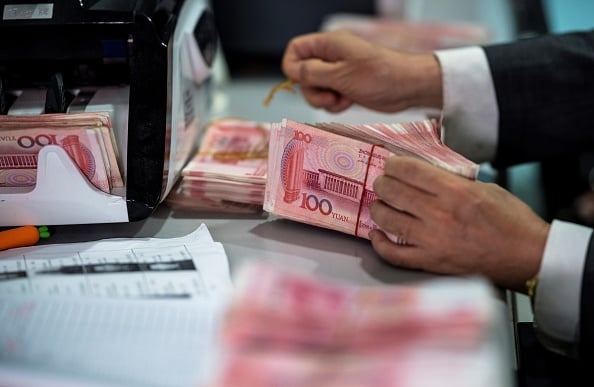
China’s latest financial statistics report for May released by the People’s Bank of China reveals several abnormal trends in financial indicators that are expanding. The report shows a surge in the M0 money supply, a collective decrease in resident loans, and structural opposition between credit issuance and deposit growth, leading regulators to issue “window guidance” to commercial banks. Meanwhile, the whereabouts of the entire society’s “deposit relocation” has once again sparked market attention: are funds flowing into the stock market, or merely shifting to another place to “sleep”?
The data indicates that following a decrease of 1.94 trillion yuan (about 267.7 billion USD) in resident deposits in April, there was a further shrinkage of 110 billion yuan (about 15.2 billion USD) in May, totaling a decrease of 2.05 trillion yuan (about 282.9 billion USD) over the two months, marking the first consecutive two-month decline in resident deposits in nearly a decade. Concurrently, deposits in non-bank financial institutions (such as securities firms and wealth management products) increased by 3.61 trillion yuan.
At the same time, the broad money supply (M2) balance reached 353.67 trillion yuan (about 48.78 trillion USD) in May, with an annual increase of 8.6%, indicating that the total money supply in the entire society remains ample. Behind this surplus of macro funds and the contraction of micro indicators lies the exposure of multiple deep-seated financial abnormal signals.
On the other end of the decline in deposit data, deposits in non-bank financial institutions (including securities firms and wealth management products) saw a significant increase of 3.61 trillion yuan (about 497.9 billion USD) during the same period. This reflects a large-scale shift of funds towards non-bank financial institutions amidst the backdrop of continued decline in bank deposit interest rates.
According to the Securities Times, the financial choices of a 62-year-old retired teacher in Shanghai, Chen Min, have confirmed this trend at the micro level. Three years ago, she deposited 300,000 yuan (about 41.4 thousand USD) in a bank time deposit, which matured recently with a total of 323,400 yuan (about 44.6 thousand USD). However, the bank’s customer manager informed her that the three-year time deposit rate had plummeted from the original 2.60% to 1.25%. Faced with a significant reduction in interest income, Chen Min ultimately decided to transfer 200,000 yuan (about 27.6 thousand USD) to a fixed-income wealth management product with an annualized return of approximately 2.5%, purchase savings-type insurance with 50,000 yuan (about 6.9 thousand USD), and leave the remaining funds in a demand deposit account.
First Financial reported on this fund transfer as the “seesaw effect.” Some market analysts, citing data such as the rise in securities margin trading and new account openings in April and May, believe that a considerable portion of the funds flowed into the securities market. Another view interprets the funds primarily entering the stock market indirectly through channels like new mutual fund offerings, as indicated by the rebound in public fund issuance and the countercyclical growth of stock index ETF shares, rather than individual investors entering directly.
Professor Sun Guoxiang from the Department of International Affairs and Business at Nanhua University in Taiwan, noted during an interview with the Epoch Times, his agreement with the assessment of funds “indirectly flowing into the stock market.” However, he emphasized that this does not simply signify a comprehensive recovery in market investment confidence, but rather defensive adjustments in the balance sheets of individual micro subjects post-asset impairment. Residents are reallocating funds among deposits, wealth management, funds, insurance, and gold, displaying a combination of reducing debt and lowering risk-return expectations.
Sun Guoxiang analyzed that in an environment where expectations for employment income and retirement security remain uncertain, and with low deposit interest rates, the trend towards “deposit-financial management” is notably prolonged. This reflects a scenario where micro subjects are unwilling to keep funds in banks yet are cautious about undertaking investment risks blindly. He cautioned investors to adhere to the principle of “avoid risking funds used for living expenses and refraining speculative investments with security-type funds,” maintaining a high alertness towards financial products claiming high guaranteed returns or short-term doubling.
Nevertheless, the massive volume of relocated funds did not entirely translate as anticipated into driving economic momentum. On the contrary, the People’s Bank of China announced in its May financial statistics report on June 12 that the year-on-year growth rate of new social financing was only 7.7%, marking the lowest growth rate on record. Notably, long-term household loans representing mortgages increased by a mere 62.8 billion yuan (about 8.66 billion USD), significantly decreasing by 771.9 billion yuan (about 106.5 billion USD) compared to the same period last year.
American economist Huang Dawei told the Epoch Times that the growth of social financing and new loans, reflecting the demand of residents and corporate entities, was below market expectations, while non-bank financial institution deposits surged during the same period. This feature indicates that a substantial amount of capital did not genuinely flow towards corporate expansion investments and final consumer spending but rather circulated between banks, bond markets, money market funds, and wealth management products, displaying internal “idle arbitrage” and an “asset shortage” phenomenon within the financial system.
Huang Dawei pointed out that the internal circulation of excess liquidity temporarily boosted bond prices, leading to a sharp increase in government bond markets in the short term; however, in the long run, this raises risks of localized asset bubbles. The core harm lies in the accumulation of excessive liquidity on low-yield virtual assets, while the real economy faces obstacles in fund transmission.
Bloomberg, citing insider sources, reported that in response to persistently low borrowing costs and the internal circulation of funds within the financial system, the People’s Bank of China has recently requested large state-owned banks to moderately reduce interbank lending, aiming to curb fund circulation and guide funds towards the real economy.
Despite regulators signaling loose liquidity,
financial data shows
that the willingness for spontaneous investment and consumption by residents and enterprises remains weak. The balance of narrow money (M1) at the end of May was 114.89 trillion yuan (about 15.85 trillion USD), with an annual growth of only 5.5%, significantly lower than the 8.6% growth rate of M2.
This has led to the enduringly high 3.1% “negative scissor difference” between M2, symbolizing the total wealth of the entire society, and M1, symbolizing funds readily available for investment and salary payments. Economists point out that “this signifies that although the banking system is willing to lend, enterprises are slowing down expansion due to fears of inadequate future demand, and residents are actively deleveraging and reducing consumption due to income expectations and asset price fluctuations, leading to funds swiftly transitioning into time deposits after entering the market.”
Another notable data point is
that the balance of circulating currency (M0) at the end of May stood at 14.69 trillion yuan (about 2.02 trillion USD), witnessing a remarkable growth of 11.9% compared to the same period last year, indicating an unusual increase in cash circulation despite the widespread adoption of digital settlements. This abnormal growth in physical cash reflects that in a low-interest rate environment, micro subjects tend to hold cash to gain substantial defensive security.
Huang Dawei mentioned that the persistent negative scissor difference between M1 and M2 indicates that the traditional monetary policy approach solely relying on “loosening the monetary tap” to inject liquidity is experiencing diminishing marginal effects. The core challenge in the current macroeconomy is not the lack of total funds but rather how to effectively restore market expectations and real confidence among micro subjects.