
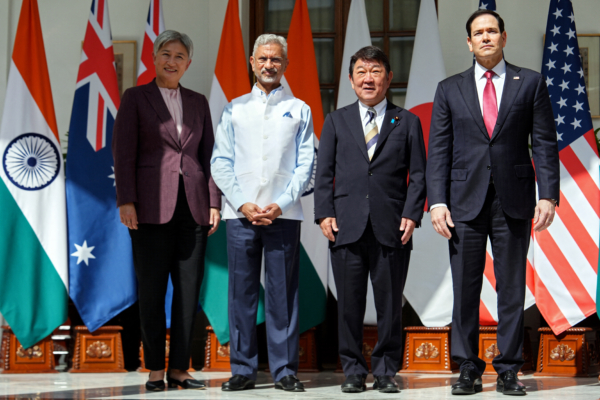
The United States, Australia, India, and Japan, collectively known as the Quad, recently announced a joint plan to cooperate in constructing a crucial port in the South Pacific island nation of Fiji, with a staggering budget of up to $1.8 billion. Analysts believe that this move signifies the Quad’s shift from a dialogue platform to a collective security mechanism, taking concrete actions together to counter the strategic expansion and threats posed by China (referred to as the CCP here) in the South Pacific. It also indicates that the competition between the U.S. and China has extended beyond the first island chain into the maritime domain.
On May 26th, the foreign ministers of the U.S., Australia, India, and Japan held a meeting in New Delhi, India. Following the meeting, they jointly announced plans to collaborate on a “demonstration” port construction project in Fiji.
U.S. Secretary of State Marco Rubio mentioned, “We will cooperate on port infrastructure issues, particularly in response to the inadequate port capacity in Pacific island countries. We have announced a plan to cooperate with Fiji.”
The Fiji Ports Corporation acting CEO Suresh Prasad expressed surprise at this announcement, speculating that if it is a Quad project, it likely targets a major development project at the Port of Suva.
Fiji Ports Corporation, with 41% government ownership, had previously discussed a $181 million port upgrade project with the U.S. and a $1.82 billion relocation plan for the Port of Suva.
The port construction in Fiji will be the first joint infrastructure development project undertaken by the Quad since its establishment, attracting immediate international attention.
Sitting in Suva, the capital and largest city of Fiji, the Port of Suva serves as Fiji’s largest seaport and the location of the Fiji Navy base, playing a critical role as a key gateway in the South Pacific, often referred to as the “Crossroads of the South Pacific.”
Currently, approximately 100 Chinese fishing vessels operate in the Pacific Ocean from Suva as their base. The Chinese PLA Navy’s ocean surveillance and missile tracking ship “Yan Wang 7” has also made stops at the port.
Su Tsai-yun, director of the Taiwan Institute for Defense Strategic Studies, stated that the Quad meeting represents a “deepening” of the entire security framework, evolving towards concrete affairs.
He remarked, “After actualizing this port issue, it reflects concrete containment against Beijing, especially outside the first island chain, aiming to prevent the CCP from gaining control over these key infrastructure facilities.”
Assistant researcher Chung Chih-tung from the Taiwan Institute of National Defense and Security Analysis also viewed this as an “upgrade” of the Quad’s role, noting that their joint involvement in the Suva port construction case indicates the Quad’s progression towards becoming a collective security mechanism.
Chung Chih-tung believes that China is actively establishing a presence in the South Pacific, attempting to break through the blockades of the first island chain, reflecting Chinese external threats as they seek to challenge the existing U.S. advantage in the Indo-Pacific.
Due to the proximity of Fiji to Australia, with a straight-line flight distance between the two countries ranging from 2,700 to 4,000 kilometers, Chung Chih-tung stated Australia also directly feels the threat. He noted that at this juncture, they (the Quad) are taking collective action to counter Beijing’s attempts to breach the first island chain and expand its influence in the Pacific, demonstrating the perception of the CCP as a “strategic competitor” by the Quad.
Furthermore, Chung Chih-tung suggested that this move by the Quad holds significant implications for the Indo-Pacific strategy, stating, “Its influence extends not only to the Suva port case in the South Pacific island of Fiji but has crucial strategic implications for the entire Indo-Pacific region.”
Reports indicate that in 2023, Fiji Prime Minister Sitiveni Rabuka personally sought economic aid from the Chinese Communist Party leader Xi Jinping to redevelop Fiji’s ports and revamp the shipbuilding industry.
Currently, Fiji owes approximately $109 million in debt to the Bank of China due to various road construction and other infrastructure projects initiated by China in Fiji a decade ago.
Chung Chih-tung expressed that since there are no security or military agreements between China and Fiji, China uses this grey area of military-civilian integration, including operations related to its Belt and Road Initiative, to “reduce its sensitivities to expanding its presence in South Pacific island nations.”
Considering China’s requirement that “everything must serve politics,” Chung Chih-tung speculates that Chinese distant-water fishing vessels may become “militarized at sea” when necessary, slowly expanding its strategic presence in these South Pacific island nations through a combination of civilian fleets, port construction, maritime law enforcement, and economic aid.
An even more concerning issue is that following the Solomon Islands’ switch of diplomatic recognition from Taiwan to China in 2019, the signing of the bilateral Security Cooperation Agreement with China in 2022, allowing China to deploy police and military forces to maintain social order, and signing the Police Cooperation Memorandum in 2023 to further expand police cooperation.
Moreover, China exported its “Fangqiao Experience” to the Solomon Islands, a grassroots societal control model for neighborly surveillance. These moves by China have raised strong concerns from the U.S., Australia, and New Zealand.
Su Tsai-yun remarked that China has ambitions to transition from land power to sea power, utilizing economic incentives systematically to persuade developing countries to allow China to invest in their ports and airports, thus providing a base and supply stations for its far-seas fleet (also known as the “blue water fleet”) for maritime expansion post land-based resource exhaustion.
Additionally, through measures such as distant-water fishing and seabed exploration, China’s ultimate goal is to “plunder marine resources and establish control over the seas post-land resource exhaustion,” influencing the core rivalry within the U.S.-Japan-India-Australia partnership vis-a-vis China’s strategic maneuvering.
Su Tsai-yun pointed out that the previous lack of emphasis placed by the U.S. and Australia on Pacific Island countries allowed China to take advantage of the situation. Now, through joint action by the Quad group, it signifies that these democratic maritime nations are convincing developing nations while persuading different policy pathways within their own countries to provide more aid; even Taiwan has joined in assisting these second island chain countries. This signifies the democratic countries’ collective efforts to resist Chinese expansion through practical cooperation.
On the other hand, Chung Chih-tung mentioned that South Pacific island countries hope to leverage the competition between the U.S. and China as well as democratic nations and China to benefit themselves.
In 2024, to prevent further Chinese control over Fiji’s critical ports, Australia agreed to work with Fiji to assist in revamping the existing port facilities but did not support the Port of Suva relocation plan.
With the Quad now officially announcing their involvement in the Port of Suva relocation plan, Chung Chih-tung believes this indicates the Quad is beginning to engage in collective strategic actions to compete with China in the South Pacific, signifying that the South Pacific islands have now become a “node of strategic competition in the Pacific beyond the first island chain.”
He stated, “The strategic competition between the U.S. and China has actually expanded from the first island chain to the maritime space of the second and third island chains.”