
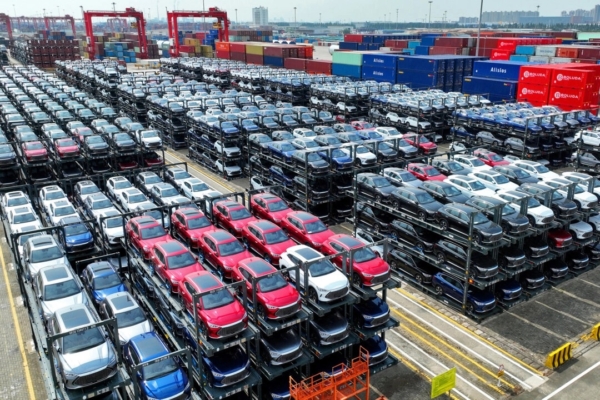
China’s automobile industry has been making a significant push into the global market in recent years. Despite the rapid increase in exports and sales, negative reviews such as chassis rust, reduced battery life, insufficient power, unstable supply of parts, and poor after-sales service have surfaced. Industry experts point out that there are significant differences in climate conditions, road environments, and driving habits among different countries. However, many Chinese car manufacturers still primarily base their designs on domestic market demands without fully completing localization adaptation, leading to frequent instances of overseas markets finding it hard to accept Chinese cars and posing long-term reputational risks.
In 2023, China rose to become the world’s largest exporter of automobiles with overseas sales continuing to grow. In the first four months of this year, China’s automobile export volume reached 3.127 million vehicles, a year-on-year increase of 61.5%. However, behind the impressive sales figures, Chinese automobile brands in overseas markets are starting to face new challenges.
According to a report by the “Daily Economic News,” compared to the past stereotype of “Chinese cars equals low-cost alternatives,” Chinese automobiles are gradually gaining product recognition in overseas markets. However, the acceptance of Chinese brands varies significantly across different regions. In mature markets such as Germany and the United Kingdom, the biggest challenge for Chinese automobiles is no longer the products themselves, but the establishment of brand credibility and service systems.
Carlos Garcia, head of a global automotive center, mentioned that due to factors such as insufficient service network coverage and lacking parts data, Chinese new energy vehicles suffer from an additional depreciation of 15% to 25% in some markets compared to European and Japanese models of the same class, directly affecting the resale value of used cars.
Benedikt Schonlau, CEO of the German technology consulting firm Viable.works, pointed out that German consumers typically keep a car for 5 to 10 years or more, considering it a long-term investment. Therefore, they place particular emphasis on repair convenience, durability, and the resale value of used cars. However, Chinese new energy vehicles are regularly updated with new models being introduced on average annually, showing a significant disparity with the consumption habits in the German market.
While the European market is still in the stage of brand establishment, the expansion speed of Chinese automobiles in emerging markets such as Latin America is notably faster.
The report highlighted that Chinese new energy vehicle leader BYD’s factory in Camaçari, Bahia state, Brazil has officially started production, with over 50,000 vehicles already produced. From January to April this year, BYD registered over 56,000 vehicles in Brazil, an 86% increase compared to the previous year.
Official data from Mexico shows that in the first four months of this year, Chinese brand automobiles accounted for a 23% market share in the local market.
However, emerging markets also face issues of product adaptation. Wang Shen, general manager of the J.D. Power China Automotive Product Power Solutions Division, stated that in Mexico, where there are many mountainous roads with complex road conditions, consumers have higher demands for vehicle power performance and noise control. Some Chinese models do not perform ideally in these aspects, leading to an increase in related complaints.
In the Russian market, Chinese brands rapidly expanded their market share due to price advantages and market gaps. However, with the growth in sales, problems of inadequate product adaptation have gradually emerged. Wang Shen pointed out that Russia and Nordic countries use a large amount of snowmelt agents in winter, requiring high corrosion resistance in the chassis. However, some Chinese models developed primarily based on the Chinese domestic environment easily face chassis rust problems after entering the local market.
It is believed that the reputation of Chinese automobile brands in overseas markets still cannot be compared with international brands such as Toyota and Hyundai. One significant reason is that Chinese car manufacturers often design products based on domestic user demands, resulting in some designs and features that are popular in the Chinese market but may not necessarily align with the usage habits of overseas consumers.
Wang Shen further emphasized that issues like chassis rust, reduced battery life, and insufficient power are fundamentally related to an inadequate understanding of overseas markets and insufficient localization adaptation by companies. The significant differences in climate conditions, road environments, and driving habits in different regions demand higher requirements for product design.
For example, in Germany, certain segments of the autobahn have no speed limits, and vehicles cruise at high speeds of 160 to 180 kilometers per hour for extended periods. This results in significant increases in energy consumption for Chinese electric vehicles in such scenarios, leading to noticeable reductions in battery life. In coastal regions of Central America, vehicles are in constant contact with high-salt air and sandy environments, exceeding the original design scenes of many Chinese car models.
Furthermore, the after-sales service system remains a critical test for Chinese brands in overseas markets.
Zheng Yun, head of the Asian automotive business at Roland Berger, mentioned that many Chinese car manufacturers currently rely mainly on overseas dealership systems to expand their markets. However, some dealerships face issues such as slow parts supply, inconsistent service standards, and insufficient repair capabilities, becoming significant sources of consumer complaints. At the same time, problems stemming from inadequate product adaptation, durability, and corrosion resistance, as well as inconsistent quality standards and partial cost-cutting measures, might further damage the long-term reputation of brands.
Garcia also pointed out that due to some Chinese models lacking complete parts data, repair time standards, and cost reference data for advanced driver assistance systems (ADAS), many overseas insurance companies charge additional “uncertainty premiums,” resulting in premiums higher than those of equivalent European or Japanese models.
He mentioned that in some markets, such extra premiums may be enough to offset the original price advantage of Chinese models, becoming a crucial factor influencing consumers’ car purchase decisions.