
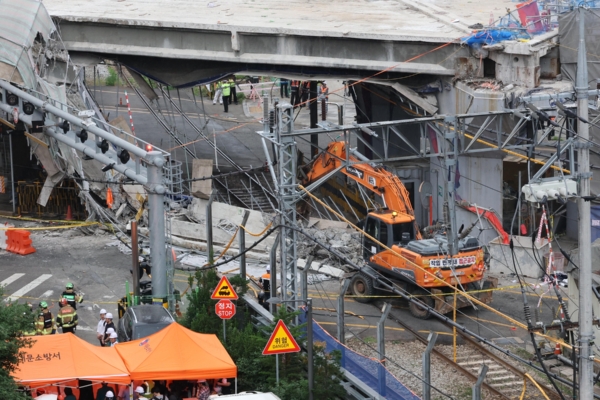
On Tuesday afternoon (May 26), a collapse accident occurred during the dismantling process of a viaduct in the Seodaemun-gu district of Seoul, South Korea, resulting in 3 deaths and 3 serious injuries. As a result, more than 120 KTX high-speed trains and some regular trains were suspended or had their routes changed, causing inconvenience for commuters.
According to reports from South Korean media, the accident happened around 2:30 pm local time on Tuesday. There were a total of 13 people at the scene, with 7 evacuating urgently for safety while the remaining 6 were trapped under the fallen debris.
Upon receiving the report, the fire department immediately activated the first phase of emergency response. After two hours of rescue efforts, all 6 trapped individuals were rescued, but unfortunately, 3 of them did not survive. The casualties included an external safety inspection expert, the construction site manager, and the chief engineering supervisor. Additionally, 3 construction-related personnel sustained severe injuries to their heads, ribs, and waists and were taken to the hospital for treatment.
It was revealed that the construction crew was conducting concrete slab cutting operations on the viaduct early that morning when they discovered a fracture in the bridge deck with a thickness of 2.9 centimeters. The city of Seoul initiated a safety diagnosis in the afternoon, and the collapse occurred during this testing process.
The head of the Seodaemun Fire Department stated that after operations were halted, workers began inspecting the fractured area in the main girder section at 2:00 pm, and tragically, a collapse incident happened at that moment, causing the workers to fall.
To prevent a secondary accident, the police quickly implemented road controls in the surrounding areas.
The Seodaemun Viaduct was completed in 1966, featuring a dual 4-lane highway, 335 meters long and 14.9 meters wide. The dismantling project commenced in August of last year and was intended to conclude at the beginning of June this year. The Seoul city government had originally planned to construct a new viaduct after the demolition, with an expected completion date in February 2028.
Upon learning of the accident, South Korean President Lee Jae-myung instructed relevant departments to make every effort to handle the incident and assist the injured. Campaign activities for the Seoul mayoral election were temporarily suspended as a result.
The police established a 50-person investigative team centered around the Seoul Metropolitan Police Agency’s Major Disaster Investigation Division to thoroughly investigate the cause of the accident.
Additionally, as the viaduct connects the areas around the Seoul city government to downtown Seoul including Chungjeongno Street, there are not only regular roads passing under the bridge but also the tracks of the Gyeongui Central Line subway and the KTX high-speed railway.
Starting from Wednesday (27th), the Korea Railroad Corporation (KORAIL) adjusted the operations of some trains. KTX services from Suseo to Seoul Station were suspended. KTX services on the Gangneung and Central Lines only operated up to Cheongnyangni Station, while other KTX services ran up to Seoul Station and Yongsan Station. As of 6 am on Wednesday, a total of 256 train services were suspended, including 123 high-speed trains and 133 regular speed trains.
KORAIL advised the public to check the operating status of trains on different routes before traveling, and mentioned that after the repair work is completed, they will inspect the power supply situation of the various lines to determine when train operations can safely resume.