
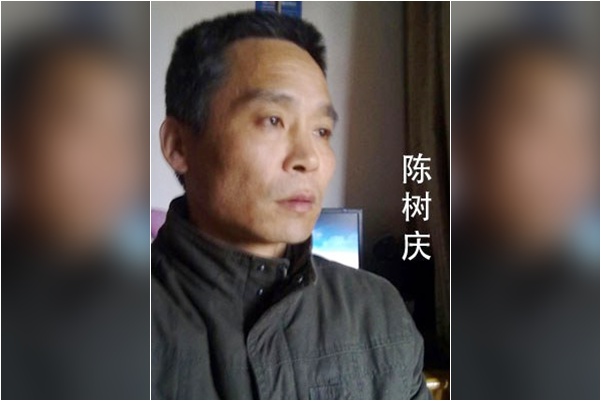
Chinese human rights activist and independent writer Chen Shuqing has been sentenced to a total of 14 years and 6 months in prison by the Chinese Communist Party due to his long-term involvement in democratic movements. In December 2025, upon reaching the age of 60, he was denied retirement procedures at the Gongshu District Human Resources and Social Security Bureau in Hangzhou. Chen Shuqing stated that the authorities have lost the trust of the people, and he will pursue his rights through legal channels.
Chen Shuqing participated in the Zhejiang student movement in the 1980s and the Beijing Tiananmen Square protests in 1989. In July 1998, he participated in and took on responsibilities in the China Democracy Party’s national preparatory committee, leading to multiple arrests and home raids by the police.
On August 16, 2007, Chen Shuqing was sentenced to 4 years in prison by the Hangzhou Intermediate People’s Court of the CCP on charges of “inciting subversion of state power.” After serving his sentence and being released on September 13, 2010, he continued to actively engage in democratic movements. However, on June 17, 2016, he was again sentenced to a harsher punishment of 10 years and 6 months for the same charge, “subverting state power,” and was released on March 10, 2025.
Speaking to Epoch Times, Chen Shuqing revealed that his family and former workplace had already contributed 24 years and 4 months of pension insurance for him. After his release, he himself made up for the missed payments during his imprisonment, exceeding the minimum threshold of 15 years of contribution. Yet, the Human Resources and Social Security Bureau rejected his retirement application based on not counting the time spent imprisoned as part of the payment years.
The reasons given by the Gongshu District Human Resources and Social Security Bureau staff for the rejection included deducting the total of 14 years and 6 months of accumulated imprisonment, leaving only a little over 9 years which fell short of the required 15 years of payment, demanding an additional 5 years of contributions.
Attempts to contact the Gongshu District Human Resources and Social Security Bureau by phone were unsuccessful.
Chen Shuqing expressed his dissatisfaction with the situation, highlighting that he had never been informed by the social security department that payments could not be made during his prison term or that he would be ineligible for retirement benefits. He emphasized that he is now eligible for social security benefits, but the bureau is refusing to grant him retirement rights.
He mentioned that if the retirement process proceeded smoothly, he would have been entitled to receive over two thousand yuan as a monthly retirement pension. “For the next 5 years, I should have been receiving retirement benefits, but now I won’t get anything,” Chen Shuqing lamented.
Chen Shuqing submitted a request for government information disclosure. However, the response provided by the Gongshu District Human Resources and Social Security Bureau’s staff member, Chen Zupeng, on December 25, 2025, through documents such as Zhejiang Human Resources Department Letter [2010] No. 358, was deemed by Chen Shuqing to be based on improper legal application and insufficient policy effectiveness. Consequently, on January 27, 2026, he filed for administrative review.
He argued that neither the Chinese Communist Party’s Labor Law nor the Insurance Law, nor any other normative documents included in the Legislation Law, contain mandatory provisions regarding social security participation during a prison term.
“I had an agreement with the social security bureau, which must be honored since it was based on mutual consent. When there’s no mandatory provision under the law, the government should uphold the principle of trust and protection of interests. The government’s refusal reflects administrative dishonesty,” Chen Shuqing stated.
He vowed to continue fighting for his rights and has submitted an administrative lawsuit to the Gongshu District Court. “According to regulations, the court must accept the case. They shouldn’t say one thing and do another. What they are doing is prohibited by the law, yet they are arbitrarily imposing restrictions using non-public policies to curtail citizens’ rights.”
Chen Shuqing’s ordeal is not an isolated case.
81-year-old dissident Dong Hongyi filed a lawsuit against the Hebei Handan City government and its Social Security Administration in December 2025, regarding the suspension and recovery of over 70,000 yuan in pension during his imprisonment, questioning the lack of clear legal basis and the violation of superior laws and legislative procedures.
Beijing Christian and human rights activist Xu Yonghai was imprisoned for 2 years and upon release over 20 years ago, his work record was reset to zero, and his pension and medical insurance were revoked, leading to financial hardship.
Guizhou dissident Chen Xi endured political persecution from the Chinese Communist Party, accumulating a total of 23 years in prison. Although he had paid his social security fees for 18 years upon his release in November 2021, the local social security bureau still suspended his pension.
Former Secretary-General of the China Human Rights Watch Xu Qin, upon his release in 2025, was similarly asked to refund the 150,000 yuan pension paid during his prison term.
Legal experts pointed out that the social security department’s actions in canceling pension funds as part of an individual’s property constituted a form of criminal financial penalty, an authority they do not possess. Moreover, there is a lack of legal basis for such actions.